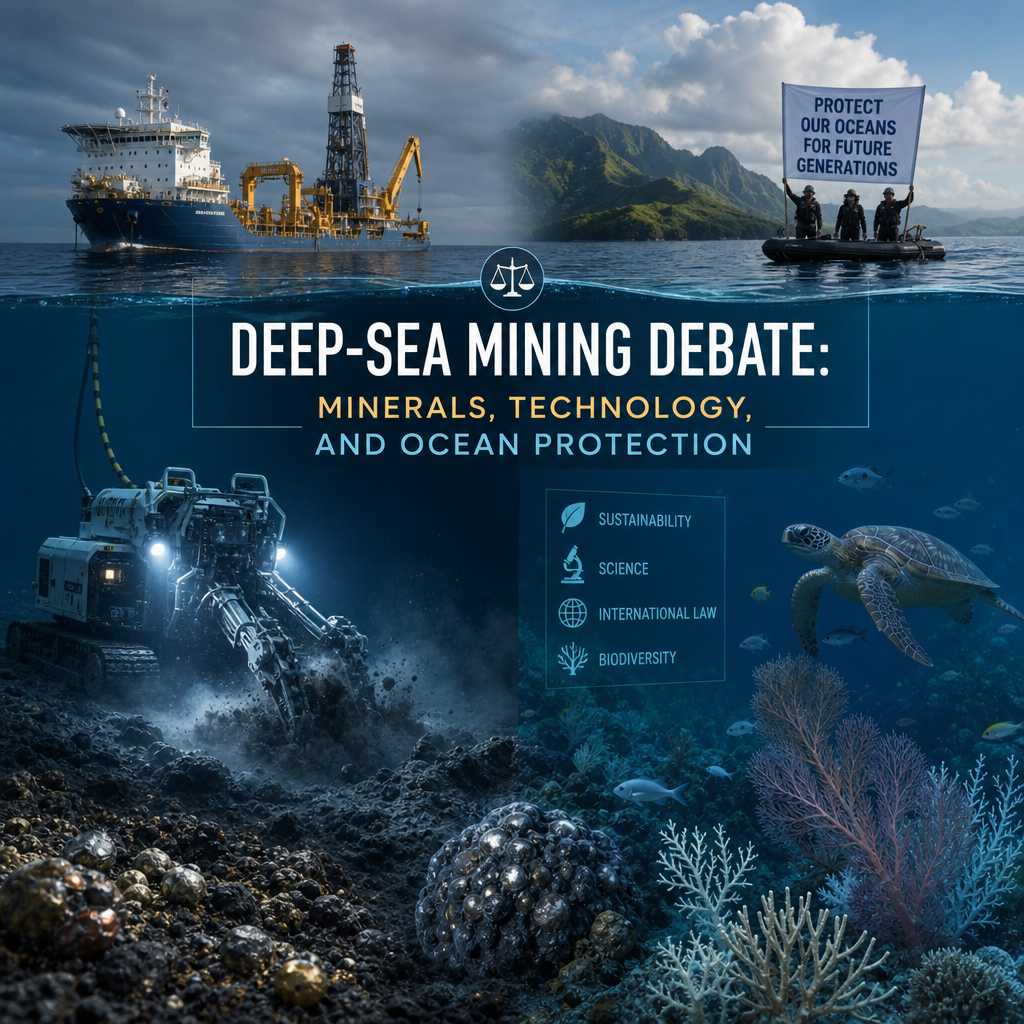
Deep-Sea Mining Debate: Minerals, Technology, and Ocean Protection
deep-sea mining is sparking a high-stakes global debate over how to secure critical minerals without putting fragile ocean ecosystems at risk. As demand for clean-energy technologies grows, the question is whether the seafloor is a smart new resource—or a frontier we should leave untouched.
By: Peter on July 27, 2026
Deep-sea mining has moved from a niche industrial idea to a global environmental and economic flashpoint. As countries and companies search for the metals needed to build batteries, wind turbines, electric vehicles, and other clean-energy technologies, the seafloor has emerged as a potential new frontier. Beneath miles of water lie deposits of cobalt, nickel, manganese, copper, rare earth elements, and other minerals that could help power the transition away from fossil fuels.
But the prospect of extracting these resources from the deep ocean has triggered intense debate. Supporters argue that deep-sea mining could reduce pressure on land-based mining and supply critical materials for a low-carbon future. Critics warn that the practice could damage fragile ecosystems we barely understand, with consequences that may be irreversible.
The argument is not simply about whether the ocean contains valuable minerals. It is about how humanity balances technological ambition, environmental protection, and the long-term health of the planet.
What Is Deep-Sea Mining?
Deep-sea mining refers to the extraction of minerals from the ocean floor, usually at depths greater than 200 meters. The most discussed target areas include:
Polymetallic nodules
These are potato-sized mineral concretions found scattered across abyssal plains. They can contain cobalt, nickel, manganese, copper, and other metals. One of the most famous prospective sites is the Clarion-Clipperton Zone in the Pacific Ocean, a vast region between Hawaii and Mexico.
Seafloor massive sulfides
These mineral deposits form near hydrothermal vents, where mineral-rich fluids rise from beneath the seafloor. They often contain copper, gold, silver, zinc, and rare metals.
Cobalt-rich crusts
These are hard mineral layers that form on underwater mountains, or seamounts. They may contain cobalt, nickel, platinum, and rare earth elements.
The appeal of these deposits is straightforward: they are rich in materials needed for modern industry. The challenge is that they lie in ecosystems under extreme pressure, in places that are difficult to access and even harder to study.
Why Deep-Sea Mining Is Getting Attention
The clean-energy transition has created surging demand for metals. Batteries for electric vehicles, grid-scale energy storage, and renewable infrastructure all require large quantities of minerals. Governments and manufacturers worry about supply bottlenecks, geopolitical risks, and rising prices.
Deep-sea mining is often presented as a possible solution to three major problems:
Growing mineral demand
The shift to electric vehicles and renewable energy could require more nickel, cobalt, copper, and manganese than existing mines can easily supply.
Supply chain concentration
Some key minerals are dominated by a small number of countries or firms, creating vulnerability to market disruptions and political leverage.
Land-based mining impacts
Mining on land can involve deforestation, forced displacement, water pollution, and significant greenhouse gas emissions. Proponents argue that the seafloor may offer an alternative source with fewer social harms.
In theory, deep-sea mining could become part of a broader mineral strategy. In practice, its environmental and technological uncertainties are significant.
The Technology Behind Deep-Sea Mining
Deep-sea mining is not simple excavation. It requires highly specialized robotic systems that can operate under crushing pressure, total darkness, and extreme isolation.
How it would work
In a typical nodule mining concept:
A collector vehicle moves slowly across the seafloor.
It gathers mineral nodules from sediment.
The material is pumped through a riser system to a surface ship.
Wastewater and sediment may be discharged back into the ocean at some depth.
For sulfide deposits or crusts, equipment may need to cut, grind, or scrape mineral-rich rock from the seabed.
Engineering challenges
The technology faces several major obstacles:
Pressure and durability: At great depths, equipment must survive enormous pressure and corrosive conditions.
Navigation and visibility: The deep ocean is dark, so machines rely on sensors and remote systems.
Sediment plumes: Collecting minerals can stir up fine particles that spread beyond the mining site.
Waste handling: Disposing of processed water and leftover sediment without causing additional harm is difficult.
Mechanical reliability: Repairs in the deep sea are expensive and complicated.
Because of these challenges, deep-sea mining is still largely in the testing or pilot stage. This matters because industrial-scale environmental impacts are hard to predict until large-scale operations begin.
The Environmental Concerns
The strongest objections to deep-sea mining center on ecological risk. The deep ocean is often described as remote and empty, but it is actually home to complex and poorly understood ecosystems.
Habitats that may be destroyed
Many deep-sea organisms are adapted to very specific conditions. Some live on or around nodules that take millions of years to form. If those nodules are removed, the habitat may be lost permanently on human timescales.
Hydrothermal vents are even more delicate. They support unique communities of tube worms, microbes, crustaceans, and other organisms found nowhere else. Mining near vents could disrupt these highly specialized habitats.
Sediment plumes
One of the greatest concerns is the creation of sediment plumes. Mining equipment can lift fine particles into the water column, potentially affecting:
filter-feeding organisms
fish and invertebrates
coral and sponge communities
water clarity and nutrient movement
Plumes may spread far beyond the mining site, depending on currents and discharge practices. Since many deep-sea species reproduce slowly and recover slowly, even limited disturbance could have long-lasting effects.
Noise and light pollution
The deep ocean is naturally quiet and dark. Mining machinery would introduce noise, vibration, and artificial light, which could disturb animals adapted to stable conditions. These impacts may seem small compared with surface industrial activity, but in the deep sea they can be significant.
Loss of biodiversity before it is known
Scientists estimate that many deep-sea species remain undescribed. In other words, mining could harm organisms before humans even know they exist. This creates a serious ethical problem: how do you regulate damage to ecosystems you have not fully mapped?
The Case for Deep-Sea Mining
Despite the environmental concerns, supporters believe the debate should not be reduced to “mining versus nature.” They argue that mineral supply is also an environmental issue because the clean-energy transition depends on materials.
Reducing pressure on land ecosystems
Land mining has major environmental costs. It can involve:
clearing forests
contaminating rivers and groundwater
creating toxic tailings ponds
displacing local communities
contributing to carbon emissions
Some proponents claim that deep-sea deposits could reduce the need for new terrestrial mines, especially in ecologically sensitive areas.
Supporting the energy transition
Building solar panels, wind turbines, transmission lines, and batteries requires a huge amount of metal. If mineral shortages slow the deployment of clean energy, climate change itself could become worse. From this perspective, refusing all deep-sea mining may have unintended consequences.
Potentially high ore grades
Some deep-sea deposits are rich in metals, meaning less material may need to be processed compared with some land-based ores. In theory, that could reduce the overall footprint of mineral production.
Strategic diversification
For countries concerned about supply security, the seafloor may provide an additional source of critical materials. Diversification could help stabilize prices and reduce dependence on a handful of mining regions.
These arguments have real weight. The challenge is proving that deep-sea mining can be done responsibly enough to justify the risks.
Regulation and the Role of the International Seabed Authority
Most deep-sea mining in international waters falls under the oversight of the International Seabed Authority (ISA), an intergovernmental organization established under the United Nations Convention on the Law of the Sea. The ISA is responsible for managing mineral resources in areas beyond national jurisdiction.
Its role includes:
issuing exploration contracts
developing environmental regulations
considering future exploitation rules
balancing resource development with protection of the marine environment
However, the ISA has faced criticism from multiple sides.
Concerns about governance
Environmental groups argue that rules are not strong enough and that commercial mining should not begin until better science exists. Some member states have called for a precautionary pause or moratorium.
Industry advocates, on the other hand, argue that the ISA has been too slow and uncertain, discouraging investment and innovation. They want clear pathways for responsible development.
This tension highlights a broader problem: global governance often struggles to keep pace with emerging technologies, especially when the environmental stakes are high.
The Precautionary Principle
A major idea in the deep-sea mining debate is the precautionary principle. This principle suggests that when an action could cause serious or irreversible harm, lack of full scientific certainty should not be used as a reason to proceed.
In practical terms, this means that if the risks are potentially severe and the ecosystem is poorly understood, caution should outweigh optimism.
Critics of deep-sea mining often invoke this principle because:
deep-sea ecosystems are difficult to study
recovery rates are unknown
impacts may be widespread
damage may be irreversible on meaningful timescales
Supporters respond that precaution should also apply to climate change and mineral shortages. They argue that delaying mineral supply could also carry environmental costs. The debate, then, is not between risk and no risk, but between different kinds of risk.
What Could Responsible Mining Look Like?
If deep-sea mining is ever to proceed, it would need strict safeguards. Some of the measures often discussed include:
extensive baseline environmental studies
protected areas where mining is prohibited
limits on plume generation and discharge
independent monitoring during operations
transparent public reporting
adaptive management that allows stoppage if damage exceeds thresholds
However, critics argue that even the best safeguards may not be enough. Unlike some surface environments, the deep sea cannot easily be restored once altered. That raises a central question: can a fundamentally disruptive activity ever be made truly sustainable in this context?
Alternatives to Deep-Sea Mining
The debate becomes more balanced when alternatives are considered. Deep-sea mining is often framed as necessary, but several other approaches could reduce mineral pressure:
Recycling and urban mining
Recovering metals from used electronics, batteries, and industrial waste can reduce the need for virgin materials.
Product redesign
Using fewer critical minerals, improving battery chemistry, and designing products for easier disassembly can lower demand.
Better land-based mining
Stronger environmental and labor standards can reduce the harms of terrestrial extraction.
Demand management
Using resources more efficiently and extending product lifespans can also ease mineral pressure.
Material substitution
Scientists are developing battery and manufacturing technologies that rely less on scarce minerals.
These alternatives are not perfect, but they show that the choice is not simply between mining the seafloor and running out of materials.
A Debate About Values as Much as Science
At its core, the deep-sea mining debate is not only technical. It is ethical and political. It asks what kinds of ecosystems deserve protection, how much uncertainty society can accept, and how to weigh present needs against future costs.
One side sees the ocean floor as a potential source of critical materials for a cleaner world. The other sees it as one of the last relatively untouched ecosystems on Earth, worth preserving because once damaged, it may never recover.
Both views reflect legitimate concerns. Clean energy requires minerals, but the planet’s largest habitat should not be sacrificed without strong evidence that the benefits outweigh the harms.
Frequently Asked Questions
1. Has commercial deep-sea mining already been approved?
No. The International Seabed Authority has issued contracts for mineral exploration, but it has not approved commercial exploitation in the international seabed area. The regulations governing exploitation remain under negotiation.
2. Which minerals are targeted by deep-sea mining projects?
Potential targets include nickel, cobalt, copper, manganese, rare earth elements, and other minerals found in polymetallic nodules, seafloor massive sulfides, and cobalt-rich ferromanganese crusts.
3. What are the primary environmental risks of deep-sea mining?
Potential risks include permanent habitat removal, sediment plumes, noise, artificial light, harm to marine organisms, and biodiversity loss. Scientists are still studying the extent and duration of these impacts.
4. Who regulates mining in international seabed areas?
The International Seabed Authority regulates mineral-related activities in seabed areas beyond national jurisdiction under the legal framework established by the United Nations Convention on the Law of the Sea.
5. Why are critical minerals important for clean-energy technologies?
Minerals such as nickel, cobalt, manganese, copper, and rare earth elements are used in batteries, electric vehicles, electricity networks, wind turbines, and other energy technologies. Recycling, material substitution, and more efficient product design can help reduce demand for newly extracted resources.
Deep-sea mining sits at the intersection of technological ambition and environmental caution. The ocean floor may contain valuable minerals needed for the energy transition, but extracting them could disturb ecosystems that are rare, fragile, and poorly understood. The debate is complicated because both sides raise serious issues: climate solutions require materials, yet the deep ocean may not be an acceptable place to pay the environmental price.
For now, the central question remains unresolved: should humanity rush to unlock the seafloor, or slow down until science, governance, and cleaner alternatives are far stronger? The answer will shape not only the future of mining, but also how we define responsible progress in the age of climate change.
Peter B holds a degree in Journalism and has 5 years
of experience covering U.S. economic policy, labor markets, and
financial news. He writes data-driven news content on topics
like inflation, interest rates, and employment trends.