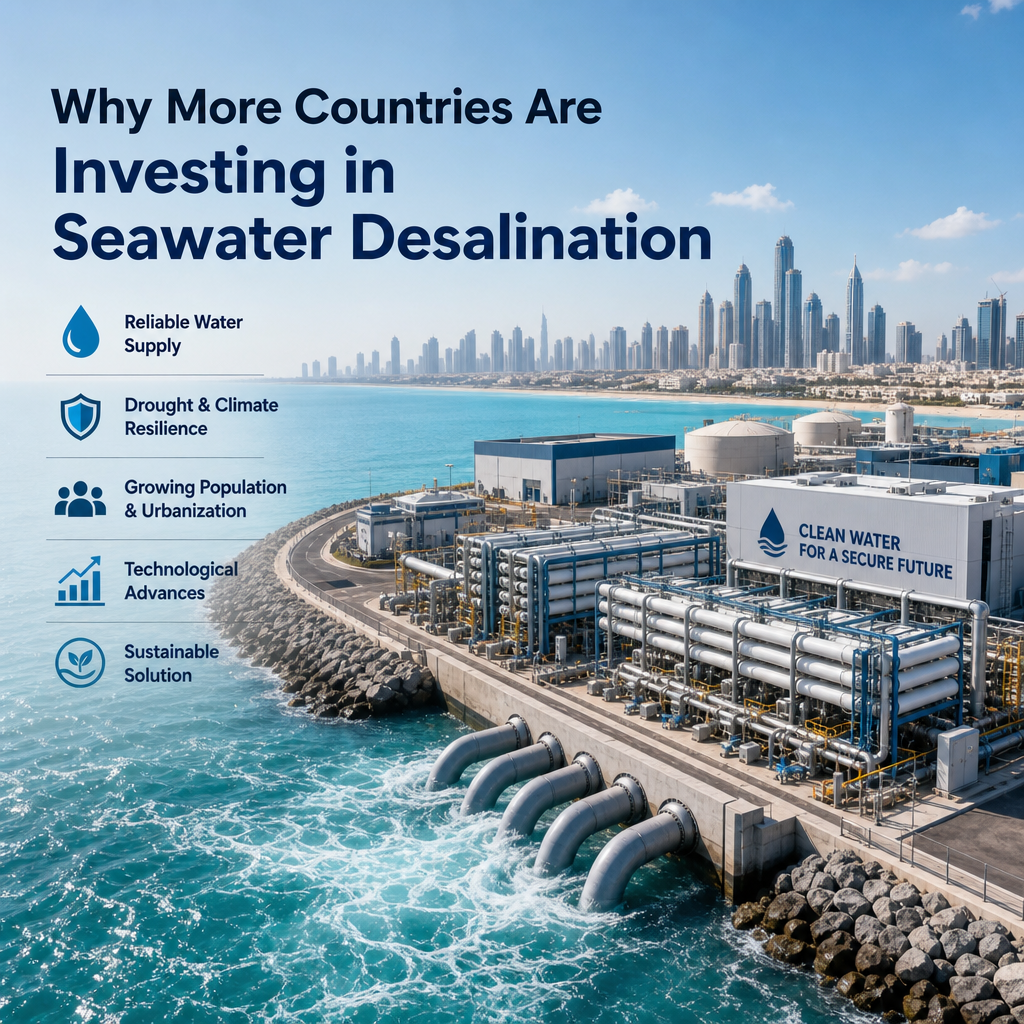
Why More Countries Are Investing in Seawater Desalination
As water stress grows and traditional freshwater sources become less reliable, more governments are looking to seawater desalination as a practical way to secure long-term supply. Once seen as a backup option, it is now becoming a key part of water planning in countries facing drought, rising demand, and climate uncertainty.
By: Peter on July 27, 2026
Water scarcity is no longer a problem limited to the driest corners of the world. As populations grow, cities expand, and climate patterns become less predictable, many countries are discovering that traditional freshwater sources are no longer enough. Rivers run lower, reservoirs shrink, groundwater is depleted, and droughts last longer than before. In response, governments are turning to a technology that once seemed like a last resort: seawater desalination.
Seawater desalination is the process of removing salt and other minerals from ocean water so it can be used as drinking water, irrigation supply, or industrial water. While the idea is not new, the scale of investment has grown rapidly in recent years. Countries in the Middle East were early adopters, but now places in Africa, Asia, Europe, and even parts of the Americas are expanding desalination capacity.
Why is this happening now? The answer lies in a mix of necessity, technology, economics, and long-term planning.
Growing Water Stress Around the World
One of the biggest drivers behind desalination investment is the rising pressure on freshwater supplies. Freshwater sources are becoming less reliable for several reasons:
Population growth: More people means more demand for drinking water, sanitation, agriculture, and industry.
Urbanization: Expanding cities need large, stable water supplies that local rivers or wells may not be able to provide.
Climate change: Droughts, heat waves, and shifting rainfall patterns are making water availability less predictable.
Overuse of groundwater: In many regions, aquifers are being pumped faster than they can naturally recharge.
Competition for water: Agriculture, industry, and households often compete for the same limited supply.
In countries where water scarcity has become a recurring crisis, seawater desalination offers a way to reduce dependence on rainfall and inland reservoirs. Because oceans are vast and constantly replenished, they provide a source of water that is far more stable than many freshwater systems.
A Reliable Supply in Uncertain Conditions
Unlike dams or snowmelt-fed rivers, desalination plants can produce water consistently throughout the year. This reliability is especially important in countries where drought can disrupt agriculture, damage tourism, and threaten public health. For governments, the appeal of a dependable supply is significant: desalinated water can serve as a backup during emergencies or as a core part of a national water strategy.
Advances in Technology Have Made Desalination More Practical
For many years, desalination was considered too expensive and energy-intensive for widespread use. That is changing. Advances in technology have made modern plants much more efficient than earlier versions.
The most common method today is reverse osmosis, which pushes seawater through semi-permeable membranes to separate salt from water. Over time, improvements in membrane materials, pumps, and energy recovery systems have lowered operating costs and improved output.
Key Improvements Driving Adoption
Several technical developments have made desalination more attractive:
More efficient membranes
Modern membranes allow water to pass through more easily while resisting fouling and damage.
Energy recovery devices
These systems capture pressure from the outgoing brine stream and reuse it, significantly reducing energy demand.
Better pretreatment systems
Cleaner intake water reduces clogging and extends the life of equipment.
Automation and monitoring
Digital controls help operators optimize performance, reduce downtime, and lower maintenance costs.
Integration with renewable energy
Some desalination plants are now powered partly by solar or wind energy, reducing operating emissions and long-term cost exposure.
These improvements have not made desalination cheap in every context, but they have made it realistic for far more countries than before. A process that once served only wealthy, resource-rich states is now part of national planning in many water-stressed regions.
Energy Costs Are Still a Challenge, But Less of a Barrier
Desalination requires energy, and that has always been one of its main drawbacks. Turning seawater into potable water is more demanding than treating freshwater. However, the energy equation is shifting.
In the past, high energy use made desalinated water expensive and less attractive for large-scale use. Today, lower electricity costs in some regions, more efficient systems, and renewable power projects are helping to offset that problem. Countries with access to low-cost energy, such as natural gas producers, have a natural advantage. Others are building desalination facilities alongside solar farms or investing in hybrid energy systems.
Why Energy Costs Matter Less Than Before
Countries are willing to invest more in desalination for several reasons:
Energy prices can be managed through long-term contracts
Efficiency gains have lowered electricity demand per cubic meter of water
Renewable energy can reduce exposure to volatile fuel markets
The cost of doing nothing may be higher in water-scarce regions
For many governments, the question is no longer whether desalination is energy-intensive. It is whether the cost of desalination is justified compared with the economic and social cost of water shortages. In many places, the answer is yes.
Climate Change Is Changing Water Strategy
Climate change is forcing governments to rethink where their water will come from in the future. As droughts become more frequent and precipitation patterns become less dependable, traditional water infrastructure is under pressure.
Reservoirs that once filled reliably may now remain low for months or years. Snowpack in mountain regions is shrinking, which reduces spring and summer runoff. Coastal aquifers are also at risk of saltwater intrusion as sea levels rise and freshwater withdrawals increase. These trends make seawater desalination especially appealing because it is not dependent on rainfall or river flow.
A Hedge Against Climate Risk
In this sense, desalination functions like an insurance policy. It may not be the cheapest water source under normal conditions, but it becomes invaluable when other sources fail. Governments investing in desalination are often trying to build resilience into their water systems so they can withstand future climate shocks.
Countries with climate-vulnerable agriculture, dense coastal populations, or limited inland water supplies see desalination as part of broader adaptation planning. It is one tool among many, but it is increasingly viewed as a strategic one.
Coastal Geography Makes Desalination Especially Attractive
Not every country can easily use seawater desalination, but for coastal nations it can be a logical solution. If a large share of the population lives near the ocean, transporting water from distant inland sources may be more difficult and expensive than treating seawater locally.
This is especially true for island nations and arid coastal regions. In such places, the ocean is literally right next door, making it a tempting resource. Rather than building enormous pipelines or relying on overdrawn groundwater reserves, governments can place desalination plants near demand centers and distribute treated water through existing networks.
Examples of Strategic Use
Island states often use desalination because they have limited rivers or aquifers.
Desert coastal countries use it to support cities and industry.
Tourism-driven economies rely on it to ensure stable water for hotels, resorts, and visitors.
Rapidly growing coastal megacities use desalination to supplement stressed municipal systems.
This geographic advantage is one reason desalination investments tend to cluster along coastlines. It offers a way to turn proximity to the sea into a practical water source rather than a vulnerability.
Economic Security and National Planning
Water is not just a social necessity; it is an economic input. Industries need it for manufacturing, cooling, processing, and cleaning. Cities need it to support housing, transportation, hospitals, and schools. Farmers need it to grow food. When water becomes unreliable, economic growth slows.
That is why many countries are investing in desalination as part of broader economic security planning. A stable water supply supports investment, jobs, and public confidence. For example, industries such as semiconductors, food processing, chemicals, and energy generation often require large amounts of clean water. If a country wants to attract such industries, it needs to demonstrate that water shortages will not disrupt operations.
Desalination as Infrastructure for Growth
Governments often view desalination in the same category as ports, highways, and power stations. It is not simply a utility project; it is an infrastructure investment that supports long-term development. In places where water scarcity has already hurt agriculture or limited expansion, desalination can unlock new economic opportunities.
It can also reduce the need for emergency water trucking, temporary rationing, or costly imports of bottled water. While these measures may solve short-term problems, they are inefficient and unsustainable. Desalination provides a more predictable foundation for planning.
Improvements in Environmental Management
A common criticism of desalination is its environmental footprint. The process produces concentrated brine and requires significant energy, which can create emissions and marine impacts if poorly managed. These concerns are real, and they have shaped how modern plants are designed.
Because of this, many countries are investing not just in desalination itself but in cleaner, more responsible versions of it. Environmental standards are improving, and plant operators are paying more attention to intake design, brine disposal, and energy sourcing.
How New Projects Are Addressing Environmental Concerns
Some of the approaches now being used include:
Subsurface or screened intakes to reduce harm to marine life
Diffusers that spread brine more effectively in the ocean
Renewable power integration to cut emissions
Co-location with industrial sites that can reuse waste heat or brine byproducts
Environmental monitoring to track effects on coastal ecosystems
These measures do not eliminate all concerns, but they make desalination more acceptable for policymakers and the public. As environmental scrutiny increases, countries are more likely to invest in plants that meet higher sustainability standards.
Water Independence Matters More Than Ever
One underrated reason for desalination investment is the desire for water independence. Countries that rely heavily on imported food or energy often want to avoid being equally dependent on external water sources. For island nations and politically sensitive regions, water security can become a matter of national resilience.
Desalination reduces exposure to upstream river disputes, cross-border water politics, and climate impacts in inland watersheds. It gives governments greater control over supply, which can be especially valuable in regions where water has strategic or geopolitical significance.
Strategic Advantages of Local Production
By producing water domestically from seawater, countries can:
Reduce reliance on shared rivers and aquifers
Improve emergency preparedness
Support long-term city planning
Protect critical infrastructure from drought disruptions
Strengthen national autonomy in water policy
This strategic angle helps explain why desalination continues to receive major public investment, even when alternatives such as water conservation or recycling are also being pursued.
Desalination Is Part of a Bigger Water Portfolio
It is important to note that most governments are not treating desalination as the only solution to water scarcity. Instead, it is becoming one part of a broader portfolio that may also include:
Water recycling and reuse
Leak reduction in municipal systems
Improved irrigation efficiency
Rainwater harvesting
Groundwater management
Demand-side conservation measures
In many cases, desalination is most effective when used to complement these strategies rather than replace them. Water reuse may be cheaper for some uses, while conservation can stretch existing supplies. But when those measures are not enough, desalination fills the gap.
This combined approach is one reason countries are increasing investment. They are not betting everything on a single technology; they are building layered resilience.
Frequently Asked Questions
1. What is seawater desalination?
Seawater desalination is the process of removing salt and other minerals from ocean water to produce freshwater. The treated water may be used for drinking, industrial processes, and, in some situations, agricultural irrigation.
2. Why are more countries investing in desalination?
Countries are investing in desalination because population growth, urban expansion, groundwater depletion, drought, and increasingly unpredictable rainfall are placing greater pressure on traditional freshwater supplies. Desalination can provide a more dependable source of water for coastal regions.
3. How does reverse osmosis desalination work?
Reverse osmosis uses high-pressure pumps to move seawater through a semipermeable membrane. Water molecules pass through the membrane while most dissolved salts and other contaminants remain behind in a concentrated brine stream.
4. What are the main disadvantages of desalination?
The primary disadvantages are high construction costs, significant energy requirements, and the production of concentrated brine. Intake systems and poorly managed brine discharge may also affect marine ecosystems, making environmental planning and monitoring important.
5. Can renewable energy make desalination more sustainable?
Solar, wind, and other renewable energy sources can reduce the greenhouse gas emissions associated with desalination. However, projects must still address construction costs, energy storage, intake design, and the responsible treatment or disposal of brine.
More countries are investing in seawater desalination because the world’s water challenges are becoming more severe and less predictable. Population growth, climate change, groundwater depletion, and urban expansion are putting enormous strain on traditional freshwater sources. At the same time, desalination technology has improved, energy management has become more flexible, and environmental safeguards are becoming more sophisticated.
For many governments, desalination is no longer just an expensive fallback option. It is a practical way to secure water supplies, support economic growth, and prepare for an uncertain future. While it is not without cost or environmental tradeoffs, its role in global water strategy is likely to keep expanding as the need for reliable freshwater grows.
Peter B holds a degree in Journalism and has 5 years
of experience covering U.S. economic policy, labor markets, and
financial news. He writes data-driven news content on topics
like inflation, interest rates, and employment trends.