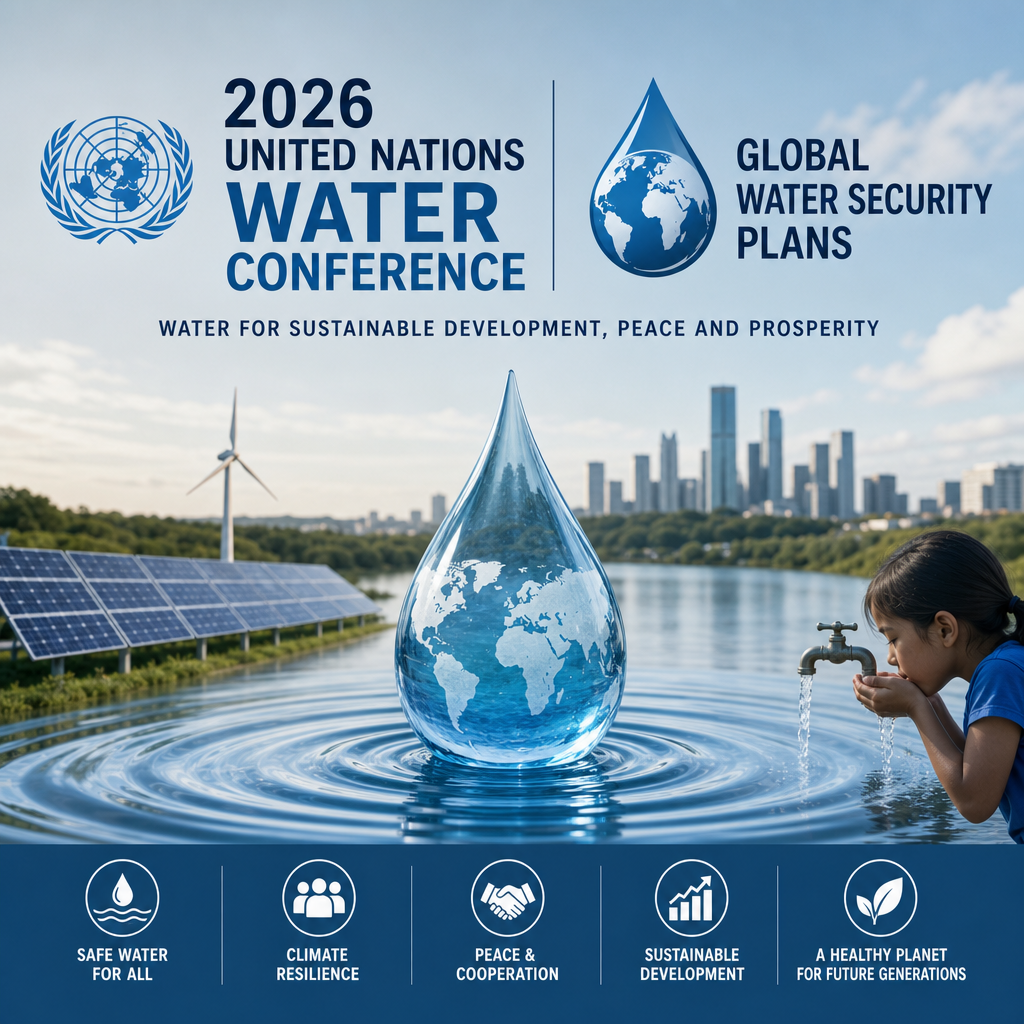
2026 United Nations Water Conference: Global Water Security Plans
The 2026 United Nations Water Conference aims to turn urgent concerns about water security into practical global action. As droughts, floods, and pollution strain freshwater systems, countries will look for shared solutions that protect people, ecosystems, and economies.
By: Peter on July 27, 2026
Water security has become one of the defining challenges of the 21st century. From drought-stricken farms to flood-prone cities, from shrinking glaciers to polluted rivers, countries everywhere are facing stress on their freshwater systems. The 2026 United Nations Water Conference is expected to build on growing global urgency and push governments, institutions, and communities toward stronger, more coordinated action.
As the world enters the final stretch of the 2030 Agenda for Sustainable Development, the conference will focus on one central question: how can nations ensure reliable, equitable, and sustainable access to water for people, ecosystems, and economies? The answer will likely involve a mix of infrastructure investment, policy reform, international cooperation, and new technology.
Why the 2026 UN Water Conference Matters
Water is not only a basic human need; it is also essential for food production, energy generation, public health, and climate resilience. Yet billions of people still live with water insecurity. Many face contaminated drinking water, unreliable supply, weak sanitation systems, or increased exposure to drought and floods.
The 2026 conference matters because it arrives at a critical time:
Climate change is intensifying water stress
Population growth is increasing demand
Urbanization is outpacing infrastructure
Agriculture is consuming large shares of freshwater
Pollution is reducing the quality of available water
The conference provides a high-level platform for governments and stakeholders to align plans, assess progress, and close the gap between promises and implementation. Unlike technical workshops or regional meetings, a UN conference has the ability to put water security at the center of global diplomacy.
The Global Water Security Challenge
Water security means different things in different regions, but the broad idea is simple: people, communities, and countries should have enough safe water at an affordable cost, while protecting ecosystems and reducing disaster risks.
Key pressures on water systems
1. Climate variability and extremes
Longer droughts, unpredictable rainfall, and stronger storms are making it harder to manage water supplies. In many places, snowpack and glaciers are shrinking, reducing seasonal meltwater that millions depend on.
2. Aging and unequal infrastructure
Some countries have modern water networks, while others still struggle with leaking pipes, unconnected rural households, and poor sanitation. Even where infrastructure exists, it is often underfunded or poorly maintained.
3. Agricultural demand
Agriculture accounts for the majority of freshwater use in many parts of the world. Inefficient irrigation, water-intensive crops, and poor soil management can strain rivers and aquifers.
4. Pollution and contamination
Industrial waste, agricultural runoff, plastics, untreated sewage, and mining pollution can make water unsafe for human use and harmful to ecosystems.
5. Groundwater depletion
Many regions rely on underground aquifers as a backup during dry periods. But overpumping can drain these reserves faster than they recharge, creating long-term risk.
Because these problems are interconnected, global plans for water security need to be integrated as well. The 2026 conference will likely emphasize that water cannot be treated as a standalone issue; it is linked to food, energy, health, biodiversity, and climate policy.
What the Conference Is Expected to Prioritize
Although exact outcomes will depend on negotiations and commitments made by member states, several priorities are likely to dominate the 2026 agenda.
1. Universal access to safe drinking water and sanitation
The most basic goal is to ensure that every person has access to safe, affordable water and sanitation services. This includes both rural and urban populations, as well as displaced communities and informal settlements.
Likely policy directions include:
Expanding piped water and sanitation networks
Supporting decentralized systems for remote areas
Improving water quality monitoring
Reducing household costs for low-income families
Strengthening hygiene and public health services
This is not only a matter of infrastructure. It also requires governance reforms, better financing, and stronger accountability.
2. Climate-resilient water management
Water security and climate adaptation are increasingly inseparable. The conference will probably encourage countries to build systems that can withstand both too much water and too little.
Examples of climate-resilient planning include:
Flood-control systems and natural buffers
Drought contingency plans
Rainwater harvesting
Smarter reservoir operations
Managed aquifer recharge
Watershed restoration
In many places, traditional grey infrastructure will need to be combined with nature-based solutions such as wetlands, forests, and floodplains that absorb excess water and improve water quality.
3. Better transboundary cooperation
Many of the world’s major rivers, lakes, and aquifers cross national borders. This makes cooperation essential. Without shared rules, neighboring states may compete over water withdrawals, dam construction, or pollution control.
The conference is likely to support:
Stronger river basin agreements
Shared data systems
Early warning mechanisms
Joint drought and flood planning
Diplomatic dialogue on shared waters
Transboundary water cooperation can reduce conflict and create opportunities for joint investment and regional stability.
4. Financing water infrastructure and services
One of the biggest barriers to water security is money. Many countries know what they need to do, but lack the financing to do it. The 2026 conference may push for a major scaling up of public, private, and multilateral investment.
Financing priorities could include:
Repairing aging pipes and treatment plants
Building storage and distribution systems
Expanding wastewater treatment
Supporting rural water access
Funding innovation and maintenance
Mobilizing climate finance for adaptation
A key lesson from past years is that one-time construction is not enough. Water systems require long-term maintenance budgets, trained staff, and institutional stability.
5. Data, monitoring, and governance reform
Sound water policy depends on reliable information. Many countries still lack accurate data on groundwater levels, pollution sources, water demand, or system losses.
A stronger global plan may include:
Open water data platforms
Satellite monitoring
Digital leak detection
Water accounting systems
Better regulation and enforcement
Community participation in governance
Good governance is just as important as physical infrastructure. Transparent institutions can help reduce corruption, improve allocation, and build public trust.
The Role of Innovation in Water Security
The 2026 conference will likely highlight the role of innovation, but not as a substitute for policy. Technology can improve water management, yet it works best when paired with local capacity and inclusive planning.
Promising innovations
Smart water systems
Sensors and digital monitoring tools can help utilities detect leaks, forecast demand, and manage supply more efficiently.
Water reuse and recycling
Treated wastewater can be reused for agriculture, industry, landscaping, or even potable supply in some settings. This reduces pressure on freshwater sources.
Desalination
For coastal countries, desalination offers a potential source of drinking water, though it remains energy-intensive and expensive. Its sustainability depends on cleaner energy and careful brine management.
Precision agriculture
Drip irrigation, soil moisture sensors, and crop data analytics can significantly reduce water use in farming while maintaining yields.
Nature-based solutions
Restoring forests, wetlands, floodplains, and mangroves can improve water filtration, reduce flood risks, and support biodiversity.
The challenge is not only inventing better tools, but making them affordable, scalable, and appropriate for different contexts.
Equity and the Human Right to Water
A serious global water strategy must address inequality. Water insecurity often hits the poorest communities first and hardest. Women and girls frequently bear the burden of collecting water in areas without reliable supply, while marginalized neighborhoods are more likely to face contamination, higher prices, and weak service.
The 2026 conference is expected to reinforce the idea that water is a human right, not a privilege. That means global plans should aim to:
Prioritize underserved communities
Involve local residents in decision-making
Protect water access during crises
Prevent discrimination in pricing and service delivery
Support gender-responsive water policies
Equity also matters across countries. Low-income nations often contribute least to climate change but face some of the greatest water risks. A fair global response should reflect this imbalance through finance, technology transfer, and capacity building.
Regional Examples of Water Security Needs
Water security challenges differ by region, and global plans must be flexible enough to address local realities.
Sub-Saharan Africa
Many countries face rapid population growth, weak infrastructure, and climate variability. Rural access remains a major concern, and investment in both basic services and resilient agriculture is essential.
South Asia
Rising demand, groundwater depletion, glacier melt, and pollution create severe pressure. Urban expansion and monsoon variability make integrated planning especially important.
Middle East and North Africa
This is one of the world’s most water-scarce regions. Desalination, wastewater reuse, efficiency improvements, and regional cooperation are all critical.
Latin America
The region has abundant freshwater overall, but distribution is uneven. Pollution, deforestation, drought, and urban stress create major local shortages.
Small island developing states
These countries face limited freshwater resources, seawater intrusion, and storm impacts. Rainwater harvesting, storage, and resilient coastal systems are vital.
These examples show why one-size-fits-all solutions do not work. The 2026 conference will need to promote broad principles while allowing countries to tailor implementation.
What Success Could Look Like After the Conference
A successful 2026 UN Water Conference would not be judged only by speeches or declarations. It would be measured by whether it accelerates real-world change. Signs of progress could include:
New national targets for water access and efficiency
Increased investment commitments
Stronger river basin cooperation agreements
Better monitoring and reporting systems
More support for climate adaptation in water sectors
Expanded partnerships among governments, cities, businesses, and civil society
Success will also depend on follow-through. International conferences can inspire momentum, but implementation is where water security is won or lost. The best outcomes will be those that translate into projects, regulations, budgets, and measurable improvements for communities.
The Broader Significance for the SDGs
Water is connected to nearly every Sustainable Development Goal. Progress on clean water and sanitation supports health, education, gender equality, food security, economic growth, and environmental sustainability. Without water, many of the SDGs become much harder to achieve.
The 2026 conference may therefore serve as a checkpoint for the entire development agenda. It can help answer whether the world is serious about turning long-standing commitments into practical action. If global leaders leave with stronger plans, better financing, and a clearer sense of urgency, the conference could become a turning point.
Frequently Asked Questions
1. When and where will the 2026 United Nations Water Conference take place?
The conference is scheduled for December 8–10, 2026, at the Abu Dhabi National Exhibition Center in the United Arab Emirates.
2. Which countries are co-hosting the conference?
The 2026 UN Water Conference is being co-hosted by Senegal and the United Arab Emirates.
3. What is the main objective of the conference?
Its central objective is to accelerate progress toward Sustainable Development Goal 6, which calls for the availability and sustainable management of water and sanitation for everyone.
4. What water-security issues are expected to receive attention?
Major issues include access to safe drinking water and sanitation, climate resilience, infrastructure financing, pollution, groundwater depletion, transboundary cooperation, data monitoring, and protection of vulnerable communities.
5. How will progress on global water security be measured?
Progress is tracked through official SDG 6 indicators covering drinking water, sanitation, water quality, efficiency, integrated water management, international cooperation, and water-related ecosystems.
The 2026 United Nations Water Conference is set to be a major moment for global water policy. With climate pressures rising and inequality still shaping access to safe water, the need for coordinated action has never been greater. The most effective plans will likely combine infrastructure investment, climate adaptation, data-driven governance, regional cooperation, and a strong focus on equity.
Water security is not just a technical challenge. It is a political, social, and moral one as well. The conference offers an opportunity for the world to move from concern to commitment, and from commitment to action.
Peter B holds a degree in Journalism and has 5 years
of experience covering U.S. economic policy, labor markets, and
financial news. He writes data-driven news content on topics
like inflation, interest rates, and employment trends.