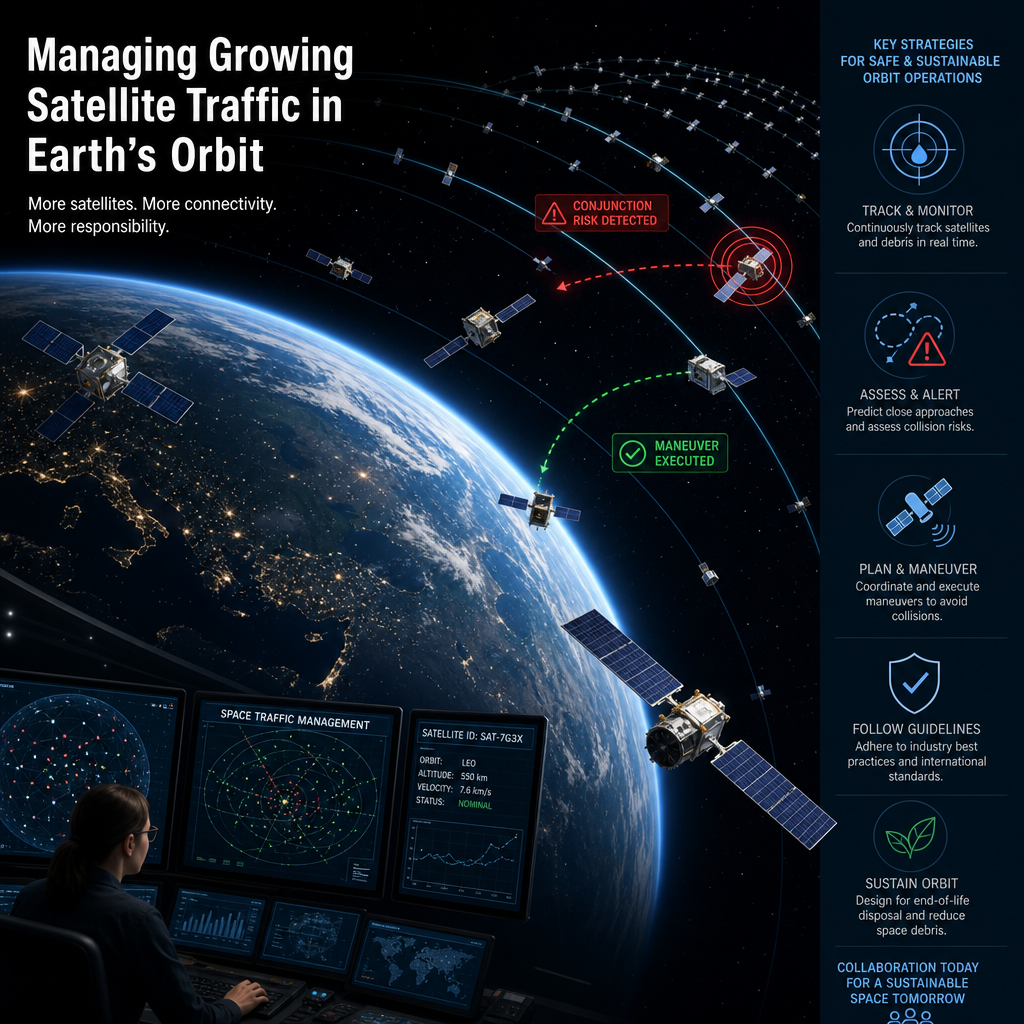
Managing Growing Satellite Traffic in Earth’s Orbit
Satellite traffic is rising fast as more companies and governments launch large constellations into Earth orbit, especially low Earth orbit. That growing congestion is making collisions, debris, and interference a bigger challenge than ever.
By: Peter on July 27, 2026
A decade ago, space traffic sounded like a problem for the distant future. Today, it is a very real issue. Earth orbit is becoming busier every year as commercial companies, governments, and research institutions launch more satellites than ever before. The result is a dramatic increase in satellite traffic, especially in low Earth orbit, where thousands of active spacecraft are now sharing a limited amount of space.
This growth is transforming communications, navigation, Earth observation, and scientific research. It is also creating serious challenges: collisions, congestion, radio interference, and orbital debris. Managing Earth’s orbit has become one of the most important infrastructure questions of the space age.
Why Satellite Traffic Is Growing So Quickly
The main driver of orbit congestion is the rapid expansion of satellite constellations. Instead of launching a few large satellites, many companies now deploy hundreds or even thousands of smaller ones to provide global internet coverage, imaging services, and real-time data.
Key reasons for the growth
Lower launch costs: Reusable rockets and rideshare missions have made access to space cheaper.
Miniaturization of technology: Satellites are now smaller, lighter, and more capable than before.
Demand for connectivity: Remote communities, ships, aircraft, and disaster response teams need reliable internet and communications.
Better Earth monitoring: More satellites mean more frequent images and more precise weather, environmental, and agricultural data.
Commercial competition: Private space companies are racing to build networks and capture markets.
For example, a single internet constellation may require thousands of satellites to ensure continuous coverage across the globe. Add navigation systems, military satellites, weather satellites, scientific missions, and national space programs, and the orbital environment becomes increasingly crowded.
The Orbital Neighborhood Is Not Infinite
Space may seem vast, but the most useful regions around Earth are limited. Low Earth orbit, or LEO, is especially crowded because it offers lower latency for communications, sharper Earth imaging, and easier launch access. But the very qualities that make LEO attractive also make it vulnerable to congestion.
Different orbital regions, different pressures
Low Earth Orbit (LEO): The busiest region, used for communications, Earth observation, and many commercial constellations.
Medium Earth Orbit (MEO): Common for navigation systems like GPS, Galileo, and similar networks.
Geostationary Orbit (GEO): A valuable belt around Earth where satellites appear fixed relative to the surface, widely used for television, weather, and communications.
Each orbital zone has finite capacity. While there is more room at higher altitudes, placing satellites there often requires more energy and longer transit times. In practice, operators prefer orbits that meet technical needs at the lowest cost, which often concentrates activity in the same areas.
Collision Risks Are Increasing
One of the most urgent concerns with rising satellite traffic is the risk of collisions. Even a small piece of debris can cause catastrophic damage when traveling at orbital speeds of around 28,000 kilometers per hour. At that speed, a paint fleck can be dangerous, and a defunct satellite can become a serious hazard.
Why collisions are such a problem
When two objects collide in orbit, they can generate thousands of fragments. These fragments can then strike other satellites, creating a chain reaction known as the Kessler Syndrome. In the worst case, orbital debris can spread so widely that certain regions become difficult or impossible to use safely.
A few real-world events have already shown how risky this can be. The 2009 collision between an active communications satellite and a defunct Russian satellite produced a large cloud of debris. More recently, anti-satellite tests have created lasting debris fields that threaten spacecraft for years.
What makes avoidance difficult
Avoiding collisions is not as simple as steering around traffic on a highway. Satellites move quickly, their paths change constantly, and many objects are too small to track with perfect accuracy. Operators must predict close approaches in advance and decide whether to maneuver. But frequent maneuvers can consume fuel, shorten mission life, and create operational complexity.
Space Debris Is a Growing Legacy Problem
Not all the objects in orbit are active satellites. Earth’s orbit also contains old rocket stages, dead satellites, fragments from explosions, and pieces of hardware lost during launches or operations. This debris represents a long-term environmental problem.
Sources of orbital debris
Defunct satellites
Used rocket bodies
Fragmentation from collisions
Explosions caused by leftover fuel or batteries
Parts released accidentally during missions
Debris from destructive weapons tests
The challenge is not only that there is already a lot of debris, but also that debris tends to remain in orbit for years or decades, depending on altitude. In some regions, natural atmospheric drag eventually pulls objects down. In higher orbits, debris can stay aloft for generations.
This creates a difficult inheritance for future space activity. Every new launch must account for the legacy of earlier missions.
Radio Spectrum Is Also Crowded
Managing orbit is not only about physical space. Satellites also rely on radio frequencies to communicate with Earth and with one another. These frequencies are limited and must be coordinated carefully to avoid interference.
As more satellites enter service, demand for spectrum grows. This can lead to conflicts between systems that need similar frequencies or operate in overlapping coverage areas.
Why spectrum management matters
Interference can degrade service
Satellite links must remain reliable for safety and navigation
Different countries and operators need coordinated access
Ground stations must avoid conflict with nearby services
A crowded spectrum can affect internet access, broadcasting, aviation, emergency response, and scientific measurement. In a connected world, reliable radio coordination is just as important as physical traffic control.
Who Manages Earth’s Orbit?
There is no single global “air traffic control” for space. Instead, management is distributed across governments, international organizations, military systems, and private operators. This patchwork approach was workable when satellites were few, but it is becoming harder to sustain as traffic increases.
Main players in orbit management
National space agencies and regulators set licensing rules and safety requirements.
International bodies help coordinate spectrum use and orbital practices.
Military and defense organizations track objects and assess threats.
Commercial operators monitor their own satellites and negotiate coordination with others.
This structure creates both strengths and weaknesses. It allows innovation and national autonomy, but it can also lead to gaps, inconsistent rules, and uneven compliance. Some operators are careful about debris and maneuvering. Others may follow less stringent practices, especially if enforcement is weak.
The Need for Better Space Situational Awareness
To manage growing satellite traffic, operators need accurate knowledge of what is in orbit and where it is headed. This is known as space situational awareness. It includes tracking active satellites, debris, launch events, maneuvers, and potential threats.
What space situational awareness helps with
Predicting close approaches
Planning collision avoidance maneuvers
Monitoring unusual behavior
Identifying debris fields
Supporting launch windows and reentry predictions
Modern tracking systems use a mix of radar, optical sensors, and data-sharing networks. But even with better tools, space remains a challenging environment. Small debris is hard to detect, and orbital predictions can become uncertain over time. More satellites mean more data to analyze, more warnings to assess, and more coordination required.
Designing for a Cleaner Orbit
One of the most effective ways to manage orbital congestion is to prevent new problems from being created. That means designing satellites and missions with end-of-life planning, debris reduction, and safe operations in mind.
Better design practices include
Passivation: Removing stored energy sources, such as leftover fuel or charged batteries, to reduce explosion risk.
Deorbit plans: Ensuring satellites can safely reenter Earth’s atmosphere at mission end.
Collision avoidance capability: Giving spacecraft the ability to maneuver away from threats.
Reliable tracking and identification: Making it easier to know which object is which.
Shorter orbital lifetimes for some missions: Especially in crowded LEO regions.
Some operators now build satellites to burn up in the atmosphere after service ends. Others place them in disposal orbits where they are less likely to interfere with active missions. These practices are important, but they must become standard rather than optional.
Active Debris Removal and Other New Solutions
Preventing future debris is only part of the answer. There is also growing interest in removing existing debris from orbit. This is much more difficult, technically and legally, than it sounds.
Possible debris-removal methods
Robotic capture and deorbit
Net or harpoon concepts
Drag devices that accelerate reentry
Laser nudging or orbital momentum transfer
Tugs that attach to dead satellites
Several companies and agencies have tested technologies for cleaning up space, but large-scale removal remains expensive and politically complicated. A major issue is liability: who is allowed to touch an object in orbit, especially if it belongs to another country or company? There are also concerns about dual-use technologies that could be mistaken for anti-satellite systems.
Even so, active debris removal is likely to become more important as orbit grows busier. In certain high-risk regions, removing just a few large objects could reduce collision hazards significantly.
Rules, Standards, and Cooperation Matter
Because Earth orbit is shared, no single actor can solve the problem alone. Better coordination is essential. This includes updated regulations, clearer standards, and more transparency about satellite operations.
Areas where cooperation is needed
Launch and licensing requirements
Shared data for collision avoidance
Common debris-mitigation standards
Spectrum coordination
Norms against destructive anti-satellite testing
Post-mission disposal rules
International cooperation is especially important because satellites cross borders constantly. A collision or interference event can affect many countries at once. In that sense, orbit is a global commons, even if national laws and commercial interests still shape how it is used.
Examples of the Challenge in Practice
Imagine a satellite internet network operating thousands of small spacecraft in low Earth orbit. Each satellite must stay on schedule, maintain spacing, avoid weather disturbances at launch, and maneuver around other objects. At the same time, the operator may receive thousands of conjunction alerts each week.
Now imagine a weather satellite in a nearby orbital band needing precision imaging. A single debris fragment could ruin years of work. Or consider a navigation system that supports aviation and shipping. Even small interference or an outage could ripple through transportation networks.
These examples show that orbit management is not abstract. It affects daily life on Earth, from streaming video and emergency communications to farming, shipping, and disaster relief.
The Future of Orbital Management
As satellite traffic continues to grow, Earth orbit will need smarter management systems. Future solutions will likely combine better tracking, stronger rules, satellite autonomy, and international cooperation. Artificial intelligence may help process orbital data and predict conflicts faster. New propulsion systems may improve maneuverability and disposal. Shared standards may make coordination easier across operators and countries.
But technology alone will not solve the problem. The real challenge is governance: deciding how much traffic is acceptable, who is responsible for cleanup, and how to balance innovation with long-term sustainability.
What a sustainable orbital future requires
Careful launch planning
Strong debris-mitigation policies
Better tracking and data sharing
Responsible end-of-life disposal
Cooperation across borders and industries
Reduced tolerance for unsafe practices
The choices made now will shape space for decades. If managed wisely, Earth orbit can support enormous scientific and economic benefits. If neglected, it could become dangerously cluttered, expensive to use, and harder to protect.
Frequently Asked Questions
1. How much debris is currently orbiting Earth?
Space-surveillance networks track tens of thousands of large objects, while agencies estimate that millions of smaller fragments are also present. Many smaller pieces cannot be tracked continuously but can still damage spacecraft.
2. Why can a small piece of orbital debris cause significant damage?
Objects in low Earth orbit travel at approximately 7 to 8 kilometers per second. The average impact speed between debris and another space object is about 10 kilometers per second, giving even small fragments enough energy to damage or disable satellites.
3. What is the Kessler Syndrome?
The Kessler Syndrome is a theoretical chain reaction in which collisions create additional debris, increasing the likelihood of further collisions. If debris levels become too high, particular orbital regions could become increasingly hazardous to use.
4. How quickly must low-Earth-orbit satellites be removed after their missions?
Under current FCC rules, covered satellites operating in or passing through low Earth orbit must be removed as soon as practicable and no later than five years after completing their missions.
5. Who coordinates satellite radio frequencies and orbital positions?
The International Telecommunication Union manages the international framework for coordinating radio-frequency assignments and satellite orbital resources. National regulators submit satellite filings and work through ITU procedures to prevent harmful interference.
Satellite traffic is growing because space has become essential to modern life. That growth brings opportunity, but also responsibility. Earth’s orbit is not limitless, and the costs of congestion, collision, and debris are rising fast. Managing orbit effectively will require better technology, stronger rules, and genuine international cooperation.
The future of space will not depend only on how many satellites we can launch. It will depend on how well we can share the sky above our planet.
Peter B holds a degree in Journalism and has 5 years
of experience covering U.S. economic policy, labor markets, and
financial news. He writes data-driven news content on topics
like inflation, interest rates, and employment trends.