NASA Psyche Mission: Searching for a Metal-Rich Asteroid
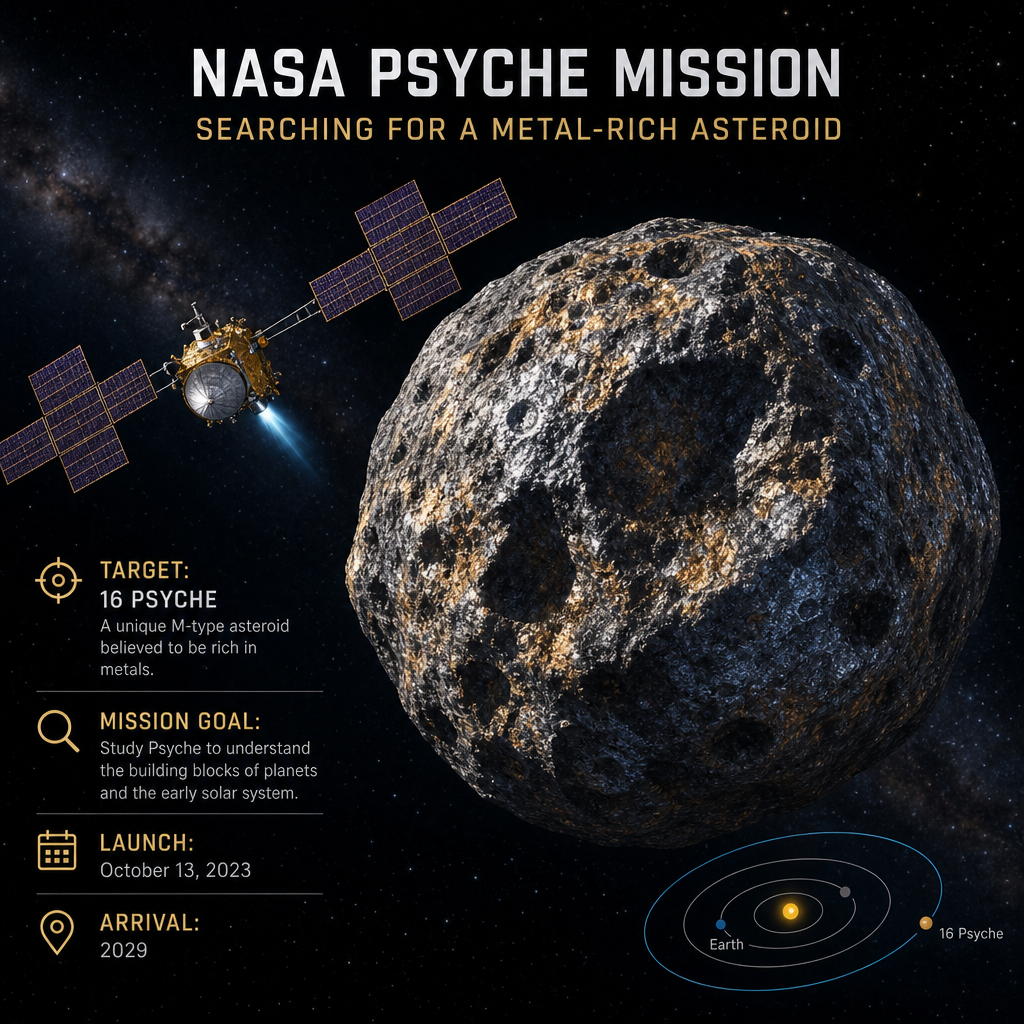
NASA’s Psyche mission is taking us to 16 Psyche, a mysterious metal-rich asteroid that could reveal clues about how planets form. By studying this unusual world up close, scientists hope to uncover the hidden history of the solar system’s earliest building blocks.
By: Peter on July 27, 2026
When most people imagine an asteroid, they picture a dark, dusty rock tumbling through space. NASA’s Psyche mission is focused on something far more unusual: a massive asteroid believed to be rich in metal. This target, known as 16 Psyche, may offer a rare glimpse into the building blocks of planets and the exposed core of a protoplanet that never fully formed.
The mission has captured wide attention because it combines astronomy, planetary science, and a bit of cosmic detective work. Scientists are not just studying one asteroid. They are trying to answer a bigger question: How did planets like Earth form, and what role did metal-heavy bodies play in that process?
What Is 16 Psyche?
16 Psyche is an asteroid orbiting the Sun in the main asteroid belt between Mars and Jupiter. It was discovered in 1852 and named after Psyche, a figure from Greek mythology. Unlike many asteroids made largely of rock or ice, Psyche has long been suspected to contain a high amount of metal, possibly including iron and nickel.
That makes it extraordinary.
For decades, astronomers have used telescopes and radar observations to estimate its composition. While early ideas suggested it could be the exposed core of an ancient planetesimal, later studies introduced more uncertainty. Psyche may not be a solid metallic core after all. Instead, it could be a mix of metal, rock, and empty space. Even so, it remains one of the most metal-rich objects known in the asteroid belt.
This is exactly why NASA is sending a spacecraft to study it up close.
Why a Metal-Rich Asteroid Matters
Asteroids are often thought of as leftovers from the solar system’s formation. In a sense, they are. But they are also time capsules. By studying them, scientists can learn about the conditions that existed 4.5 billion years ago.
A metal-rich asteroid is especially interesting because metal is tied to planetary formation. In young planetary bodies, heavy materials like iron and nickel tend to sink toward the center, forming a core. Lighter silicates remain in the mantle and crust. If Psyche is the exposed core of a shattered protoplanet, then it could be a rare window into the hidden interiors of planets.
That matters for several reasons:
Understanding planetary cores: Earth’s core cannot be sampled directly, but Psyche may offer indirect clues about how metallic cores form.
Learning about early collisions: If Psyche once had a rocky outer layer, then it may have lost that layer in violent impacts.
Studying solar system history: The object could preserve evidence of how materials were distributed early in the solar system.
In other words, Psyche is not just another asteroid. It could help scientists piece together the story of planet formation itself.
The Goal of NASA’s Psyche Mission
NASA launched the Psyche mission to conduct the first-ever visit to a metallic asteroid. The spacecraft’s job is not to land, mine, or alter the asteroid. Instead, it will orbit Psyche and use scientific instruments to map its surface, measure its gravity, and determine its composition.
The mission’s main goals include:
Identifying Psyche’s composition
Scientists want to know how much metal it contains and whether that metal is mixed with rock.
Studying its geology
Surface features such as craters, ridges, and possible impact scars may reveal how the asteroid evolved.
Measuring magnetic properties
If Psyche has magnetic remnants, that could support the idea that it once had a molten metal core.
Determining its density and structure
By understanding how mass is distributed inside the asteroid, researchers can test competing theories about its origin.
This mission is part science, part mystery-solving. The spacecraft will collect clues that help researchers decide whether Psyche is truly a planetary core remnant or something more complex.
How the Psyche Spacecraft Works
The Psyche spacecraft is designed to operate far from Earth in the cold, dim environment of the asteroid belt. It relies on solar electric propulsion, a highly efficient system that uses solar panels to generate power, then converts that power into thrust using electric fields. This allows the spacecraft to travel smoothly and efficiently over long distances.
Key Instruments on Board
The spacecraft carries several scientific tools to investigate the asteroid:
Multispectral imager
Captures images at different wavelengths to help reveal surface composition and geologic features.
Gamma-ray and neutron spectrometer
Measures the elements on the surface by detecting emissions from atoms struck by cosmic rays.
Magnetometer
Searches for signs of a magnetic field or ancient magnetization.
Radio science system
Uses tiny changes in the spacecraft’s motion to infer the asteroid’s mass and gravity field.
Together, these tools will help build a detailed picture of Psyche’s surface and interior.
What Scientists Hope to Find
There are several possible outcomes for the Psyche mission, and each one would teach scientists something valuable.
1. A metallic core remnant
If Psyche turns out to be mostly metal, this would strongly support the theory that it is the exposed core of an early planetary body. That would make it one of the most scientifically important objects in the solar system.
2. A mixed metal-rock body
Psyche may contain both metal and silicate rock. If so, it could represent a more complicated history, perhaps involving collisions, partial melting, or mixing over billions of years.
3. A porous rubble pile
Another possibility is that Psyche is not a solid chunk of metal at all, but a loosely held-together object with large pockets of empty space. This would affect how scientists interpret its density and origin.
The mission does not need to confirm one simple story to be successful. Even if Psyche turns out to be different from expectations, that result would still refine scientific understanding of asteroid formation.
Why NASA Chose Psyche
NASA did not choose Psyche because it is the largest asteroid or the most dangerous one. It was chosen because it is scientifically unique.
Most missions to asteroids have focused on rocky or carbon-rich bodies. Psyche, by contrast, offers a chance to investigate a largely unexplored type of object: a metal-rich asteroid. Since metals behave differently from rock under heat and pressure, Psyche may preserve a record of early planetary differentiation, the process by which dense materials sink and separate from lighter ones.
The mission also pushes engineering boundaries. Operating a spacecraft in deep space, using solar electric propulsion, and studying a small, distant target all require precision. NASA often uses such missions to advance both science and technology at the same time.
What Psyche Can Tell Us About Earth
At first glance, a distant asteroid may seem unrelated to life on Earth. But the study of Psyche could offer clues about our own planet’s interior.
Earth has a metallic core made mostly of iron and nickel. This core drives the planet’s magnetic field, which helps protect the atmosphere and supports habitability. But scientists cannot directly inspect the core. They have to infer its properties from seismic waves, gravity, and laboratory experiments.
By comparison, Psyche may offer a natural example of metal separated from rock in a primitive body. That means it could help answer questions such as:
How do iron-rich cores form?
How much heating and melting is needed?
What happens when a small world loses its crust and mantle?
How do magnetic fields form in early planetary bodies?
These are not just abstract questions. They help scientists understand why some worlds became Earth-like and others did not.
The History of Psyche Research
Interest in Psyche goes back long before the spacecraft was built. Over time, astronomers have used different methods to infer what the asteroid is made of.
Telescope observations
Visible and infrared observations revealed that Psyche’s surface does not behave like typical rocky asteroids. Some of its reflectivity patterns suggest metal, though not pure metal.
Radar studies
Radar can bounce signals off an asteroid and reveal clues about surface roughness and composition. Psyche has shown radar properties consistent with a high metal content, though the data are not definitive.
Density estimates
By studying how Psyche moves and how it influences nearby objects, scientists estimated its density. High density often points toward a metal-rich object, but internal porosity can complicate the picture.
These studies built excitement for the mission, but they also showed that remote sensing has limits. A spacecraft in orbit can provide much more precise data.
The Challenge of Exploring an Asteroid Belt Target
Traveling to Psyche is not simple. The asteroid belt is enormous, and the spacecraft must navigate across millions of miles of space. Timing, fuel use, and trajectory planning all matter.
Unlike a large planet, an asteroid has weak gravity. That makes orbiting it more difficult in some ways, because the spacecraft must maintain a careful balance between speed and gravitational pull. Too fast, and it escapes. Too slow, and it may drift into an unstable path.
There is also the challenge of operating far from the Sun. Even though Psyche is in the inner part of the asteroid belt, sunlight is much weaker there than near Earth. That affects power generation, communication, and long-term mission design.
Despite these challenges, the mission is a strong example of how modern spacecraft can explore distant and unusual objects with remarkable precision.
Why the Mission Inspires Public Interest
Part of Psyche’s appeal is that it sounds like something from science fiction: a metallic world in space, possibly the exposed core of an ancient planet. But the mission is also inspiring because it connects to a human desire to understand origins.
People are naturally drawn to big questions:
Where did the solar system come from?
How do planets form?
What hides beneath the surfaces of worlds?
Psyche is a rare chance to investigate those questions in a direct way. Rather than simply observing from Earth, scientists are sending a machine to a unique object and asking it to report back.
That kind of exploration captures the imagination. It also reminds us that even small, distant objects can hold big answers.
What Comes Next
As the Psyche spacecraft reaches its destination and begins its science phase, researchers will examine every detail it sends back. Images will help map the terrain. Chemical measurements will reveal elemental clues. Gravity data will help estimate the asteroid’s internal structure.
The results may confirm some long-standing theories and overturn others. That is the nature of exploration. The most interesting discoveries are often the ones scientists did not fully expect.
Whether Psyche proves to be a true metallic core, a hybrid body, or something entirely different, the mission will deepen our understanding of how worlds form and change.
Frequently Asked Questions
1. What is asteroid Psyche?
Psyche, also known as 16 Psyche, is a large, metal-rich asteroid located in the main asteroid belt between Mars and Jupiter. Scientists believe it contains substantial amounts of metal mixed with rocky material, but its exact composition remains unknown.
2. Is Psyche definitely the exposed core of an ancient planet?
No. One leading hypothesis suggests that Psyche may be part of the core of an early planetesimal, but other explanations remain possible. It could be a mixed metal-and-rock body or an object shaped by collisions, melting, and reassembly.
3. When will NASA’s spacecraft reach Psyche?
NASA’s Psyche spacecraft is expected to arrive at the asteroid in August 2029. It successfully completed a Mars gravity-assist flyby on May 15, 2026, which adjusted its trajectory toward the main asteroid belt.
4. What instruments are aboard the Psyche spacecraft?
The spacecraft carries a multispectral imager, a gamma-ray and neutron spectrometer, and magnetometers. Scientists will also use its radio telecommunications system to study the asteroid’s gravity field and internal structure.
5. Is NASA planning to mine asteroid Psyche?
No. The mission is designed exclusively for scientific exploration. The spacecraft will orbit the asteroid and collect measurements but will not land on it, extract metals, or conduct mining operations.
NASA’s Psyche mission is more than a journey to an asteroid. It is a search for answers about planetary origins, metallic cores, and the early solar system. By studying 16 Psyche, scientists hope to uncover clues hidden in one of the most unusual objects ever targeted by a spacecraft.
In the end, Psyche may teach us that the solar system still has plenty of surprises left. A metal-rich asteroid orbiting between Mars and Jupiter could help explain not only how planets were built, but also how Earth came to be the world we know today.
Peter B holds a degree in Journalism and has 5 years
of experience covering U.S. economic policy, labor markets, and
financial news. He writes data-driven news content on topics
like inflation, interest rates, and employment trends.