Global Quantum Computing Race and Cybersecurity Impact
The global quantum computing race is accelerating fast, and its biggest ripple effect may be on cybersecurity. As powerful quantum machines edge closer to reality, organizations must start preparing now for a future where today’s encryption may no longer be enough.
By: Peter on July 27, 2026
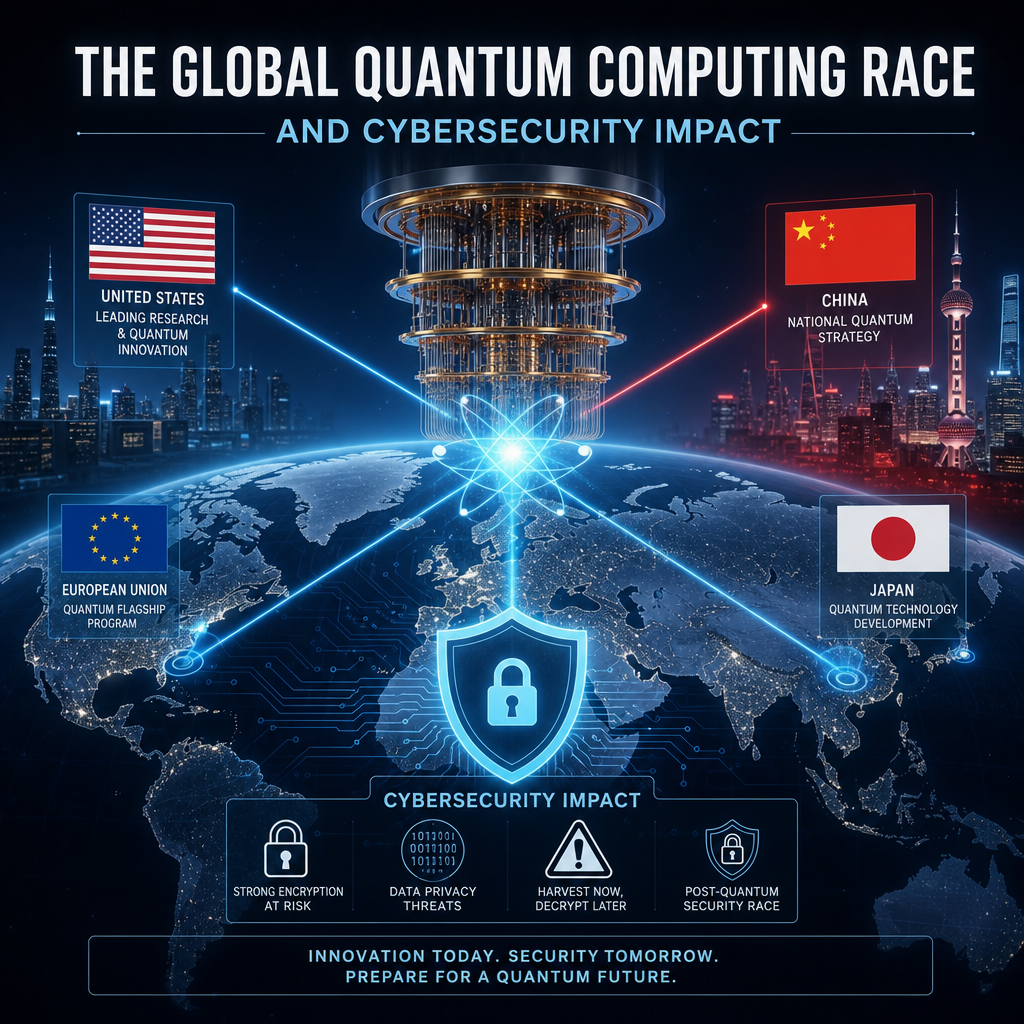
Quantum computing has moved from theory to strategic reality. Governments, tech giants, startups, and research labs around the world are investing heavily in the race to build machines that can solve problems far beyond the reach of today’s classical computers. This competition is not only about scientific prestige or commercial advantage. It has direct consequences for cybersecurity, because quantum computers could eventually break many of the encryption methods that protect digital life.
That possibility is changing how organizations think about risk, data protection, and long-term security planning. The world is entering a period where the growth of quantum computing and the evolution of cybersecurity are tightly linked. Understanding this race is essential for businesses, governments, and anyone who relies on secure digital systems.
Why Quantum Computing Matters
Traditional computers process information using bits, which are either 0 or 1. Quantum computers use qubits, which can exist in multiple states at once thanks to quantum properties such as superposition and entanglement. In practice, this means they may be able to explore many possible solutions to a problem simultaneously.
For certain tasks, quantum computers could provide enormous speedups. These tasks include:
Simulating molecules for drug discovery and materials science
Optimizing logistics and supply chains
Improving financial modeling
Solving specific mathematical problems much faster than classical systems
From a cybersecurity perspective, the most important issue is that quantum computers could eventually solve some of the mathematical problems that make modern encryption secure.
The Global Quantum Computing Race
The race for quantum computing is global, but the competition is especially intense among the United States, China, the European Union, Canada, the United Kingdom, and several private technology companies. Each is pursuing quantum capability for a mix of scientific, economic, and national security reasons.
Government investment
Many governments see quantum technology as a strategic asset. Large public funding programs are supporting research centers, national laboratories, university partnerships, and workforce development. The goal is not just to build better computers but also to maintain technological sovereignty in a future where quantum capability may influence defense, intelligence, and economic competitiveness.
Private sector competition
Major companies are also investing aggressively. Firms like IBM, Google, Microsoft, Amazon, and several specialized startups are building hardware, software, and cloud-based quantum platforms. Their progress is measured not only by qubit counts but also by error correction, stability, and practical applications.
International talent and supply chains
Quantum computing depends on rare expertise in physics, computer science, materials science, and engineering. It also relies on specialized supply chains, including cryogenic systems, lasers, and advanced fabrication. Countries and companies that control this ecosystem may gain a long-term advantage.
This race matters because the first entity to achieve a fault-tolerant quantum computer of sufficient scale could influence the security landscape worldwide.
The Cybersecurity Threat: Why Encryption Is at Risk
Most of the internet depends on cryptography. Encryption protects everything from banking and email to cloud services and government communications. Today’s systems rely on algorithms that are considered secure because classical computers would take impractically long periods to break them.
Quantum computing threatens some of these assumptions.
Public-key encryption under pressure
The biggest concern involves public-key cryptography, especially algorithms used for key exchange and digital signatures. These systems depend on problems such as factoring large integers or solving discrete logarithms, which are hard for classical computers.
A sufficiently powerful quantum computer running Shor’s algorithm could break widely used schemes like:
RSA
Elliptic Curve Cryptography (ECC)
Diffie-Hellman key exchange
If these systems were broken, attackers could potentially decrypt sensitive communications, impersonate trusted entities, or forge digital signatures.
Symmetric encryption is less exposed, but not immune
Symmetric algorithms such as AES are more resilient against quantum attacks, but they are not untouched. Grover’s algorithm could reduce the effective security of symmetric keys by roughly half. That means longer key sizes may be needed to maintain the same security margin in a quantum future.
For example:
AES-128 may face reduced security confidence
AES-256 is generally seen as a stronger long-term option
Hash functions may need adjustments depending on use case
The “Harvest Now, Decrypt Later” Problem
One of the most urgent cybersecurity concerns is not future decryption in theory, but present-day data theft for future use. Attackers may already be collecting encrypted traffic, archived files, or intercepted communications with the hope of decrypting them later when quantum computers become powerful enough.
This is often called the “harvest now, decrypt later” threat.
Why this matters now
Some data remains valuable for many years, such as:
Government records
Healthcare data
Intellectual property
Legal archives
Financial records
Personal identity information
If this information is stolen today and decrypted years from now, the damage could be severe even if the quantum machine does not exist yet. This makes quantum risk a long-term security issue, not a distant hypothetical.
Post-Quantum Cryptography: The Main Defense
The cybersecurity world is not waiting passively. Researchers and standards bodies are developing post-quantum cryptography, often called PQC. These are encryption algorithms designed to resist attacks from both classical and quantum computers.
What makes PQC different
Unlike quantum cryptography, which uses quantum physics to secure communication, post-quantum cryptography refers to mathematical algorithms that can run on ordinary systems but are believed to be safe against quantum attacks.
Common families of PQC approaches include:
Lattice-based cryptography
Code-based cryptography
Hash-based signatures
Multivariate polynomial approaches
Isogeny-based methods, though some have faced setbacks
Standardization efforts
The National Institute of Standards and Technology (NIST) has been leading a major effort to evaluate and standardize post-quantum algorithms. This is a critical step because organizations need stable, vetted standards before widespread migration can begin.
The existence of standardization does not mean the transition is simple. Many organizations have large legacy systems, complex certificate infrastructures, and embedded devices that are difficult to update. But without planning, they may face a painful scramble later.
How Organizations Should Prepare
Quantum-safe security is a process, not a single product purchase. Businesses and governments need to assess exposure, prioritize critical assets, and build migration plans.
1. Inventory cryptographic dependencies
The first step is understanding where cryptography is used. Many organizations do not know exactly which systems depend on RSA, ECC, or other vulnerable mechanisms.
An inventory should cover:
Websites and APIs
VPNs and remote access
Email systems
Internal authentication systems
Software update mechanisms
Cloud storage and backups
IoT and embedded devices
Digital signing workflows
Without this visibility, migration becomes guesswork.
2. Classify data by longevity
Not every asset has the same sensitivity window. Data that loses value in a few months may be less urgent than records that must remain confidential for 20 years or more. Organizations should identify which data needs long-term protection.
Examples include:
Medical and patient histories
Trade secrets
Classified government communications
Legal evidence
Long-term financial records
3. Adopt crypto-agility
Crypto-agility means designing systems so that cryptographic algorithms can be replaced without major disruption. It is one of the smartest ways to reduce future risk.
A crypto-agile system can:
Swap algorithms more easily
Support multiple cryptographic standards
Update certificates and keys without rebuilding everything
Adapt as standards evolve
This capability is especially important because quantum-safe standards may continue to mature over time.
4. Plan hybrid deployments
Many organizations will likely use hybrid approaches during the transition. This means combining classical and post-quantum algorithms so that security relies on both. Hybrid strategies can reduce risk while standards and implementations become more mature.
For example, a system might use both ECC and a post-quantum key exchange method until confidence in the new approach is stronger.
5. Update vendor and procurement policies
Quantum readiness should not be limited to internal teams. Organizations also need to ask vendors the right questions:
Is your product crypto-agile?
Do you support post-quantum algorithms?
How will firmware updates be handled for embedded devices?
What is your migration roadmap?
Procurement decisions made today may determine security posture for years to come.
Real-World Sectors Most Affected
The impact of quantum computing on cybersecurity will not be uniform. Some sectors face greater urgency because they depend heavily on confidentiality, long-lived records, or digital trust.
Financial services
Banks, payment processors, and fintech platforms rely on secure transactions, identity verification, and digital signatures. A quantum breakthrough could disrupt trust in secure communications and certificate systems. Even before quantum computers become fully capable, financial institutions are already planning migrations.
Healthcare
Healthcare data is highly sensitive and often must be retained for long periods. Patient records, lab results, imaging data, and billing systems are all potential targets. Quantum risk is especially serious because health information can remain personally valuable for decades.
Government and defense
Public-sector systems may face the most strategic pressure. Classified communications, diplomatic cables, military networks, and intelligence archives all depend on strong cryptography. For governments, the stakes include national security and geopolitical advantage.
Critical infrastructure
Energy grids, water systems, transportation networks, and telecom infrastructure increasingly depend on secure digital controls. These systems often include legacy technologies, making transition difficult. A quantum-driven cryptographic failure could have cascading effects.
Cloud and enterprise software
Cloud services are the backbone of modern business. If major identity systems, certificate chains, or secure channels are weakened, the impact could spread across thousands of organizations at once.
Quantum Advantage vs. Quantum Hype
The global race is real, but so is the hype. It is important to separate credible progress from exaggerated claims.
Today’s quantum computers are still limited. They are noisy, error-prone, and not yet capable of breaking modern public-key encryption. But that does not mean the threat is imaginary.
Why caution is needed
Quantum development is moving quickly
Breakthroughs can happen faster than expected
Migration of complex systems takes years
Sensitive data stolen now may remain valuable later
Security planning must therefore be based on preparation, not panic. Organizations should not assume they have decades before acting. In cybersecurity, long lead times are common, and quantum migration is no exception.
The Strategic Impact on Global Cybersecurity
The quantum race is reshaping cybersecurity in three major ways.
1. Security becomes a long-term architecture issue
Organizations can no longer treat encryption as a fixed technical detail. Cryptography must be viewed as a living part of infrastructure that may need periodic overhaul.
2. Trust frameworks may need rebuilding
Digital signatures, certificates, identity systems, and secure update mechanisms all depend on public-key cryptography. If those foundations must change, then the broader trust model of the internet may evolve too.
3. National security and commercial security are converging
Quantum capability is both a national strategic priority and a business risk. This means cybersecurity policy, export controls, intelligence efforts, and corporate roadmaps are increasingly connected.
Frequently Asked Questions
1. Can current quantum computers break RSA or elliptic-curve encryption?
No. Existing quantum computers are not sufficiently powerful, stable, or fault-tolerant to break widely deployed RSA or elliptic-curve cryptography. However, future advances could make these systems vulnerable.
2. Which forms of encryption face the greatest quantum risk?
Public-key systems based on integer factorization and discrete logarithms face the greatest risk. These include RSA, elliptic-curve cryptography, and commonly used Diffie-Hellman key-exchange methods.
3. What does “harvest now, decrypt later” mean?
It describes a strategy in which attackers collect encrypted information today and store it until sufficiently powerful quantum computers become available. Data requiring long-term confidentiality may therefore face risks before cryptographically relevant quantum computers exist.
4. Has NIST already approved post-quantum cryptography standards?
Yes. NIST finalized FIPS 203 for ML-KEM key establishment, FIPS 204 for ML-DSA digital signatures, and FIPS 205 for SLH-DSA digital signatures in August 2024.
5. How should organizations prepare for post-quantum migration?
Organizations should identify where cryptography is used, prioritize information requiring long-term protection, evaluate vendor plans, improve crypto-agility, test post-quantum implementations, and develop a risk-based migration roadmap.
The global quantum computing race is about more than faster machines. It is a competition that could reshape the foundations of cybersecurity, especially the cryptography that secures today’s digital world. While large-scale quantum computers capable of breaking widely used encryption do not yet exist, the risk is already influencing policy, business planning, and security architecture.
The most important lesson is simple: preparation must begin before the threat becomes fully real. Organizations that inventory their cryptographic systems, adopt crypto-agile designs, and plan for post-quantum standards will be far better positioned than those that wait. In the quantum era, cybersecurity will belong to the prepared.
Peter B holds a degree in Journalism and has 5 years
of experience covering U.S. economic policy, labor markets, and
financial news. He writes data-driven news content on topics
like inflation, interest rates, and employment trends.