How Undersea Internet Cables Became Critical Global Infrastructure
Undersea cables are the hidden backbone of the internet, carrying most international data across oceans with speed and reliability that satellites can’t match. From video calls to global finance, these vital lines keep the modern world connected every second of the day.
By: Peter on July 27, 2026
When most people think about the internet, they picture Wi‑Fi routers, data centers, satellites, or perhaps the phone in their pocket. What many do not picture is the vast network of fiber-optic cables lying on the ocean floor, quietly carrying the majority of the world’s digital traffic. These undersea cables are one of the most important pieces of modern infrastructure on the planet, yet they remain largely invisible to the public.
Today, undersea internet cables connect continents, support trillions of dollars in commerce, and keep global communication running in real time. Their rise to critical status did not happen overnight. It was the result of decades of engineering progress, changing economics, and an increasingly interconnected world.
The Hidden Backbone of the Internet
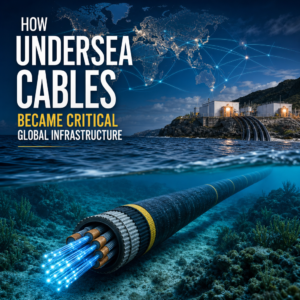
Undersea cables are long fiber-optic lines laid across the seabed to connect countries and continents. Despite the existence of satellites and wireless technologies, these cables carry the overwhelming majority of international internet traffic. In many cases, more than 95% of cross-border data moves through submarine cables rather than through space-based systems.
That includes:
Video calls between families on different continents
Financial transactions between banks and trading firms
Cloud services used by companies around the world
Online shopping and digital payments
Government communications and emergency coordination
Streaming media and social platforms
Without these cables, the internet would slow dramatically, become more expensive to use, and lose much of its reliability.
Why Cables Matter More Than Satellites
Satellites are useful for reaching remote areas, but they have limitations. They introduce higher latency, or delay, because the signal has to travel much farther. They also have lower capacity compared with fiber-optic cables.
Undersea cables, by contrast, provide:
High bandwidth: They can carry enormous amounts of data.
Low latency: They are faster for real-time applications.
Cost efficiency: They can move data at much lower cost per bit.
Reliability at scale: They support the constant demand of global internet traffic.
In short, undersea cables are the reason digital life can function globally at the speed people expect.
How It All Started
The story of undersea cables began long before the internet. The first undersea telegraph cable was laid across the English Channel in the mid-19th century, followed by more ambitious transatlantic telegraph cables. These early lines made it possible to transmit messages across oceans in minutes instead of weeks.
Over time, submarine cables evolved from telegraph wires to telephone cables and eventually to fiber-optic systems. The internet age transformed them into something far more powerful.
From Telegraph to Fiber Optics
The biggest leap came with the adoption of fiber-optic technology in the late 20th century. Fiber-optic cables transmit information as pulses of light rather than electrical signals. This made it possible to send vastly more data over longer distances with far less signal loss.
Compared with older systems, fiber optics offered:
Much higher data capacity
Faster transmission speeds
Lower maintenance requirements
Better resistance to interference
As global internet use exploded in the 1990s and 2000s, fiber-optic submarine cables became essential for connecting the world’s digital economy.
Why Undersea Cables Became Critical Infrastructure
Undersea cables are now considered critical infrastructure because so many essential services depend on them. Their importance is not only technical but also economic and political.
1. They Support the Global Economy
Modern commerce depends on constant, high-speed communication. When a business sends invoices, processes payments, coordinates logistics, or runs cloud software, data often travels across oceans. This is especially true for multinational companies with offices, customers, and suppliers on multiple continents.
Examples include:
A retailer in Europe using servers in the United States
A financial firm in London trading with partners in Asia
A software company in India serving customers in South America
A manufacturing supply chain coordinating orders across several countries
If undersea cables were disrupted, even briefly, the effects could be enormous. Financial markets could slow, supply chains could stall, and cloud services could become unreliable.
2. They Power Communication in Everyday Life
People often think of global internet traffic as abstract, but it is deeply personal. Undersea cables help make everyday digital interactions possible:
Messaging a relative overseas
Joining a remote work meeting
Watching international streaming content
Using social media in real time
Playing online games with users in other regions
As remote work, teleconferencing, and digital entertainment became more common, the role of submarine cables grew even more important.
3. They Enable Cloud Computing and Data Centers
Cloud computing depends on moving data quickly between users and data centers, many of which are located in different countries. Major technology companies invest heavily in their own cable systems to ensure their services stay fast and resilient.
This matters for services such as:
Email platforms
Online collaboration tools
AI applications
Enterprise software
Backup and storage systems
The rise of cloud computing made undersea cables not just helpful, but indispensable.
4. They Have Strategic and National Security Value
Because undersea cables are so important, they also have major strategic significance. Governments, military organizations, and intelligence agencies all depend on secure, reliable data links. As a result, submarine cables are now treated as assets of national importance.
Countries care about:
Who owns cable landing stations
Which routes cables take
How resilient networks are during crises
Whether adversaries could disrupt or tap communication lines
In a world where digital infrastructure can influence diplomacy, security, and military readiness, undersea cables are no longer just private telecom assets. They are strategic infrastructure.
The Engineering Behind the Ocean Floor
Building an undersea cable is a remarkable feat of engineering. These systems must travel thousands of miles, withstand deep-sea pressure, avoid damage from anchors and fishing gear, and remain operational for decades.
What a Submarine Cable Looks Like
A modern undersea cable is usually much thinner than people imagine—often closer to a garden hose than a giant pipeline. Inside, however, it contains an advanced structure:
Fiber-optic strands for transmitting data
Protective layers of insulation
Steel wire for strength in shallower waters
Waterproof materials
Repeaters placed along the route to boost signal strength
In deep ocean areas, cables are often lighter because they do not need as much physical protection. Near shorelines, where the risk of human activity is higher, they are heavily armored.
The Role of Repeaters
Signals traveling through fiber-optic cable weaken over long distances. To solve this, engineers place repeaters at intervals along the route. These devices amplify the optical signal so the data can travel thousands of kilometers without losing quality.
A long transoceanic cable may include dozens of repeaters. Each one must function reliably underwater for many years, often without maintenance.
How Routes Are Chosen
Choosing a route for a submarine cable is a careful process. Planners must account for:
Ocean depth and seabed conditions
Earthquake zones and underwater landslides
Shipping lanes and fishing areas
Environmental regulations
Political boundaries and landing permissions
The ideal route balances cost, safety, and connectivity. In some cases, cables are laid in redundancy networks so that if one route fails, traffic can be rerouted elsewhere.
Fragility in a World That Depends on Them
Despite their power, undersea cables are surprisingly vulnerable. They can be damaged by natural disasters, accidents, and deliberate interference. That fragility is one reason they are considered critical infrastructure.
Common Causes of Damage
Many cable outages are caused by ordinary human activity rather than sabotage. For example:
Fishing trawlers dragging heavy equipment
Ship anchors striking cables near coastlines
Underwater landslides
Earthquakes and volcanic activity
Construction near shore landing sites
Even though the cables are buried in some shallow areas and protected in others, they are not immune to disruption.
What Happens When a Cable Breaks?
When a submarine cable is damaged, traffic does not necessarily stop entirely. Internet providers can often reroute data through other cables. However, the available capacity may be reduced, and performance can degrade.
Possible effects include:
Slower internet speeds
Delays in video calls and streaming
Interruptions in financial services
Increased latency for online applications
Higher costs for providers managing rerouted traffic
In regions with limited cable redundancy, a single break can have serious consequences.
Real-World Examples
History has shown how disruptive submarine cable failures can be. Islands and coastal nations are especially vulnerable because they may depend on just a few cable links. When those links are damaged, the impact can reach schools, hospitals, businesses, and government offices.
In some cases, major outages have led to:
Internet slowdowns across entire countries
Delayed banking operations
Disrupted airline or shipping communications
Challenges for emergency response coordination
These incidents underline a simple truth: modern life depends on infrastructure that most people never see.
The Geopolitics of the Ocean Floor
As submarine cables became more valuable, they also became part of global geopolitics. Control over cable routes, landing stations, and suppliers can shape the balance of power in the digital age.
Who Owns the Cables?
Cable ownership is often shared among telecom companies, technology giants, and government-linked entities. In recent years, major tech firms have become some of the largest investors in new submarine cables, reflecting how important fast global connectivity has become to their businesses.
This has raised important questions:
Which companies control the flow of data?
How much influence should governments have over route approvals?
Can a nation trust infrastructure built by a foreign rival?
How can networks be protected from espionage or interference?
Landing Stations: The Critical Chokepoints
A cable’s landing station is where it comes ashore and connects to land-based networks. These sites are highly sensitive because they are concentrated points of access. Protecting them is essential for resilience and security.
Landing stations matter because they:
Connect ocean cables to national networks
Are easier to monitor and secure than the open sea
Can become bottlenecks if they are too few
Represent strategic control points for national infrastructure
Because so much depends on them, governments increasingly regulate landing stations closely.
Building Redundancy for a Digital World
As dependence on submarine cables has grown, so has the need for redundancy. Resilient infrastructure means having multiple cable routes, backup systems, and diversified landing points.
Why Redundancy Matters
If one route fails, traffic should have another path. This is especially important for:
Financial hubs
Cloud service providers
Government networks
Emergency communications
Regions with high internet dependence
Without redundancy, a single accident could isolate an entire market or country from the rest of the world.
New Investments in Cable Networks
To reduce risk and meet rising demand, companies and governments continue to invest in new cable systems. These projects often aim to:
Increase capacity between major data hubs
Create alternate routes around high-risk areas
Improve connectivity for underserved regions
Support future growth in cloud and AI traffic
The demand keeps rising because global data use keeps growing. Video, artificial intelligence, remote collaboration, and online commerce all require more and better network capacity.
The Future of Undersea Cables
The future of undersea cables will likely involve more capacity, more routes, and more attention to security. As the world becomes even more data-driven, the seabed will remain one of the most strategically important places on Earth.
What’s Next
Several trends are shaping the next generation of submarine infrastructure:
More fiber pairs to carry higher volumes of data
Smarter monitoring systems to detect damage faster
Improved route planning to avoid hazards
Greater government oversight of critical connections
Integration with emerging technologies such as AI and cloud platforms
Undersea cables are likely to become even more important as digital systems expand into every part of life.
Frequently Asked Questions
1. How much international internet traffic travels through undersea cables?
According to the International Telecommunication Union, submarine cables carry more than 99% of international data exchanges, including financial transactions, cloud services, government communications, and everyday internet traffic.
2. Why are undersea cables used instead of satellites for most global data traffic?
Fiber-optic submarine cables provide greater capacity, lower latency, and a lower cost per unit of data. Satellites remain valuable for remote locations and specialized services but cannot currently replace the capacity provided by global cable networks.
3. What causes most submarine cable failures?
Most failures result from accidental human activity, particularly fishing equipment and ship anchors. Natural hazards, abrasion, equipment failure, earthquakes, and underwater landslides can also damage cables.
4. Does one damaged cable disconnect an entire country?
Not always. Networks with multiple cable routes can redirect traffic after a failure. However, countries and islands with limited connections may experience significant slowdowns or outages until repairs are completed.
5. Who regulates submarine cables in the United States?
The Federal Communications Commission issues licenses for submarine cables and their associated landing stations in the United States. Other federal agencies may also participate in environmental, security, and national-interest reviews.
Undersea internet cables may be out of sight, but they are at the center of global connectivity. They carry the data that powers commerce, communication, cloud computing, and modern life itself. What began as 19th-century telegraph wires has evolved into a vast fiber-optic network linking continents and economies.
As the digital world grows more interconnected, these cables have become much more than engineering marvels. They are critical global infrastructure—essential, strategic, and worth protecting.
Peter B holds a degree in Journalism and has 5 years
of experience covering U.S. economic policy, labor markets, and
financial news. He writes data-driven news content on topics
like inflation, interest rates, and employment trends.