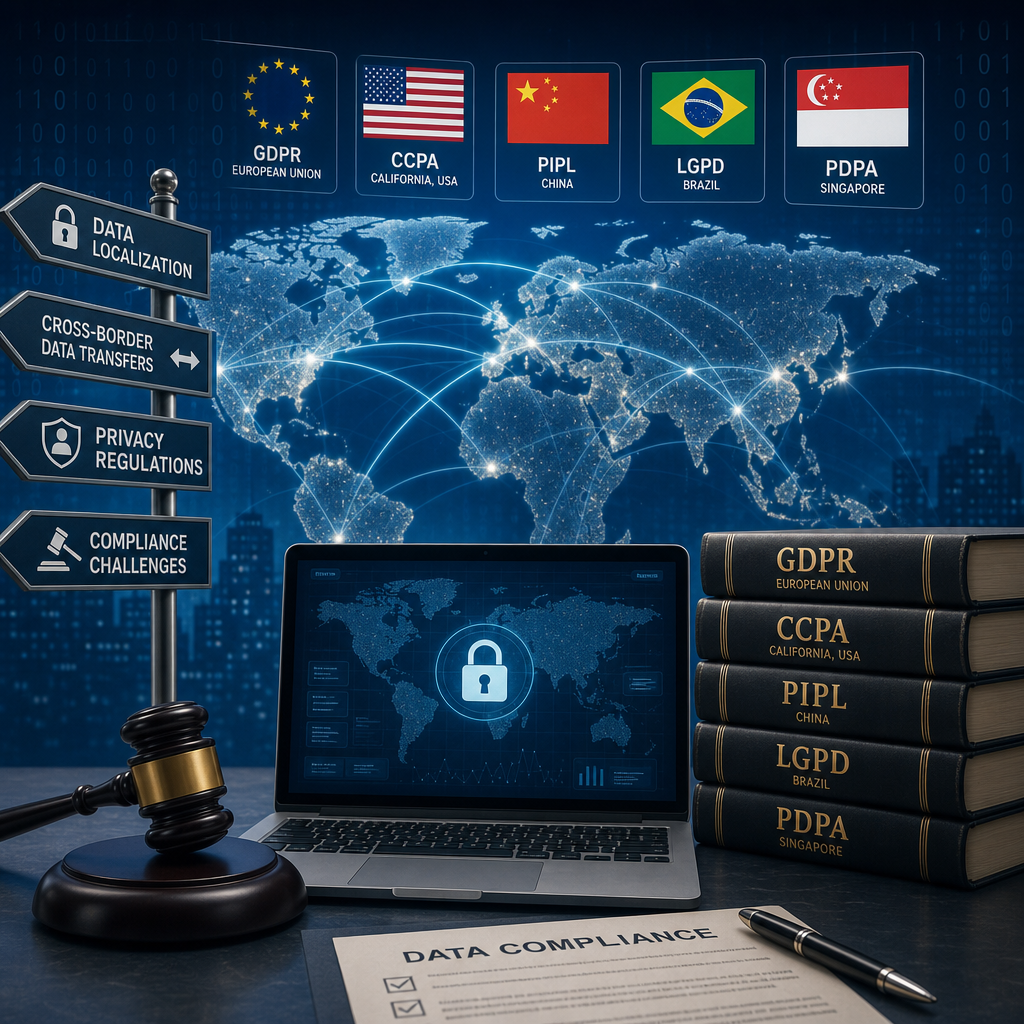
How Cross-Border Data Laws Affect Global Technology Companies
Cross-border data laws shape how global technology companies move, store, and protect information across regions, turning compliance into a key part of product design and business strategy. As rules tighten worldwide, companies must balance innovation with privacy, security, and local legal requirements.
By: Peter on July 27, 2026
For global tech companies, data rarely stays in one place. A user in California might upload files stored on servers in Ireland, while support teams in India access them and product analytics are processed in Singapore. That kind of flow powers modern digital services—but it also creates serious legal complexity. Cross-border data laws determine how companies collect, transfer, store, and use information across national boundaries, and those rules can shape everything from cloud architecture to product launches.
As governments tighten privacy and cybersecurity requirements, technology companies must do more than meet one country’s standards. They need systems that can handle overlapping laws, regional restrictions, and shifting regulatory expectations. In practice, that means legal compliance is now a core part of product design, vendor management, and global business strategy.
What Are Cross-Border Data Laws?
Cross-border data laws are the legal rules that govern how data moves between countries. They include privacy laws, cybersecurity rules, sector-specific regulations, and government access requirements. Some laws focus on whether personal data can leave a country at all. Others require companies to safeguard data in transit, notify regulators about breaches, or keep certain records locally.
These laws matter because the internet is global, but regulation is still mostly national or regional. A company operating worldwide may have to comply with:
Data transfer restrictions
Data localization requirements
Consent and notice obligations
Security and breach reporting rules
Government requests for access or disclosure
For technology companies, the challenge is not simply understanding the rules. It is designing products and operations that work across many legal systems at once.
Why Cross-Border Data Laws Matter to Global Technology Companies
Technology companies rely on data for product functionality, advertising, analytics, machine learning, customer support, and fraud prevention. If cross-border transfers are restricted or mismanaged, the consequences can be serious.
Business operations can slow down
When a company cannot freely move data between regions, it may need separate infrastructure, localized teams, or duplicate storage environments. That can increase costs and complicate operations.
Product features may need to change
A feature that works well in one market may violate data transfer laws in another. For example, a global collaboration app may need region-specific settings for file storage, account authentication, or user profiling.
Compliance risks can become expensive
Violating cross-border data laws can lead to fines, investigations, injunctions, contract disputes, and reputational damage. Even when penalties are not immediate, the cost of responding to audits or restructuring systems can be substantial.
Customer trust is on the line
Users and enterprise customers increasingly care about where their data goes and who can access it. A company that cannot explain its data practices clearly may lose business, especially in regulated industries.
Key Laws and Regulatory Frameworks Tech Companies Must Track
No single law controls all cross-border data transfers. Global companies typically face a patchwork of rules.
GDPR and international data transfers
The European Union’s General Data Protection Regulation (GDPR) is one of the most influential privacy laws in the world. It restricts transfers of personal data outside the European Economic Area unless the receiving country offers adequate protections or the transfer uses approved safeguards.
Common transfer mechanisms include:
Adequacy decisions
Standard Contractual Clauses (SCCs)
Binding Corporate Rules (BCRs)
Specific contractual or consent-based exceptions in limited cases
For many companies, GDPR compliance is the baseline for global privacy programs.
Data localization laws
Some countries require certain data to stay within national borders or be stored locally. These rules are often tied to sensitive information, public sector data, financial records, health data, or personal identifiers.
Data localization laws can force companies to:
Build regional data centers
Use approved local cloud providers
Limit remote access from foreign employees
Create separate workflows for different markets
Sector-specific rules
Industries such as healthcare, finance, telecommunications, and education often have stricter data rules than general consumer apps. A technology company serving hospitals, banks, or schools may need to comply with both general privacy laws and industry-specific data handling requirements.
Government access and surveillance laws
Some countries require companies to provide data to law enforcement or intelligence agencies under specific conditions. Others require local presence or legal representation to process requests. For global tech firms, this creates difficult questions about transparency, encryption, and user notification.
How Cross-Border Data Laws Change Technology Company Operations
Cross-border compliance affects nearly every part of a tech company’s operations.
1. Data architecture and cloud design
Engineers may need to build systems that separate data by region, limit transfer routes, or anonymize information before movement. This can influence:
Where backups are stored
How logs are retained
Whether training data can be centralized
How identity systems share information across borders
In some cases, the simplest product design is no longer the legally safest one.
2. Vendor and third-party management
Most tech companies depend on processors, cloud providers, payment services, customer support tools, analytics platforms, and marketing vendors. Each of those relationships can create a transfer risk.
Companies need to know:
Where the vendor stores data
Which subcontractors the vendor uses
Whether support staff can access data from abroad
What transfer clauses and security commitments are in place
A weak vendor can undermine an otherwise strong compliance program.
3. Internal access controls
Cross-border laws often affect who can access data, not just where it is stored. A customer service representative in one country may not be allowed to view certain records from another jurisdiction unless legal safeguards are in place.
That means companies need role-based access controls, clear approval workflows, and logging systems that track who viewed or moved data.
4. Mergers, acquisitions, and expansion
When tech companies enter a new country, acquire a foreign startup, or consolidate infrastructure after a merger, they often discover that the acquired systems do not meet local data rules. Integration plans may need to account for regional privacy obligations before the deal closes.
Common Compliance Challenges for Global Tech Companies
Even companies with mature legal teams struggle with cross-border data laws. The main challenge is not awareness—it is execution.
Conflicting legal requirements
A company may face a conflict between one country’s privacy restrictions and another country’s disclosure demands. If a government order in one jurisdiction conflicts with transfer limits in another, the company may need to pursue legal review, narrow the request, or resist disclosure.
Fast-changing rules
Privacy law is evolving quickly. Court decisions, new regulations, and regulator guidance can change how companies move data internationally. A transfer method that was acceptable last year may require new documentation or updated risk analysis today.
Lack of visibility into data flows
Many companies do not have a complete map of where data is collected, stored, processed, and shared. Without that map, it is difficult to identify unlawful transfers or prove compliance.
Fragmented business ownership
Legal, engineering, security, procurement, and product teams all influence data handling. If those teams work in silos, no one may see the full compliance picture.
User expectations vs. legal limits
Customers often want global services with instant access everywhere. But regulatory requirements may force slower onboarding, regional restrictions, or limited features in some markets. Managing expectations is a business problem as much as a legal one.
Best Practices for Managing Cross-Border Data Laws
There is no universal compliance blueprint, but strong programs usually share several traits.
Build a data map
Start by identifying:
What data you collect
Where it comes from
Where it goes
Who can access it
Which vendors process it
How long it is retained
A current data map helps legal and security teams spot risky transfers and prioritize fixes.
Classify data by sensitivity
Not all data should be treated the same. Personal data, sensitive personal data, employee records, payment details, and trade secrets may require different controls and transfer rules.
Use lawful transfer mechanisms
When personal data must cross borders, companies should rely on recognized legal tools such as SCCs, BCRs, adequacy findings, or other approved safeguards where applicable. These tools should be paired with practical technical and organizational measures.
Minimize unnecessary transfers
Data minimization is one of the most effective compliance strategies. If a product only needs aggregate analytics, don’t transfer raw personal data. If support can solve a problem with limited records, avoid exposing the full profile.
Strengthen encryption and access controls
Encryption helps protect data in transit and at rest. Combined with strong authentication, logging, and least-privilege access, it can reduce the risk of unauthorized disclosure during cross-border processing.
Train teams regularly
Employees involved in product, engineering, operations, sales, and support should understand basic data transfer risks. Training should be role-specific and updated as regulations change.
Review vendors continuously
Due diligence should not end at contract signing. Companies should periodically reassess vendor locations, subprocessors, certifications, and legal commitments.
Practical Example: A SaaS Company Expanding into Europe and Asia
Imagine a U.S.-based SaaS company that offers project management software to enterprise customers worldwide. At launch, the company stored all user data in a single U.S. cloud region and used one global support team.
As it expanded, it ran into three issues:
European customers wanted clearer transfer safeguards for personal data.
One Asian market required specific local hosting arrangements for certain customer records.
The company’s support staff in multiple countries needed controlled access to ticket data.
To adapt, the company:
Added regional cloud hosting options
Signed updated data processing agreements
Implemented SCCs for restricted transfers
Separated sensitive customer records from general usage data
Restricted support access based on region and job function
The result was not just legal compliance. It also improved customer confidence and made the business more resilient.
The Role of Legal, Security, and Product Teams
Cross-border compliance works best when it is built into the company culture.
Legal teams
Legal teams interpret transfer rules, negotiate agreements, monitor regulatory changes, and advise on lawful mechanisms.
Security teams
Security professionals implement encryption, access control, incident response, and technical safeguards that support compliance.
Product and engineering teams
Product teams decide how data is collected and shared. Engineers build the systems that enforce those decisions. If compliance is considered early, the company can avoid costly redesign later.
Leadership teams
Executives must treat cross-border data laws as a strategic issue. Compliance decisions affect revenue, market entry, customer trust, and long-term scalability.
How to Prepare for Future Changes
Cross-border data laws will continue to evolve. Companies that stay flexible will adapt more easily than those that treat compliance as a one-time project.
A future-ready program should include:
Regular legal reviews of transfer mechanisms
Documented data flow inventories
Incident response planning for cross-border breaches
Ongoing privacy impact assessments
Scalable regional infrastructure options
Strong governance over AI and analytics data use
Artificial intelligence adds another layer of complexity, especially when training data, model outputs, and vendor tools span multiple countries. Companies that already have a solid cross-border data framework will be better positioned to manage those emerging risks.
Frequently Asked Questions
What are cross-border data laws?
Cross-border data laws are rules that control how information is transferred, stored, and accessed across national borders. They can include privacy laws, cybersecurity obligations, data localization requirements, and government access rules.
Why are cross-border data laws important for technology companies?
Tech companies often process data in multiple countries at once. Cross-border data laws affect cloud hosting, support operations, analytics, vendor use, and product design. Failing to comply can lead to fines, business disruption, and loss of customer trust.
What is the difference between data transfer restrictions and data localization?
Data transfer restrictions limit when and how data can leave a country or region. Data localization goes further by requiring certain data to remain stored or processed inside the country. Some laws use both approaches.
How can companies legally transfer personal data internationally?
Companies often use approved transfer mechanisms such as Standard Contractual Clauses, Binding Corporate Rules, adequacy decisions, or other lawful exceptions where available. The right method depends on the jurisdictions involved and the type of data being transferred.
What is the best first step for a company improving cross-border compliance?
The best first step is to create a detailed data map. Companies need to know what data they collect, where it travels, who can access it, and which vendors process it before they can assess legal risk and build effective controls.
Cross-border data laws are no longer a niche legal concern. For global technology companies, they influence product design, cloud strategy, vendor selection, customer trust, and market expansion. As data moves across more jurisdictions, businesses must navigate a growing mix of privacy rules, localization requirements, and transfer safeguards.
The companies that handle this well do not rely on one department alone. They build compliance into architecture, procurement, security, and governance from the start. They keep clear records of data flows, use lawful transfer tools, and update practices as laws change. Most importantly, they treat privacy and data protection as part of long-term business resilience, not just regulatory burden.
If your organization operates internationally, now is the time to review where your data lives, who can access it, and whether your current transfer methods still hold up. A thoughtful approach to cross-border data laws can reduce risk, support growth, and strengthen confidence across every market you serve.
Peter B holds a degree in Journalism and has 5 years
of experience covering U.S. economic policy, labor markets, and
financial news. He writes data-driven news content on topics
like inflation, interest rates, and employment trends.