El Niño Strengthens in 2026: Global Weather Pattern Impacts
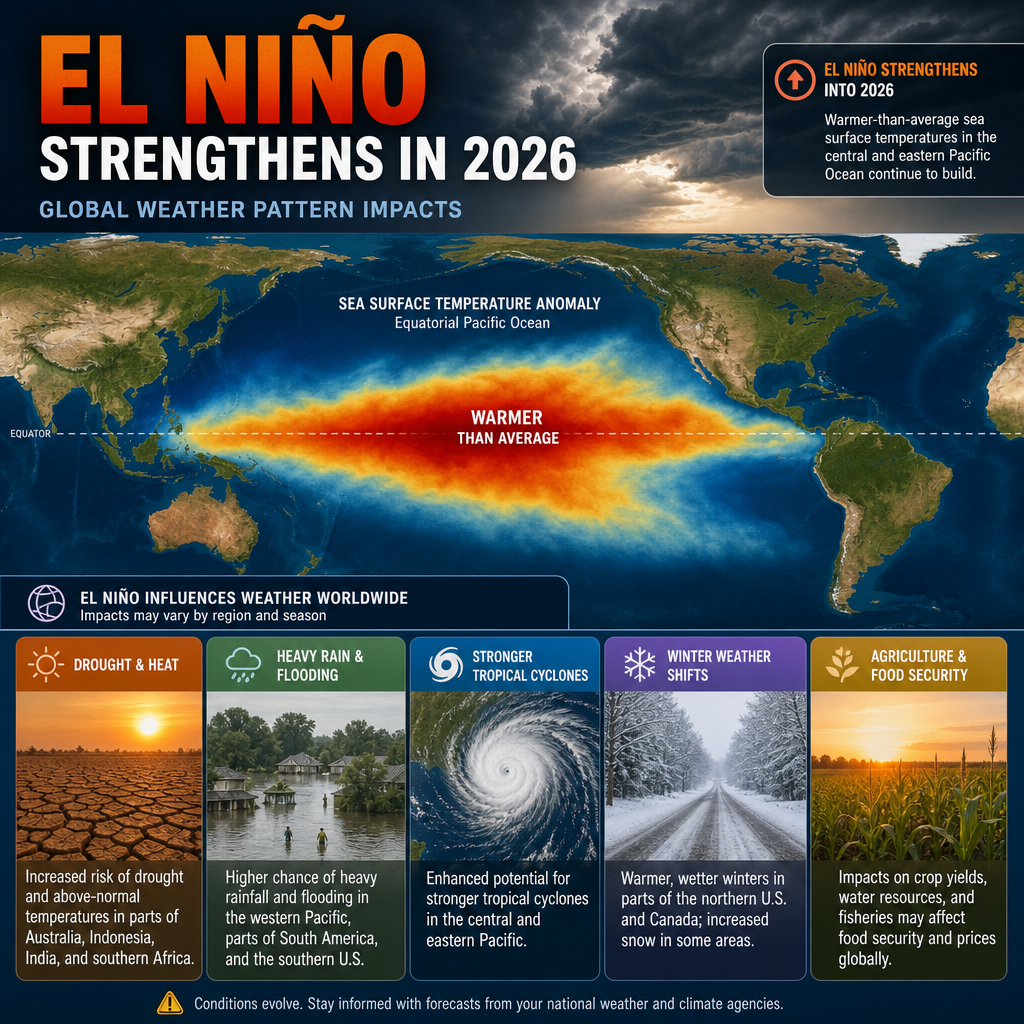
El Niño conditions are expected to strengthen in 2026, and that could mean major shifts in weather around the world. From heavier rains in some regions to worsening drought in others, the coming months may bring challenges for communities, farmers, and emergency planners alike.
By: Peter on July 27, 2026
El Niño is one of the most influential climate patterns on Earth, and when it strengthens, its effects can ripple across continents. In 2026, a stronger-than-normal El Niño is expected to reshape weather conditions in many parts of the world, bringing wetter seasons to some regions, harsher drought to others, and heightened risks for agriculture, water supplies, and disaster preparedness.
Although El Niño originates in the tropical Pacific Ocean, its influence reaches far beyond that region. It can alter jet streams, shift storm tracks, and change rainfall and temperature patterns on a global scale. Understanding how a stronger El Niño works—and what it may mean in 2026—can help governments, businesses, and individuals prepare for the months ahead.
What Is El Niño?
El Niño is the warm phase of the El Niño-Southern Oscillation, often shortened to ENSO. It occurs when sea surface temperatures in the central and eastern equatorial Pacific Ocean become warmer than average for an extended period.
This warming may sound limited to one region, but it disrupts the normal interaction between ocean and atmosphere. Trade winds weaken, warm water spreads eastward, and the atmospheric circulation above the Pacific shifts. Those changes influence weather systems around the world.
The basic ENSO cycle
ENSO has three main phases:
El Niño: warmer-than-average Pacific waters
La Niña: cooler-than-average Pacific waters
Neutral: temperatures near average
El Niño events happen every few years, but their intensity varies. Some are weak and have modest effects. Others, like the powerful events of 1997–98 and 2015–16, caused severe global disruptions. A strengthening El Niño in 2026 could create a similar, though not identical, pattern of impacts.
Why a Stronger El Niño Matters in 2026
A stronger El Niño does not simply mean more heat in one ocean basin. It changes the movement of heat and moisture through the atmosphere. The result is a domino effect on rainfall, temperature, storm intensity, and seasonal extremes.
In 2026, a strengthening El Niño could matter even more because the world is already warmer than in past decades. That baseline warming can amplify the effects of natural climate variability. In practical terms, this means some regions may experience more intense heat waves, heavier rainfall, or prolonged dry periods than they would have under the same El Niño conditions in the past.
The role of a warmer world
Global warming does not cause El Niño, but it can intensify the outcomes associated with it. For example:
Warmer air holds more moisture, increasing the chance of heavy rain and flooding.
Hotter baseline temperatures can worsen heat stress during dry periods.
Changing ocean temperatures can affect tropical cyclone behavior.
Drought conditions can become more severe when rainfall is already below average.
This is why a strong El Niño in 2026 is not just another weather event. It is likely to interact with broader climate trends, creating complex and sometimes extreme conditions.
Global Weather Patterns Likely to Shift
The effects of El Niño are not uniform. Some regions get wetter, others drier, and some experience temperature swings that are more dramatic than usual. Below are the broad patterns most commonly associated with a strengthening El Niño.
1. Wetter conditions in parts of the Americas
One of the best-known El Niño signals is increased rainfall in parts of the southern United States, Central America, and the west coast of South America.
Southern United States
During stronger El Niño events, the southern U.S. often sees:
More frequent rainstorms
Cooler-than-average winter temperatures
Reduced likelihood of some types of drought
States such as California, Texas, Louisiana, and Florida may experience more active storm patterns, especially in winter. In some years, this can help replenish reservoirs and soil moisture. But it can also bring flooding, landslides, and infrastructure damage.
Peru and Ecuador
On the opposite side of the Pacific, coastal areas of Peru and Ecuador are often vulnerable to heavy rainfall and flooding during strong El Niño events. Warm waters along the eastern Pacific fuel moisture-rich air, which can lead to:
Flash flooding
River overflow
Damage to roads and homes
Disruptions to fisheries and agriculture
For countries in this region, stronger El Niño conditions can be especially disruptive because they may arrive after periods of relative dryness, making the land less able to absorb intense rain.
2. Drier conditions in Australia and parts of Southeast Asia
El Niño is often linked to reduced rainfall in Australia, Indonesia, and nearby parts of Southeast Asia. A stronger event in 2026 could deepen drought risk across these regions.
Australia
Australia is particularly sensitive to El Niño because it can suppress rainfall over large areas. Effects may include:
Dry soils and water shortages
Increased bushfire danger
Heat waves becoming more intense
Agricultural losses for crops and livestock
Farmers may need to adapt quickly to lower rainfall during critical growing seasons. Water managers may also face difficult decisions about storage and allocation.
Indonesia and neighboring regions
In Indonesia, Malaysia, and parts of the Philippines, El Niño often brings:
Lower-than-normal rainfall
Hotter weather
Greater wildfire risk, including peatland fires
Stress on food and water systems
A strong El Niño can create haze and air-quality problems due to widespread burning, affecting public health and regional transportation.
3. Altered storm behavior in the Atlantic and Pacific
El Niño can also influence the frequency and strength of tropical cyclones. In many years, it tends to suppress Atlantic hurricane activity while enhancing cyclone activity in the central and eastern Pacific.
Atlantic hurricanes
A stronger El Niño usually increases upper-level wind shear over the Atlantic. Wind shear can tear apart developing storms, making it harder for hurricanes to form and intensify. As a result, the Atlantic hurricane season may be less active than in neutral or La Niña years.
However, “less active” does not mean “safe.” Even a quieter season can still produce devastating storms if one makes landfall in a vulnerable location.
Eastern Pacific cyclones
In contrast, the eastern Pacific may see more active tropical cyclone development during El Niño. Some storms may remain over open water, but others can affect Mexico and parts of Central America with heavy rain and flooding.
Seasonal Weather Changes by Region
To understand the 2026 El Niño more clearly, it helps to look at likely seasonal effects across major regions.
North America
In North America, a stronger El Niño often shifts the jet stream southward, changing winter storm tracks.
Common outcomes may include:
Wetter winters across the southern U.S.
Milder winter temperatures in the northern U.S. and parts of Canada
Increased snow in some mountainous regions if temperatures stay cold enough
Reduced wildfire risk in some dry areas, but greater flooding risk in others
For example, cities like Los Angeles or Houston may see more rain than usual, while parts of the Pacific Northwest may not get the same pattern of storm enhancement seen in other climate phases.
South America
South America often experiences some of the most dramatic El Niño effects.
Likely patterns include:
Heavy rain in Peru and Ecuador
Flooding in coastal and low-lying areas
Drier conditions in parts of Brazil, Colombia, and Venezuela
Impacts on coffee, soy, and other agricultural exports
In regions dependent on seasonal rainfall, even a modest shift can affect planting schedules, harvest timing, and water availability.
Europe and Africa
El Niño does not affect Europe as directly as it does the Pacific or the Americas, but it can still influence weather patterns through broader atmospheric connections. Impacts may be subtle and vary by season.
In parts of Africa, especially southern and eastern regions, El Niño can have stronger consequences. Some areas may become drier, increasing drought and food insecurity risks. Others may see unusual rainfall patterns that challenge farming and water management.
Asia
Asia is a large and complex region, so El Niño impacts are not uniform. Still, some broad trends are often observed:
South Asia: monsoon rainfall can be reduced in some El Niño years, affecting agriculture and water supply
Southeast Asia: higher drought and fire risk
East Asia: temperature and precipitation shifts may vary by season, with some regions seeing unusual winter patterns
Because millions of people depend on monsoon rainfall for food production, any El Niño-related weakening of the monsoon can have major socioeconomic consequences.
Agriculture, Water, and Food Security Risks
El Niño is more than a weather story. It can become a food and water story very quickly.
Agriculture
Farmers are often among the first to feel the effects of El Niño. Changes in rainfall and temperature can influence:
Soil moisture
Crop planting dates
Pest and disease pressure
Irrigation demand
Harvest yields
For instance, drought in Australia or Southeast Asia may reduce rice, wheat, or corn production. Meanwhile, excess rain in South America can delay harvests, damage fields, or lower crop quality.
Water supplies
Reservoirs, rivers, and groundwater systems depend on seasonal rainfall. El Niño can either strain or temporarily improve water supplies depending on the region. In areas facing drought, municipalities may need to impose water restrictions or adjust long-term planning.
Food prices
When weather disrupts major agricultural regions, global food prices can rise. Even if shortages are localized, commodity markets can react quickly. This means consumers far from the affected areas may still feel the impact through higher prices for staples such as grains, cooking oils, and livestock feed.
Public Health and Disaster Preparedness
A stronger El Niño in 2026 may also affect human health and emergency response systems.
Health risks
Weather-related health concerns may include:
Heat stress and dehydration
Flood-related injuries and waterborne disease
Respiratory problems from wildfire smoke
Increased mosquito-borne illness in some regions after heavy rains
Public health systems may need to prepare for both extremes: dry heat in one place and dangerous flooding in another.
Infrastructure and emergency planning
Governments and local authorities may need to strengthen preparedness in areas likely to be affected by El Niño-driven weather extremes. That can include:
Checking drainage systems before heavy rains
Managing reservoirs during drought
Preparing evacuation routes for flood-prone zones
Updating wildfire response plans
Communicating risks early to residents
A strong El Niño provides a window of warning, which is valuable. Unlike sudden disasters, its effects often develop over weeks and months, giving decision-makers time to act.
How to Stay Informed and Prepared
Individuals and communities can take practical steps to reduce risk during an El Niño year.
For households
Monitor seasonal forecasts from trusted weather agencies
Review flood, heat, and wildfire preparedness plans
Check insurance coverage for weather-related damage
Store emergency supplies, including water and medications
Reduce water use if drought conditions are likely
For businesses
Assess supply chain vulnerabilities linked to weather disruptions
Plan for transportation delays and crop shortages
Protect facilities from flooding or extreme heat
Review employee safety protocols for hot or smoky conditions
For farmers and land managers
Adjust planting schedules if needed
Consider drought-tolerant crop varieties
Improve soil moisture retention through conservation practices
Monitor pest outbreaks and disease patterns
Coordinate with agricultural extension services and local weather agencies
Frequently Asked Questions
1. Has El Niño officially developed in 2026?
Yes. NOAA confirmed that El Niño conditions were present in July 2026 and reported that the event was continuing to strengthen.
2. How long is the 2026 El Niño expected to last?
NOAA estimates a 97% probability that El Niño will continue through the Northern Hemisphere’s early spring of 2027.
3. How strong could the 2026 El Niño become?
NOAA’s July 2026 outlook indicated an 81% probability of a very strong El Niño during the October–December period. Forecasts may still change as ocean and atmospheric conditions develop.
4. Does a strong El Niño guarantee extreme weather in every region?
No. El Niño changes the probability of particular weather patterns, but it does not guarantee that every region will experience its typical effects. Other oceanic and atmospheric conditions also influence local weather.
5. Which regions may experience the most significant effects?
Official seasonal outlooks indicate increased rainfall risk across the central and eastern equatorial Pacific, while parts of Australia, the Indian subcontinent, and the tropical Indian Ocean may experience below-normal rainfall. Regional impacts will depend on the season and local conditions.
A stronger El Niño in 2026 could reshape weather patterns around the world, from heavy rain in the Americas to drought in Australia and Southeast Asia. It may also alter storm activity, strain agriculture and water systems, and increase risks tied to heat, flooding, and wildfire.
While El Niño is a natural climate pattern, its effects can be amplified by a warming planet. That makes preparation more important than ever. By paying attention to seasonal forecasts, understanding regional risks, and taking early action, communities can better withstand the challenges ahead.
Peter B holds a degree in Journalism and has 5 years
of experience covering U.S. economic policy, labor markets, and
financial news. He writes data-driven news content on topics
like inflation, interest rates, and employment trends.