LIHEAP 2026 Income Eligibility for Heating and Cooling Bill Help
Wondering if you qualify for help with energy costs this year? LIHEAP income eligibility for 2026 depends on factors like household size and gross income, and this guide explains what to expect before you apply.
By: Emilly Adams on July 28, 2026
Energy bills can strain any household budget, especially when temperatures climb in summer or drop in winter. For many families, LIHEAP—the Low Income Home Energy Assistance Program—can provide meaningful relief by helping cover heating and cooling costs. If you’re trying to understand LIHEAP 2026 income eligibility, this guide breaks down how the program works, who may qualify, what income limits usually look like, and how to prepare an application.
While exact rules can vary by state, LIHEAP remains one of the most important federal energy assistance programs in the United States. Knowing the basics can help you determine whether your household may qualify and what to expect when applying.
What Is LIHEAP?
LIHEAP is a federally funded program that helps eligible households pay home energy costs. In most states, LIHEAP assistance may be used for:
Heating bills in the winter
Cooling bills in the summer
Utility bill payment assistance
Emergency energy assistance
In some cases, weatherization or energy-related home improvements
Each state, territory, and tribal grantee administers its own LIHEAP program, which means benefits, application timelines, and eligibility rules are not identical everywhere. However, income eligibility is a major part of the process across all programs.
How LIHEAP Income Eligibility Works in 2026
LIHEAP income eligibility is generally based on your household’s gross income, household size, and sometimes other factors such as energy burden or vulnerability. The federal government sets broad guidelines, but local agencies decide how to apply them.
For 2026, most LIHEAP programs will likely continue using income limits tied to a percentage of the Federal Poverty Level (FPL) or the State Median Income (SMI). In practice, this means your eligibility depends on how much money your household earns compared with the number of people living in your home.
Common Income Thresholds
Many LIHEAP programs use one of these standards:
Up to 150% of the Federal Poverty Level
Up to 60% of State Median Income
In some cases, a higher threshold if the state chooses to expand eligibility
Because LIHEAP is administered locally, the income limit for a family of four in one state may be different from the limit in another state.
Why Household Size Matters
A household of one person has a much lower income threshold than a household of five or more. This is because LIHEAP recognizes that larger households have greater energy needs and different financial pressures.
For example:
A single adult may qualify at a lower annual income than a family of four
A senior living alone may have a different limit than a household with children
Shared living arrangements may require careful review to determine who counts as part of the household
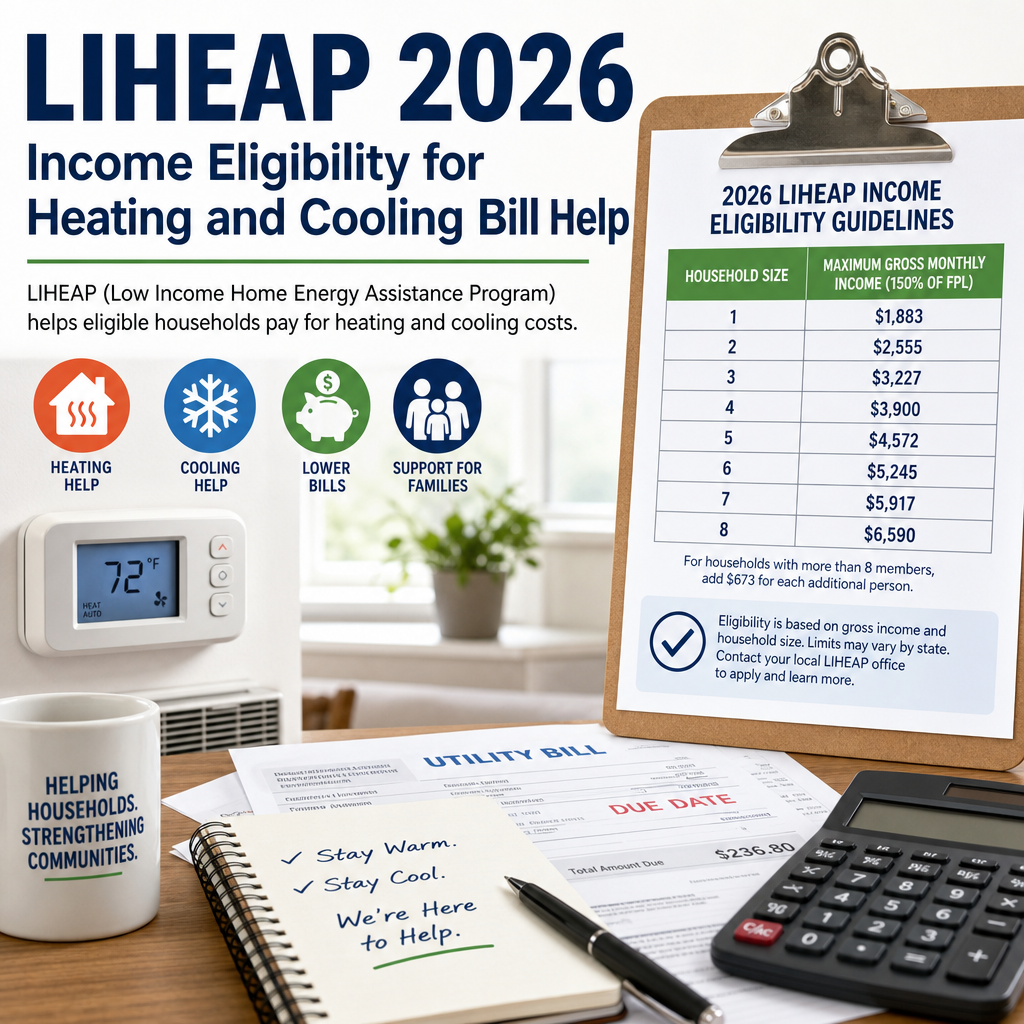
Typical LIHEAP 2026 Income Limits
Exact 2026 limits may not be finalized until states update their program rules, but LIHEAP income eligibility usually follows annual adjustments based on poverty guidelines and median income levels.
Example of How Eligibility May Be Calculated
If a state uses 150% of the Federal Poverty Level, a household’s income limit might look something like this:
1 person: lower annual limit
2 people: higher annual limit
3 people: higher still
4 people: even higher
Additional members: increase by set amounts
If a state uses State Median Income, the numbers may be different and sometimes more generous.
Important Note About Gross Income
Most LIHEAP programs look at gross income, not take-home pay. Gross income is the amount before taxes and deductions. This can include:
Wages and salaries
Social Security benefits
Unemployment benefits
Pension income
Child support in some cases
Self-employment income
Veterans benefits
Certain disability payments
Because gross income is used, some households that feel “tight on money” may still appear over the limit, while others with modest earnings may qualify.
Who Can Qualify for LIHEAP?
LIHEAP is designed to help low-income households, but income is only one part of eligibility. Most programs also require that you:
Live in the state or service area where you apply
Be responsible for home heating or cooling costs
Meet income requirements
Provide documentation of identity, residency, and income
Some states give priority to households with:
Older adults
Young children
People with disabilities
Households with very high energy burdens
Families facing shutoff notices or heating emergencies
Heating Assistance vs. Cooling Assistance
LIHEAP is often associated with winter heating help, but many states also offer summer cooling assistance. This matters a lot in warmer regions where air conditioning is essential for safety and health.
Heating Assistance
Heating assistance may help with:
Natural gas bills
Electric heating bills
Propane
Heating oil
Wood or pellet fuel
Furnace repair or replacement in some cases
Cooling Assistance
Cooling assistance may help with:
Electric bills during heat waves
Air conditioning costs
Fan or cooling equipment support in some programs
Emergency assistance for households at risk from extreme heat
Not every state offers both benefits in the same way, so it’s important to check the local LIHEAP program rules for 2026.
Other Factors That Can Affect Eligibility
Although income is the main requirement, other details can affect whether you qualify and how much help you receive.
1. Household Composition
A household typically includes everyone who lives together and shares expenses. However, certain people may or may not count depending on the program rules. For example, a college student who lives at home part-time may be treated differently from a full-time resident.
2. Utility Responsibility
You usually need to show that you pay the energy bill or are responsible for home heating or cooling costs. Renters may qualify if utilities are included in rent or if they pay separate utility bills.
3. Type of Fuel Used
Some LIHEAP programs prioritize households using certain fuels, especially those with higher heating costs like propane, fuel oil, or delivered fuels. Others may focus on electricity or gas assistance.
4. Crisis Situations
Emergency LIHEAP may be available if you have:
A utility shutoff notice
A broken heating system
Low fuel or no fuel in the tank
An imminent risk to health and safety
These situations may have faster processing and different documentation requirements.
How to Check If You Meet the Income Rules
The easiest way to estimate your eligibility is to compare your household’s gross monthly or annual income to your state’s LIHEAP limit.
Step 1: Count Your Household Members
Include everyone who lives in the home and shares financial responsibility, according to your local program rules.
Step 2: Add Gross Income
Add together income from all sources for everyone in the household who must be counted.
Step 3: Find Your State’s LIHEAP Limits
Look for your state or territory’s LIHEAP income chart. These are often published by:
State human services agencies
Energy assistance offices
Community action agencies
Local LIHEAP administrators
Step 4: Compare Your Income to the Chart
If your household income is at or below the published limit, you may qualify.
Step 5: Review Additional Rules
Even if you pass the income test, you still need to meet residency and utility-related requirements.
Example Scenarios
Here are a few simple examples to show how income eligibility may work.
Example 1: Single Adult Renter
Maria lives alone and pays her electric bill directly. She works part-time and receives a small amount of Social Security income. Her gross annual income falls below her state’s limit for one-person households, so she may qualify for LIHEAP cooling assistance in the summer.
Example 2: Family of Four
James and Tasha have two children and pay natural gas bills in the winter. James works full-time, and Tasha is a part-time caregiver. Their combined gross household income is close to the limit for a family of four, but still under the state threshold. They may qualify for heating assistance.
Example 3: Senior Couple Facing High Utility Costs
An older couple living on Social Security and a modest pension has difficulty paying winter heating bills. Even though they own their home, their limited income may make them eligible for assistance, especially if their state prioritizes elderly households.
Example 4: Household Above Income Limit but Facing Crisis
A family may earn too much for standard assistance but still face an emergency shutoff notice. Some states offer crisis assistance or hardship exceptions, so it is still worth checking local rules.
Documents You May Need to Apply
When applying for LIHEAP in 2026, most programs will ask for documentation to verify your household size, income, and utility situation. Common documents include:
Photo ID
Social Security numbers or identification for household members
Proof of address
Recent utility bills
Lease agreement or mortgage statement
Pay stubs or income statements
Benefit award letters for Social Security, SSI, SNAP, TANF, or unemployment
Proof of disability or age, if relevant
Shutoff notice or fuel delivery invoice for emergency cases
Having these ready can speed up the application process.
How and When to Apply
LIHEAP application windows vary by state. Some programs open in the fall for winter heating assistance, while others run year-round or have separate seasons for heating and cooling benefits.
Where to Apply
You may be able to apply through:
Your state LIHEAP office
A local community action agency
County human services offices
Online application portals
In-person appointment centers
Mail-in applications
Why You Should Apply Early
Funds are limited, and some programs operate on a first-come, first-served basis. Applying early can help you avoid delays, especially during peak winter or summer demand.
What If Your Income Is Slightly Over the Limit?
If your income is just above the threshold, don’t assume you’re automatically out. Some states offer:
Crisis-only benefits
Priority assistance for vulnerable households
Expanded eligibility during emergencies
Separate weatherization or energy-saving services
Also, income may be calculated over a specific period, such as the last 30 days or the previous month, depending on the program. That means your eligibility may shift if your earnings have recently changed.
Tips for a Stronger LIHEAP Application
A complete and accurate application can help prevent delays or denials.
Helpful Tips
Review your state’s income chart before applying
Make sure all income sources are included
Submit recent documents
Confirm your utility account information matches your application
Respond quickly to requests for additional paperwork
Keep copies of everything you submit
If your application is denied, ask the local office for the reason. You may be able to correct an error, provide missing documents, or appeal the decision.
LIHEAP and Other Energy Help Programs
LIHEAP is not the only source of assistance. Depending on where you live, you may also qualify for:
Utility company payment plans
State emergency rental assistance programs
Weatherization assistance
Local charity energy funds
Supplemental benefits through senior or disability programs
Combining resources can make it easier to manage bills throughout the year.
Frequently Asked Questions
1. What is LIHEAP and what expenses can it cover?
LIHEAP is a federally funded program that helps eligible households manage home energy costs. Depending on the local program, assistance may cover heating bills, cooling expenses, utility emergencies, fuel deliveries, or certain energy-related repairs.
2. What income limits apply to LIHEAP in 2026?
Income limits vary by state, territory, or tribal program. Administrators generally establish eligibility using federal poverty guidelines, state median income, or another approved standard. Applicants should check the limits published by their local LIHEAP office.
3. Does LIHEAP use gross or net household income?
Many LIHEAP programs evaluate gross household income before taxes and deductions. However, the income sources counted, verification period, and permitted exclusions can differ, so applicants must follow their local program’s rules.
4. Can renters qualify for LIHEAP assistance?
Yes. Renters may qualify whether they pay their energy bills directly or have energy costs included in their rent. The local agency may request utility bills, a lease, or documentation explaining how energy expenses are paid.
5. What should someone do when facing a utility shutoff?
A household facing disconnection, loss of fuel, or another energy emergency should contact its local LIHEAP office immediately and ask about crisis assistance. A shutoff notice, utility bill, identification, income documentation, and proof of residence may be required.
LIHEAP can be a valuable lifeline for households struggling with home energy costs, and LIHEAP 2026 income eligibility will continue to be based largely on household size, gross income, and state-specific program rules. While exact limits vary, many programs follow poverty-level or median-income guidelines and may give priority to families with seniors, children, disabilities, or urgent utility needs.
If you think you may qualify, start by checking your state’s income chart, gathering your documents, and applying as early as possible. A few minutes of preparation could lead to meaningful help with heating and cooling bills when you need it most.
Emily A, holds a Master's degree in Public Administration (MPA) and has over 7 years of experience researching federal and state assistance programs. She writes educational content focused on government benefits, public policy, and community resources, using information from official agencies to help readers understand available programs and eligibility requirements.