2026 Federal Poverty Guidelines: Income Levels for Benefit Eligibility
Every year, millions of people in the United States interact with government programs that use income as part of their eligibility rules. One of the most important reference points for those programs is the Federal Poverty Guidelines. These guidelines are a simplified measure of income that help determine who qualifies for certain benefits, discounts, and assistance programs.
For 2026, the Federal Poverty Guidelines continue to play a central role in decisions about health coverage, food assistance, legal aid, childcare support, and other forms of public and nonprofit aid. While they are often confused with the Federal Poverty Level or the Census Bureau’s poverty thresholds, the guidelines are a separate tool created specifically for administrative use.
Understanding how these income levels work can help families estimate whether they may qualify for help and plan for applications more confidently.
What Are the Federal Poverty Guidelines?
The Federal Poverty Guidelines are income limits issued each year by the U.S. Department of Health and Human Services (HHS). They are based on the prior year’s poverty thresholds and are adjusted annually for inflation.
These guidelines are primarily used to determine eligibility for many federal programs. In simple terms, they tell agencies and organizations whether a household’s income is low enough to qualify for assistance.
A few important things to know:
- They are updated every year.
- They vary by household size.
- They are usually higher in Alaska and Hawaii because of higher living costs.
- They are often used as a percentage, such as 100%, 133%, 150%, 200%, or 400% of poverty.
Because many benefit programs set eligibility at a percentage of the guideline rather than a fixed number, the guidelines are more flexible than a single cutoff.
Why the 2026 Guidelines Matter
The 2026 guidelines are important because they serve as a benchmark for a wide range of programs. If your income is near one of these cutoffs, the difference of even a few hundred dollars can affect whether you qualify for assistance.
These guidelines matter for:
- Medicaid and marketplace health coverage
- CHIP and children’s health programs
- SNAP in some contexts
- Head Start and early childhood programs
- legal aid and civil assistance
- housing and utility assistance
- subsidized childcare
- certain nonprofit and state-based assistance programs
For many households, this annual update can change access to benefits. A family that qualified one year may no longer qualify the next if income rises, and a family whose income stayed flat may still be affected if the guidelines increase.
How the Guidelines Are Used
The Federal Poverty Guidelines are not a single universal rule. Instead, programs choose how to apply them. Some use the exact guideline amount, while others use a percentage of it.
Common percentage levels
Here are some common ways the guidelines are used:
- 100% of poverty: Often used as a baseline for assistance or eligibility
- 133% of poverty: Common in Medicaid-related rules in some states
- 138% of poverty: Used in many states for Medicaid expansion eligibility
- 150% of poverty: Sometimes used for reduced-cost programs or fee waivers
- 200% of poverty: Used for sliding-scale programs and nonprofit aid
- 250% or 400% of poverty: Common in some health insurance subsidy calculations or special programs
The exact percentage that matters depends on the benefit program. That is why two families with the same income may be treated differently depending on the type of help they seek.
2026 Federal Poverty Guideline Income Levels
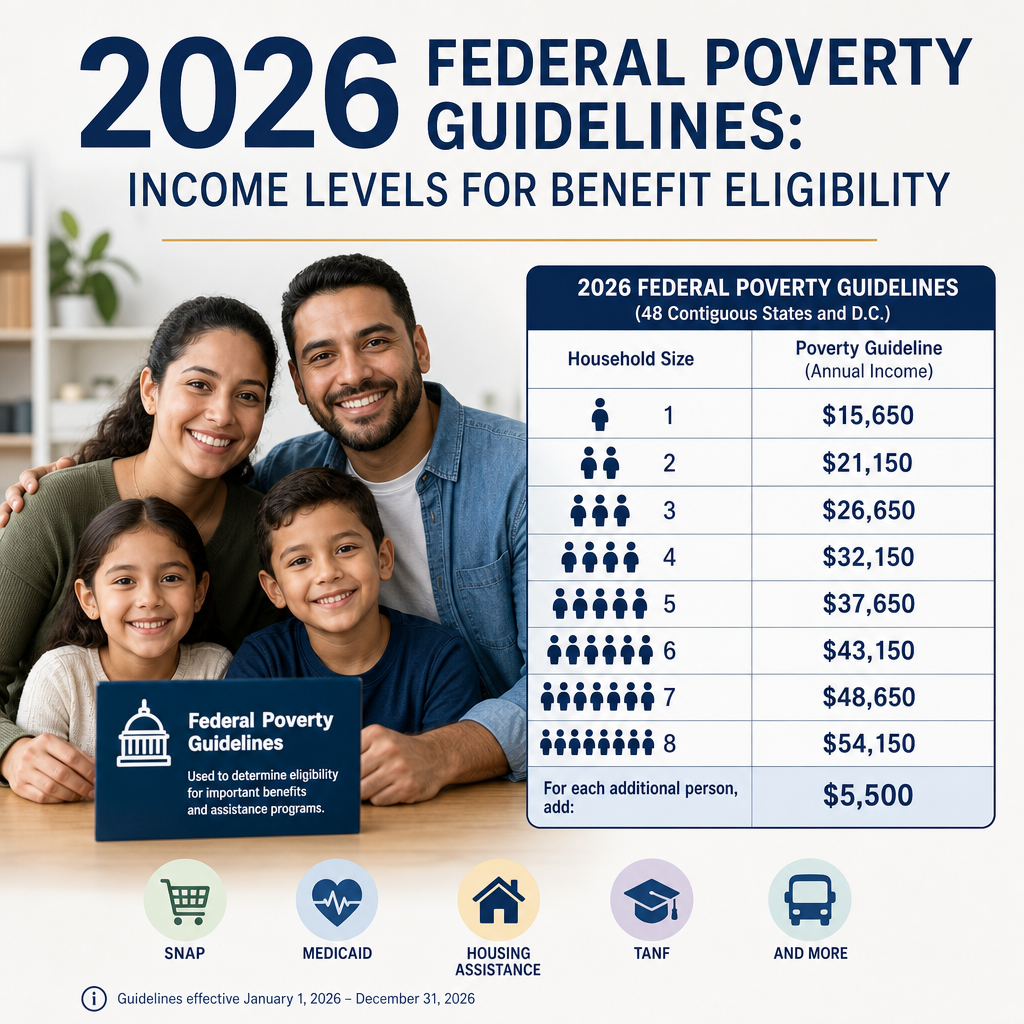
The Federal Poverty Guidelines are based on household size. In most of the contiguous United States and Washington, D.C., the 2026 annual amounts are used as a basic reference point for one-person through eight-person households, with an added amount for each additional person.
For most households in the 48 contiguous states and D.C., the 2026 guideline amounts are as follows:
| Household Size | 2026 Poverty Guideline |
|---|---|
| 1 | $15,650 |
| 2 | $21,150 |
| 3 | $26,650 |
| 4 | $32,150 |
| 5 | $37,650 |
| 6 | $43,150 |
| 7 | $48,650 |
| 8 | $54,150 |
| Each additional person | +$5,500 |
These numbers are the standard annual income amounts used for most of the country.
Alaska and Hawaii
Because living costs are higher in Alaska and Hawaii, separate guideline levels are used there.
For 2026:
- Alaska has higher guideline amounts than the continental U.S.
- Hawaii also has higher guideline amounts than the continental U.S., though generally less than Alaska
If a program uses the Federal Poverty Guidelines, it will usually specify which table applies based on where the household lives.
Examples of Eligibility Based on Household Income
To understand the guidelines better, it helps to see how they work in real situations.
Example 1: Single adult
A single adult living in the contiguous U.S. has a 2026 poverty guideline of $15,650.
If a local nonprofit uses eligibility at 150% of poverty, the income limit would be:
- $15,650 × 1.5 = $23,475
That means the person could qualify if their annual income is below or at $23,475, depending on the program’s rules.
Example 2: Family of four
A family of four has a guideline of $32,150.
If a childcare assistance program uses 200% of poverty, the limit would be:
- $32,150 × 2.0 = $64,300
A household earning $62,000 could qualify, while a household earning $66,000 would not.
Example 3: Household of six
A family of six has a guideline of $43,150.
At 138% of poverty, the income cutoff would be:
- $43,150 × 1.38 = $59,517
This type of calculation is commonly used in some health coverage determinations.
Poverty Guidelines vs. Poverty Thresholds
It is easy to confuse the Federal Poverty Guidelines with the poverty thresholds, but they are not the same thing.
Poverty thresholds
- Created by the U.S. Census Bureau
- Used mainly for statistical purposes
- Help measure poverty rates in the United States
- Based on family size and composition
Federal Poverty Guidelines
- Issued by HHS
- Used for administrative and eligibility purposes
- Applied by federal, state, and local programs
- Simpler and easier for agencies to use
In short, the thresholds help researchers measure poverty, while the guidelines help agencies decide who qualifies for assistance.
Who Uses the 2026 Guidelines?
Many programs rely on the Federal Poverty Guidelines in some way. While exact rules vary, the guidelines are often referenced by:
- Medicaid and CHIP
- Marketplace health insurance subsidies
- Head Start
- School meal-related programs
- Housing assistance
- Energy assistance programs
- Immigration fee waivers
- Legal aid organizations
- Community health clinics
- Charitable assistance programs
Some programs use income before taxes, while others consider adjusted gross income or count only certain household members. That means the guideline number is only one part of eligibility. The way income is measured can matter just as much as the amount itself.
How Household Size Affects Eligibility
Household size is a critical part of the calculation. The larger the household, the higher the income limit.
This is important because a family of four does not have the same guideline as a single adult. Programs assume larger households need more income to meet basic needs.
A few practical examples:
- A single adult at $22,000 may be above 100% of poverty but below 150%
- A family of four at $60,000 may be above 100% and 150% but still under 200%
- A household of six may qualify with income that would be too high for a smaller family
When applying for benefits, always make sure the program is counting household members the way you expect. Some programs include all people in the home, while others count only tax dependents or people who share financial responsibility.
Common Mistakes People Make
Many people lose time or miss benefits because they misunderstand how the guidelines work.
1. Using the wrong household size
Not every program defines household size the same way. For example, tax household, insurance household, and SNAP household can differ.
2. Confusing gross income and net income
Some programs use gross income before taxes, while others use net income after deductions.
3. Assuming one rule applies everywhere
A program in one state may use 138% of poverty, while another uses 200% or a different calculation entirely.
4. Forgetting about Alaska and Hawaii
The higher cost-of-living tables can make a major difference for residents there.
5. Not checking annual updates
Because the guidelines are updated each year, eligibility can shift even if your income stays the same.
How to Estimate Your Eligibility
If you want to estimate whether your household may qualify for a program using the 2026 Federal Poverty Guidelines, follow these steps:
- Find your household size
Determine how many people the program counts in your household. - Identify the correct guideline table
Use the contiguous U.S., Alaska, or Hawaii table. - Check the percentage used by the program
Common levels include 100%, 133%, 150%, 200%, and 400%. - Multiply the poverty guideline by the percentage
For example, if the guideline is $32,150 and the program uses 150%, multiply by 1.5. - Compare your income with the cutoff
Make sure you know whether the program uses gross income, net income, or another measure.
This simple process can give you a strong estimate before you apply.
Why These Guidelines Are Important Beyond Government Aid
Although they are most often associated with government programs, the Federal Poverty Guidelines also affect many private and nonprofit services. Community organizations, hospitals, universities, and charities sometimes use these figures to create sliding-scale fees or determine whether someone qualifies for reduced-cost services.
For example:
- A clinic may offer discounted care to households below 200% of poverty
- A legal aid office may prioritize applicants under 125% of poverty
- A utility assistance program may use 150% or 200% of poverty as a cutoff
- A nonprofit may use the guidelines to set scholarship or hardship criteria
This makes the guidelines relevant far beyond traditional public benefits.
What to Do If Your Income Is Close to the Limit
If you are near a cutoff, do not assume you are ineligible. Many programs have deductions, exceptions, or alternative ways to qualify. In some cases, additional household members, medical expenses, childcare costs, or disability-related expenses may affect the calculation.
You may also qualify for:
- partial benefits
- temporary assistance
- other programs with higher income limits
- state or local programs with different rules
Because eligibility rules vary, it is worth applying or asking for a full screening if you are close to the line.
Frequently Asked Questions
1. What are the Federal Poverty Guidelines?
The Federal Poverty Guidelines are income figures issued annually by the U.S. Department of Health and Human Services. Government agencies and other organizations use them to help determine eligibility for certain assistance programs.
2. Do the poverty guidelines vary according to household size?
Yes. The guideline increases as the number of people in the household grows. Separate amounts also apply to Alaska and Hawaii, while the 48 contiguous states and Washington, D.C., use the same standard table.
3. How do programs use percentages of the poverty guidelines?
Programs may establish income limits at percentages such as 100%, 138%, 150%, or 200% of the applicable guideline. The relevant percentage and method of counting income depend on the rules of each program.
4. Are poverty guidelines and poverty thresholds the same?
No. HHS poverty guidelines are simplified figures primarily used for administrative eligibility decisions. Census Bureau poverty thresholds are more detailed and are mainly used to calculate official poverty statistics.
5. Does being below a poverty guideline guarantee eligibility for benefits?
No. Each program has its own requirements for household composition, residency, income calculation, assets, and other factors. Applicants should use the guidelines as an initial estimate and confirm eligibility directly with the program.
Official Resources
- U.S. Department of Health and Human Services: Poverty Guidelines
- HealthCare.gov: Federal Poverty Level Explained
- HealthCare.gov: Income Levels and Health Coverage Savings
- HealthCare.gov: Medicaid Expansion and Income Eligibility
- U.S. Census Bureau: How Poverty Is Measured
Conclusion
The 2026 Federal Poverty Guidelines are an important income measure used to decide eligibility for many kinds of assistance. They are based on household size, adjusted each year, and often used as percentages depending on the program. Whether someone is applying for health coverage, childcare help, legal aid, or another benefit, these guidelines provide a common reference point for determining need.
If you understand your household size, know which table applies, and identify the percentage used by a program, you can better estimate whether you qualify. For many families, that knowledge can make the difference between missing out on help and accessing support that improves stability and security.