Bond Duration: How Interest Rate Changes Affect Bond Prices
Bond duration helps you see how strongly a bond’s price may react when interest rates change, making it a key tool for managing interest rate risk. Whether you’re investing for income or stability, understanding duration can help you choose bonds that better match your goals.
By: Sarah Mitchell on July 28, 2026
If you invest in bonds, you’ve probably heard that bond duration matters when interest rates move. But duration is more than just a technical term—it’s one of the most useful tools for understanding how much a bond’s price may rise or fall when market interest rates change.
For investors building a portfolio for income, stability, or diversification, understanding bond duration can help you make smarter decisions. It can show you why some bonds react sharply to rate changes while others move more slowly, and why longer maturities are not always the only factor that matters.
What Is Bond Duration?
Bond duration is a measure of how sensitive a bond’s price is to changes in interest rates. In simple terms, it estimates how much a bond’s value may change when rates go up or down.
Many investors think duration only means time, but that’s only part of the picture. Duration reflects both:
The bond’s time until payments are received
The size and timing of those payments
Because of that, duration is often a better measure of interest rate risk than maturity alone.
Duration vs. Maturity
These two terms are related, but they are not the same:
Maturity is the date when the bond’s principal is repaid.
Duration measures price sensitivity to rate changes.
A bond with a long maturity usually has a longer duration, but not always. For example, a bond that pays a high coupon has cash flows returned sooner, which can reduce duration compared with a lower-coupon bond of the same maturity.
Why Bond Duration Matters
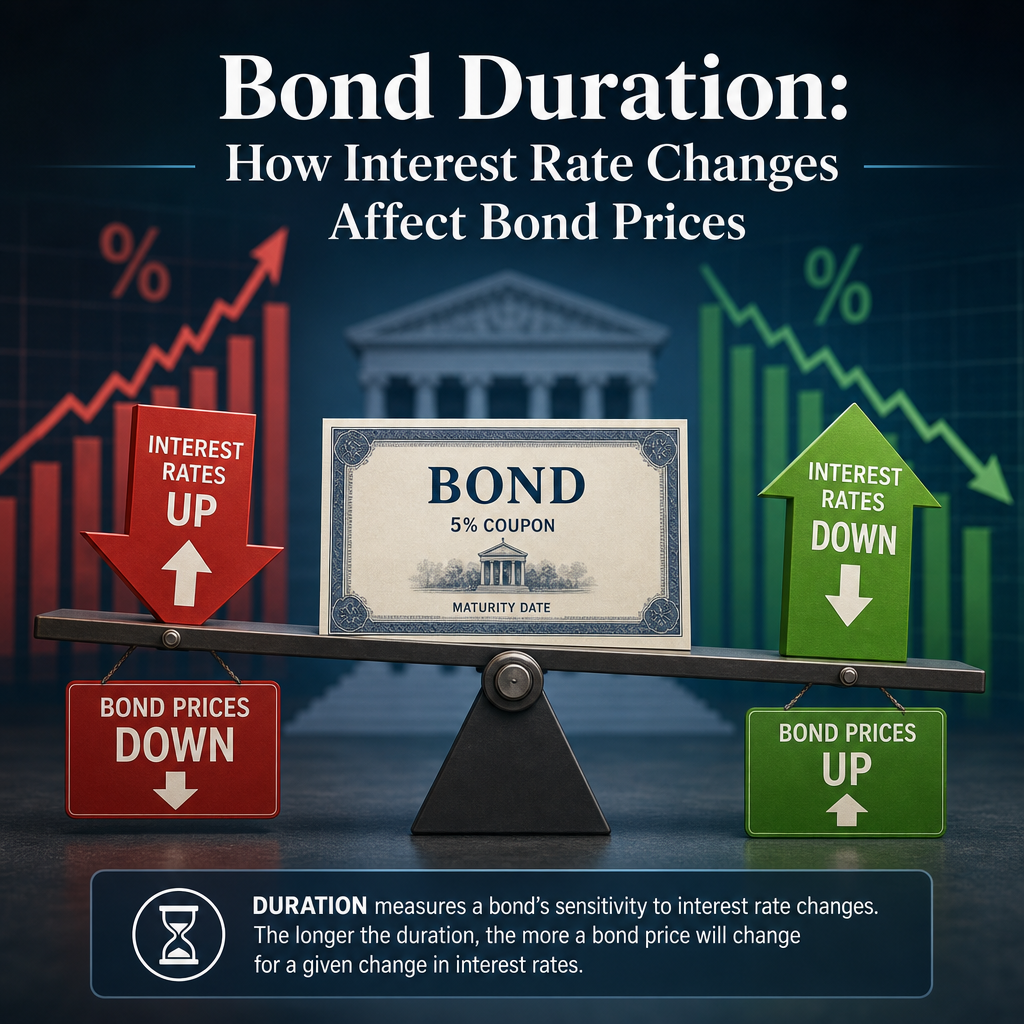
Bond prices and interest rates move in opposite directions. When interest rates rise, bond prices usually fall. When rates decline, bond prices usually rise.
Bond duration helps estimate how large that price change might be.
This matters because:
It helps investors compare interest rate risk across bonds
It supports portfolio construction and risk management
It can guide decisions about whether to hold shorter- or longer-duration bonds in different rate environments
For example, if you expect rates to rise, shorter-duration bonds may be less volatile. If you want more price upside when rates fall, longer-duration bonds may offer greater sensitivity.
How Interest Rate Changes Affect Bond Prices
The relationship between interest rates and bond prices is one of the core concepts in fixed-income investing.
When newly issued bonds offer higher yields, existing bonds with lower coupon payments become less attractive. Their prices must adjust downward to compete. The reverse happens when market yields fall.
A Simple Example
Imagine a bond with:
A face value of $1,000
A fixed coupon rate
A market yield that changes after issuance
If market interest rates rise after the bond is issued, investors can buy newer bonds that pay more. To make the older bond competitive, its price drops. If market rates fall, the older bond becomes more valuable because its coupon looks better than what new bonds offer.
Bond duration estimates how much that price move might be.
Macaulay Duration and Modified Duration
When people talk about bond duration, they usually mean one of two related measures: Macaulay duration or modified duration.
Macaulay Duration
Macaulay duration measures the weighted average time it takes to receive a bond’s cash flows. It is useful for understanding the timing of payments.
Modified Duration
Modified duration is the more practical measure for investors because it estimates how much a bond’s price will change for a 1% change in interest rates.
For example, if a bond has a modified duration of 5, its price may fall by about 5% if interest rates rise by 1%, and rise by about 5% if rates fall by 1%.
That estimate is not perfect, but it gives investors a useful starting point.
What to Remember
Higher duration = greater price sensitivity
Lower duration = less price sensitivity
Duration gives an approximation, not a guarantee
Key Factors That Influence Bond Duration
Several bond features affect duration. Understanding these can help you predict how a bond may behave.
1. Coupon Rate
Bonds with higher coupon payments usually have lower duration because investors receive more money earlier.
Bonds with lower coupon rates tend to have higher duration because more of the bond’s value comes from the final principal payment.
2. Maturity
Longer maturities generally lead to higher duration. The further away the principal repayment, the more exposed the bond is to interest rate changes.
3. Yield to Maturity
A bond’s yield also affects duration. As yields rise, duration tends to decline because future cash flows are discounted more heavily.
4. Embedded Options
Some bonds include features such as call or put options. These can change the bond’s sensitivity to interest rates.
For example:
Callable bonds may be redeemed early by the issuer, which can limit price gains when rates fall
Putable bonds may give investors some protection when rates rise
These bonds often require more advanced duration analysis.
Bond Duration in a Rising Interest Rate Environment
When rates are climbing, bond duration becomes especially important. Longer-duration bonds usually experience bigger price declines than shorter-duration bonds.
That’s why many investors shift toward:
Short-term bonds
Floating-rate securities
Bond funds with lower duration
A bond ladder with staggered maturities
Practical Example
Suppose two bonds are otherwise similar:
Bond A has a duration of 2
Bond B has a duration of 8
If interest rates rise by 1%, Bond A might decline by about 2%, while Bond B might decline by about 8%. That difference can have a big impact on portfolio performance.
This is why investors often pay close attention to duration when they think interest rates may move higher.
Bond Duration in a Falling Interest Rate Environment
When rates fall, longer-duration bonds tend to benefit more because their future coupon payments become more valuable in present-value terms.
This can create opportunities for investors who hold intermediate- or long-duration bonds before rates decline.
However, there’s a tradeoff:
You may get greater price appreciation if rates fall
But you also take on more volatility if rates rise unexpectedly
That’s why duration should fit your goals, time horizon, and risk tolerance.
Duration vs. Convexity
Duration is useful, but it doesn’t tell the whole story.
Convexity measures how much the duration-based price estimate changes as interest rates move further. In other words, it helps refine the estimate of a bond’s price sensitivity.
Why Convexity Matters
Duration assumes a mostly linear relationship between price and yield. In reality, bond price movements are curved, not perfectly straight.
Convexity becomes more important when:
Interest rates change a lot
A bond has unusual cash flow features
You want a more accurate estimate of price movement
For many retail investors, duration is enough for day-to-day decisions. But if you want a more complete picture, convexity adds useful depth.
How Investors Use Bond Duration
Bond duration can help with several practical investment decisions.
Portfolio Risk Management
Investors use duration to keep bond portfolios aligned with their risk tolerance. A portfolio with high average duration may be more volatile in changing rate environments.
Matching Future Liabilities
Some investors, such as retirees or institutions, use duration to match expected future payments with bond cash flows.
Comparing Bond Funds
Bond mutual funds and ETFs often list average duration in their fact sheets. This makes it easier to compare funds based on interest rate sensitivity.
Building a Bond Ladder
A bond ladder spreads investments across different maturities. This can reduce reinvestment risk and help balance duration exposure over time.
Duration in Bond Funds and ETFs
For individual bonds, duration helps estimate price risk. For bond funds and ETFs, it becomes even more important because the underlying holdings can change.
Fund duration helps investors understand how the fund may react to rate changes, but it is still only an estimate. Fund managers may adjust holdings over time, and market conditions can affect performance in ways that duration alone does not capture.
When evaluating a fund, look at:
Average duration
Credit quality
Portfolio turnover
Expense ratio
Maturity profile
These factors together give a more complete view of risk.
Common Misunderstandings About Bond Duration
Many investors make the same mistakes when first learning about duration.
“Duration Is the Same as Maturity”
It isn’t. Maturity is a date. Duration is a price sensitivity measure.
“A Higher Coupon Means Higher Risk”
Not necessarily. Higher coupon bonds often have lower duration because they return cash sooner.
“Duration Predicts Exact Price Changes”
It does not. Duration provides an estimate, and actual price changes may differ due to convexity, supply and demand, credit concerns, and liquidity.
“Only Long-Term Bonds Are Sensitive to Rates”
Even short-term bonds can move when rates shift, though usually not as much as long-duration bonds.
How to Use Bond Duration as an Investor
If you want to use bond duration wisely, keep your purpose in mind.
Ask These Questions
What is my time horizon?
How much volatility can I tolerate?
Do I expect rates to rise, fall, or remain uncertain?
Am I investing for income, preservation, or total return?
Am I buying an individual bond or a bond fund?
A Simple Rule of Thumb
Use shorter duration if you want less interest rate risk
Use longer duration if you want more sensitivity to falling rates and can tolerate more volatility
Diversify across durations when you want balance
Bond Duration and Interest Rate Risk: A Real-World Perspective
No one can predict interest rates perfectly. That’s why duration should be viewed as a planning tool, not a forecast.
A bond with a long duration is not “bad.” It simply behaves differently. In some markets, that sensitivity can work in your favor. In others, it can cause unnecessary losses if you weren’t prepared for the risk.
The key is to align duration with your strategy rather than chasing the highest yield or the longest maturity.
Frequently Asked Questions
1. What does bond duration tell me?
Bond duration tells you how sensitive a bond’s price is to changes in interest rates. A higher duration means the bond price will generally move more when rates change.
2. Is duration the same as maturity?
No. Maturity is the date when the bond’s principal is repaid. Duration measures interest rate sensitivity and the timing of cash flows. A bond can have a long maturity but a shorter duration if it pays high coupons.
3. Why do bond prices fall when interest rates rise?
When rates rise, newly issued bonds usually offer better yields. Existing bonds with lower coupons become less attractive, so their prices decline to stay competitive in the market.
4. How can I find a bond fund’s duration?
Most bond mutual funds and ETFs list duration in their fact sheets or on the fund company’s website. Look for “average duration” or “effective duration” in the fund’s portfolio details.
5. Should I avoid long-duration bonds?
Not necessarily. Long-duration bonds are more sensitive to interest rate changes, which can mean bigger losses when rates rise but bigger gains when rates fall. Whether they fit your portfolio depends on your goals, time horizon, and risk tolerance.
Bond duration is one of the most important concepts in fixed-income investing because it helps explain how interest rate changes affect bond prices. Instead of relying on maturity alone, duration gives you a clearer sense of how sensitive a bond or bond fund may be when rates move.
That insight can improve nearly every part of your bond strategy. It can help you compare investments, manage risk, choose between short- and long-term securities, and decide whether a bond ladder or fund fits your goals. Just as important, it reminds you that yield is only one part of the equation. Price volatility matters too.
If you want to invest more confidently in bonds, start by checking duration alongside credit quality, maturity, and yield. Over time, that habit can help you build a more resilient portfolio and make better decisions in changing rate environments.
Sarah Mitchell
Mary S, CFP®, is a Certified Financial Planner with over 12 years of experience in personal finance, retirement planning, and wealth management. She writes educational content that helps readers understand financial concepts and make informed decisions based on reliable information.