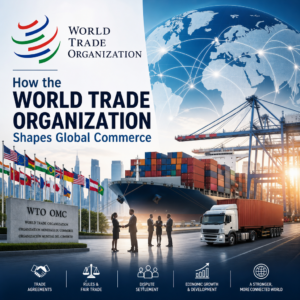
How the World Trade Organization Shapes Global Commerce
The World Trade Organization plays a central role in shaping global commerce by setting the rules that make trade more predictable, fair, and stable. From resolving disputes to opening markets, the WTO influences everything from international business strategy to the prices consumers pay every day.
By: Peter on July 27, 2026
Global commerce depends on more than shipping lanes, digital platforms, and international demand. It also depends on rules. One of the most important institutions shaping those rules is the World Trade Organization (WTO). Since its creation in 1995, the WTO has helped define how countries trade with one another, how disputes are resolved, and what standards govern global exchange.
For businesses, governments, and consumers, the WTO may seem distant and technical. In reality, its influence reaches into everyday life—from the price of imported goods to the availability of foreign markets for exporters. Understanding how the WTO works reveals why international trade tends to be more predictable, more open, and more structured than it would otherwise be.
What Is the World Trade Organization?
The World Trade Organization is an international body that oversees the global trading system. It was formed after the Uruguay Round of trade negotiations and replaced the earlier General Agreement on Tariffs and Trade (GATT). Today, it includes more than 160 member countries, representing the vast majority of world trade.
At its core, the WTO serves three major purposes:
Set and enforce rules for global trade
Promote trade liberalization
Resolve disputes between member countries
Unlike a world government, the WTO cannot force countries to trade in a certain way. Instead, it creates a framework of agreed-upon rules that members accept voluntarily. These rules are designed to make trade more transparent, fair, and stable.
Why the WTO Matters for Global Commerce
International trade is complicated. Countries have different laws, tax systems, political goals, and economic priorities. Without shared rules, trade between nations could become chaotic, inconsistent, and prone to conflict.
The WTO helps reduce that uncertainty by creating a common structure. This matters because businesses rely on predictable conditions when deciding where to source materials, manufacture products, or sell goods abroad.
Key ways the WTO supports global commerce
Reduces trade barriers
Encourages lower tariffs
Discourages quotas and excessive restrictions
Creates predictability
Gives firms and governments clearer expectations
Helps long-term planning for trade and investment
Improves market access
Opens foreign markets to exporters
Makes international competition broader and more balanced
Provides a dispute resolution system
Helps settle conflicts without immediate retaliation
Reduces the risk of trade wars
Encourages transparency
Requires members to publish trade-related regulations and practices
These functions help make global commerce more efficient. When companies can better predict trade costs and market conditions, they are more likely to invest in cross-border trade.
The WTO’s Core Principles
The WTO’s influence comes largely from the principles that guide its agreements. These principles shape how countries treat one another in trade relationships.
Most-Favored-Nation Treatment
This principle means that if one WTO member grants a trade advantage to another member, it must generally extend that same advantage to all members. For example, if a country lowers tariffs on steel imports from one member, it should apply the same tariff rate to other members as well.
This principle helps prevent discrimination and supports a more level playing field.
National Treatment
Once imported goods enter a country’s market, they must be treated no less favorably than domestic goods. In other words, a government cannot create hidden barriers that favor local companies over foreign competitors.
This principle helps ensure that imported products compete fairly after crossing the border.
Trade Without Discrimination
Together, these principles reduce favoritism and promote a more stable trading environment. They do not eliminate all differences between countries, but they limit arbitrary treatment that could disrupt commerce.
Transparency
Members are expected to make trade rules public and notify the WTO about certain policy changes. This makes it easier for traders and investors to understand the rules they must follow.
How the WTO Influences Tariffs and Market Access
One of the WTO’s most visible effects on commerce is its role in lowering trade barriers. Tariffs, which are taxes on imported goods, can raise prices and limit competition. Through negotiation rounds and agreements, the WTO has contributed to significant tariff reductions over time.
Example: Lower tariffs help exporters
Imagine a furniture company in Vietnam that wants to sell wooden tables in Europe. If tariffs are high, its products may become too expensive for consumers. If tariffs are lower under WTO commitments, the company has a better chance of competing successfully.
The same logic applies in reverse. A consumer in Brazil might buy cheaper electronics because trade agreements and WTO rules help keep tariffs in check.
Beyond tariffs
The WTO is also concerned with:
Import quotas
Customs procedures
Technical barriers to trade
Sanitary and phytosanitary standards
Subsidies and anti-dumping measures
These issues matter because trade is not only about taxes at the border. Regulations, standards, and government support can also affect whether goods move freely across countries.
The Role of Dispute Settlement
One of the WTO’s most important contributions is its dispute settlement system. When one member believes another member has violated trade rules, it can bring a case to the WTO.
This process helps prevent disagreements from escalating into broader trade conflicts. Instead of responding immediately with tariffs or sanctions, countries can seek a formal ruling.
How dispute settlement works
The process generally involves:
Consultations
The countries first try to settle the issue directly
Panel review
If talks fail, a panel of experts examines the case
Appeal
A legal review may follow, depending on the system in place
Implementation
The losing country is expected to adjust its policy
This mechanism gives countries a legal and diplomatic route to resolve disputes. For global commerce, that creates confidence. Businesses are more likely to trade internationally when they believe rules will be enforced consistently.
Example: A tariff dispute
Suppose Country A imposes a special tariff on imported solar panels from Country B, claiming the panels are unfairly subsidized. Country B may argue that the tariff breaks WTO rules. A WTO dispute panel can examine the evidence and determine whether the measure is justified.
Without such a system, the conflict might lead to retaliatory tariffs, harming both economies and disrupting supply chains.
How the WTO Affects Developing Countries
The WTO’s influence on global commerce is especially important for developing economies. For many of these countries, access to international markets is essential for growth, job creation, and industrial development.
Opportunities for developing nations
The WTO can help developing countries by:
Opening access to larger export markets
Encouraging foreign investment
Providing a platform to negotiate with stronger economies
Offering technical assistance and trade capacity support
For example, a textile producer in Bangladesh can benefit from rules that make it easier to export garments to major markets. Similarly, agricultural exporters in Kenya may gain improved market access through trade commitments.
Challenges and criticisms
At the same time, some critics argue that the WTO does not always treat developing countries fairly. Concerns include:
Unequal bargaining power
Pressure to open markets before local industries are ready
Complex compliance requirements
Limited ability to defend against trade disputes
These concerns are important because trade liberalization can create winners and losers. While some sectors grow, others may struggle to compete. The WTO tries to address this with special provisions for developing countries, but debates over fairness continue.
The WTO and Supply Chains
Modern global commerce is built on supply chains that stretch across multiple countries. A smartphone may be designed in the United States, have components made in South Korea and Japan, be assembled in China, and be sold worldwide.
The WTO helps support these networks by reducing uncertainty and encouraging the smooth movement of goods across borders.
Why supply chains depend on WTO rules
Businesses managing global supply chains need:
Predictable customs procedures
Reasonable tariffs
Stable import and export rules
Non-discriminatory treatment
Clear product standards
When rules change suddenly, supply chains can become more expensive and less efficient. WTO commitments help reduce that risk.
Example: Manufacturing across borders
Consider an automotive company that sources steel from one country, electronics from another, and assembly services from a third. If each border crossing faces unpredictable tariffs or conflicting regulations, production becomes costly. WTO rules help lower these obstacles and support the integrated production models common in global manufacturing.
The WTO and Digital Commerce
Commerce today is not limited to physical goods. Services, data, software, and online platforms are increasingly central to the global economy. While the WTO was originally designed around traditional trade, it also influences digital commerce through agreements on services, intellectual property, and customs treatment.
Areas of digital trade influence
The WTO affects digital commerce through:
Services trade rules
Intellectual property protections
E-commerce discussions
Customs practices for digital products
For example, a cloud software company selling subscriptions abroad depends on rules that support cross-border services. A streaming platform or online marketplace also benefits from a stable international framework.
Ongoing challenges
Digital trade evolves faster than trade negotiations. Questions about data flows, privacy, cyber regulation, and taxation are becoming increasingly important. The WTO remains part of the conversation, but many countries are also negotiating digital trade rules through regional agreements and bilateral deals.
Criticism and Limitations of the WTO
Although the WTO has had a major influence on global commerce, it is not without critics. Some argue that it has not kept pace with changes in the world economy. Others believe it gives too much weight to trade liberalization and too little to labor rights, environmental protection, or public health.
Common criticisms include
Slow negotiations
Major agreements can take years to complete
Weak enforcement
The WTO relies on member compliance
Stalemates among members
Different economic interests can block progress
Outdated rules
Some agreements do not fully address modern trade issues
Public concern over globalization
Trade rules can be seen as favoring large corporations over local communities
These criticisms do not erase the WTO’s importance, but they show that its role is evolving. As global commerce changes, the institution faces pressure to adapt.
Real-World Impact on Consumers and Businesses
The WTO may seem abstract, but its rules affect both everyday shoppers and international companies.
For consumers
WTO-facilitated trade can mean:
Lower prices on imported goods
More product variety
Greater availability of seasonal or specialized items
Faster access to foreign products
For businesses
Companies benefit from:
Easier access to foreign markets
Lower trade costs
Better legal predictability
Fairer competition rules
Greater confidence in long-term planning
A small coffee exporter in Colombia, for instance, may rely on WTO rules to reach buyers in Asia or Europe. A retailer in the United States may depend on stable import rules to stock affordable products from abroad. In both cases, the WTO helps make global commerce more workable.
Frequently Asked Questions
1. How many countries are members of the WTO?
The World Trade Organization has 166 members, accounting for approximately 98% of global trade. Countries and customs territories seeking membership must negotiate their entry terms and bring relevant trade policies into alignment with WTO agreements.
2. Does the WTO create international trade laws?
WTO agreements establish binding trade commitments negotiated and accepted by its members. The organization does not operate as a world government, but members are expected to keep their trade measures consistent with the agreements they have accepted.
3. What is the most-favored-nation principle?
The most-favored-nation principle generally requires a WTO member to provide the same trade advantage to all other members when it grants that advantage to one member. WTO agreements contain certain exceptions, including provisions related to regional trade agreements.
4. Is the WTO Appellate Body currently functioning?
No. The Appellate Body is currently unable to review appeals because its vacancies have not been filled. Some WTO members use the Multi-Party Interim Appeal Arbitration Arrangement as a temporary alternative for participating disputes.
5. How does the WTO affect consumers and businesses?
WTO agreements can influence tariffs, customs procedures, technical requirements, services, intellectual property, and access to foreign markets. These rules may affect product availability, import costs, export opportunities, and the predictability of international supply chains.
The World Trade Organization plays a central role in shaping global commerce. By setting rules, lowering barriers, resolving disputes, and promoting transparency, it helps create a trading system that is more predictable and interconnected. Its influence can be seen in tariffs, supply chains, market access, and even digital trade.
At the same time, the WTO is not perfect. It faces criticism over fairness, speed, and its ability to respond to modern economic challenges. Still, it remains one of the most important institutions in the international economy. Whether you are a policymaker, business owner, or consumer, the WTO affects how goods, services, and ideas move across borders every day.
Peter B holds a degree in Journalism and has 5 years
of experience covering U.S. economic policy, labor markets, and
financial news. He writes data-driven news content on topics
like inflation, interest rates, and employment trends.