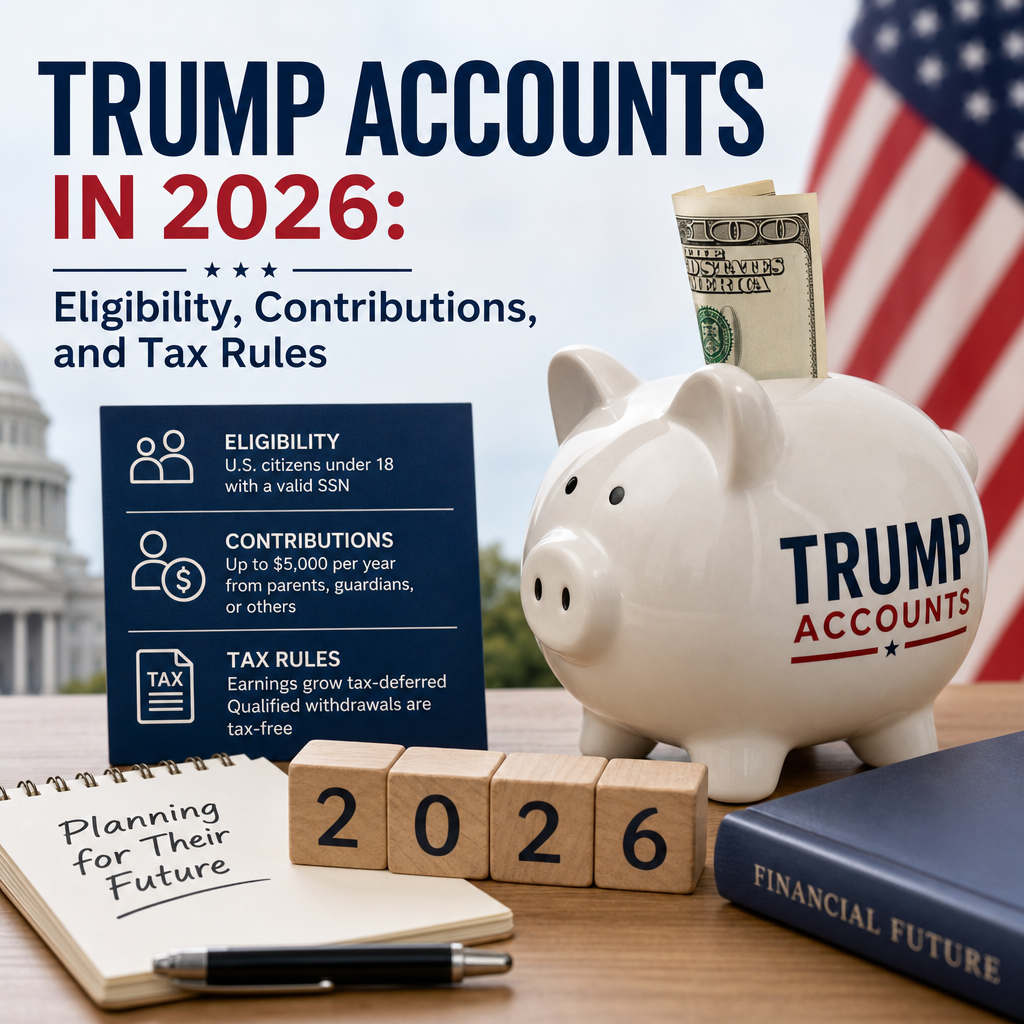
Trump Accounts in 2026: Eligibility, Contributions, and Tax Rules
Trump Accounts in 2026 could offer families a tax-advantaged way to save for a child’s future, but the rules on eligibility, contributions, and taxes will matter most. Here’s what to know so you can decide whether they fit into your long-term savings plan.
By: Sarah Mitchell on July 28, 2026
Planning for a child’s financial future can feel overwhelming, especially when new tax-advantaged options enter the conversation. Trump Accounts in 2026 are expected to draw attention from families looking for a long-term way to save and invest for children. Whether you’ve heard about them through financial news, family discussions, or employer benefits, it helps to understand the basics before making any decisions.
In this guide, we’ll break down Trump Accounts in 2026 in plain English: who may be eligible, how contributions may work, what tax rules could apply, and how these accounts may fit into a broader savings strategy. Because account rules can change as legislation and agency guidance evolve, it’s especially important to focus on the core principles and practical planning considerations.
What Are Trump Accounts?
Trump Accounts in 2026 are discussed as a type of tax-advantaged savings vehicle intended to help families build assets for children over time. Depending on the final rules and implementation details, these accounts may share some features with other long-term savings tools, such as custodial investment accounts or education-focused savings plans.
The key idea is simple: money contributed early has more time to grow, especially when invested for the long term. That makes these accounts potentially useful for:
Education costs
First-home savings
Starting a business
General financial support in early adulthood
Because the term “Trump Accounts” is still likely to be used in a policy-specific context, families should pay close attention to the official eligibility requirements, contribution limits, and tax treatment once the rules are finalized.
Trump Accounts in 2026: Who May Be Eligible?
Eligibility is one of the most important factors to check before opening any new savings account. For Trump Accounts in 2026, the most likely eligibility questions will involve the child’s age, residency status, and who can open or manage the account.
Child eligibility
In many child-focused savings programs, eligibility often depends on whether the beneficiary is a minor, usually someone under age 18 or 21 depending on the structure. For Trump Accounts in 2026, you should expect that:
The account is likely meant for a child beneficiary
A parent, guardian, or legal custodian may need to open or manage the account
The child may need a valid Social Security number or taxpayer identification number
Adult control and custodianship
Children generally cannot manage their own investment accounts. A parent or guardian typically serves as the account controller until the child reaches a specified age. That age may differ based on the legal structure of the account.
If Trump Accounts are designed with custodial-style oversight, the adult may be responsible for:
Opening the account
Choosing investments
Making contributions
Following any withdrawal restrictions
Income and residency considerations
Some savings programs are available to all families, while others phase out based on income or require U.S. residency or citizenship. At this stage, families should avoid assumptions and review the final rules carefully.
A few eligibility details to watch for:
Whether the child must be a U.S. resident
Whether the account is open to all households or income-limited
Whether the account can be funded by parents, relatives, or employers
Whether there are age-based deadlines for opening the account
Contribution Rules for Trump Accounts in 2026
Contribution rules determine how much money can go into the account each year, who can contribute, and whether there are special tax implications for deposits. These details matter because they affect how useful the account is for long-term planning.
Annual contribution limits
The most common feature in tax-advantaged accounts is a yearly cap on how much can be contributed. For Trump Accounts in 2026, that limit may be designed to encourage steady saving without allowing the account to become a loophole for unlimited tax sheltering.
When reviewing any official guidance, look for:
Annual contribution maximums
Lifetime contribution caps, if any
Whether limits apply per child or per account owner
Whether contributions are indexed for inflation
Who can contribute?
Many family savings accounts allow multiple people to contribute, including:
Parents
Grandparents
Other relatives
Friends
Employers, in some cases
If Trump Accounts follow a similar approach, this could make them especially useful for birthdays, holidays, and milestone gifts. Instead of sending cash that may be spent quickly, family members could add to a child’s long-term savings.
Contribution timing and practical strategy
Even if the annual limit is modest, starting early can matter more than waiting for a larger lump sum later. Consistent contributions can help families build momentum.
For example:
A parent contributes monthly from a checking account
A grandparent adds birthday money each year
An employer contribution, if allowed, boosts the balance over time
That combination can create a meaningful foundation without requiring a large one-time deposit.
Non-deductible vs. deductible contributions
One of the biggest tax questions is whether contributions are deductible. Many tax-advantaged accounts do not allow a federal income tax deduction for deposits, but they may still offer tax-free growth or other benefits.
For Trump Accounts in 2026, the final tax treatment will matter more than the label. Be sure to confirm:
Whether contributions are made with after-tax dollars
Whether any state tax deduction exists
Whether the account offers tax-free or tax-deferred growth
Tax Rules: What Families Need to Know
Taxes often determine whether a savings account is truly valuable. A strong account structure can reduce the drag of taxes over many years, which is why understanding the tax rules for Trump Accounts in 2026 is essential.
Tax treatment of investment growth
If the account allows investments such as mutual funds, ETFs, or other assets, the earnings may be treated differently depending on the final law.
Possible tax structures include:
Tax-deferred growth: Taxes are delayed until withdrawal
Tax-free growth for qualified uses: Earnings are not taxed if the money is used for approved purposes
Taxable growth: Earnings may be taxed annually like a regular brokerage account
The more favorable the growth treatment, the more powerful the account can be over time.
Qualified withdrawals
Most tax-advantaged accounts come with rules about how money can be taken out without penalties. For Trump Accounts in 2026, withdrawals may need to be used for specific qualified expenses, such as education, housing, or other approved uses.
If withdrawals are not qualified, families may face:
Income tax on earnings
Penalties
Loss of tax benefits
This is why it’s smart to think ahead about the account’s purpose before contributing.
Early withdrawal penalties
If the money is used too soon or for the wrong reason, a penalty may apply. That is common in many savings programs designed for long-term goals.
Before opening the account, ask:
What counts as a qualified withdrawal?
Are there exceptions for emergencies?
Is principal treated differently from earnings?
What happens if the child does not use the funds for the intended purpose?
Gift tax considerations
Family contributions can also raise gift tax questions. In many cases, smaller annual gifts fall well below federal gift tax thresholds, but larger transfers can require more attention.
If relatives want to contribute to Trump Accounts in 2026, they should understand:
Whether direct contributions count as gifts
Whether the account has special gift-tax treatment
Whether contributions should be coordinated with estate planning
How Trump Accounts May Compare to Other Savings Options
Families rarely rely on just one account. It helps to compare Trump Accounts in 2026 with other common savings vehicles.
Custodial brokerage accounts
A custodial brokerage account can hold stocks, bonds, ETFs, and mutual funds for a minor. These accounts offer flexibility, but they usually do not provide special tax advantages.
Pros:
Broad investment choices
Easy to open
Flexible use of funds
Cons:
Less favorable tax treatment
Assets may affect financial aid more heavily
529 education savings plans
A 529 plan is designed primarily for education expenses. It often offers tax-free growth when used for qualified education costs.
Pros:
Strong education-focused tax benefits
State tax incentives in some places
Good for long-term college planning
Cons:
Limited to qualified education expenses
Less flexible for non-education goals
Trump Accounts
If the final rules give Trump Accounts broader usage than a 529 plan, they may appeal to families who want flexibility beyond college. That flexibility could make them useful for:
Apprenticeships
First-time home purchases
Starting a small business
Emergency starter funds in early adulthood
The right choice depends on the family’s priorities, not just the tax rate.
Practical Steps for Families Considering Trump Accounts
If you’re thinking about opening one of these accounts in 2026, a simple plan can help you stay organized.
1. Confirm eligibility
Start with the official account rules. Verify who qualifies, who can open the account, and whether there are age or residency requirements.
2. Understand the tax treatment
Before contributing, review whether the account offers tax-free growth, tax-deferred growth, or another structure. This will shape the long-term value of the account.
3. Set a realistic contribution schedule
You do not need to max out an account immediately. Even small, regular deposits can be helpful.
A practical approach might include:
Monthly automatic transfers
Holiday gifts from relatives
Annual review of contribution progress
4. Choose investments carefully
If the account allows investment options, choose a mix that matches the time horizon. A younger child typically has more years for growth, which may support a more aggressive long-term allocation, though every family should consider risk tolerance and account rules.
5. Keep records
Good records make tax filing and withdrawal decisions easier. Save documentation for:
Contributions
Investment statements
Qualified expenses
Withdrawal confirmations
Common Mistakes to Avoid
Even a well-designed savings plan can go off track if families misunderstand the rules.
Here are some common mistakes to avoid with Trump Accounts in 2026:
Assuming contributions are tax-deductible without checking
Withdrawing money for non-qualified expenses
Missing annual contribution limits
Ignoring custodial control rules
Failing to compare the account with other savings tools
A little planning now can prevent tax surprises later.
Frequently Asked Questions
1. What are Trump Accounts in 2026 used for?
Trump Accounts in 2026 are expected to help families save and invest for a child’s future. Depending on the final rules, the money may be used for education, housing, starting a business, or other approved goals. The exact permitted uses will depend on official guidance.
2. Who can open a Trump Account?
Typically, a parent, guardian, or legal custodian would open the account for a minor child. The child is the beneficiary, but an adult usually manages the account until the child reaches the age specified in the rules.
3. Are Trump Account contributions tax-deductible?
That depends on the final law and guidance. Some savings accounts allow after-tax contributions with tax-free or tax-deferred growth, while others offer deductions. Families should not assume deductions exist unless they are clearly stated in official rules.
4. Can grandparents contribute to Trump Accounts in 2026?
If the account structure permits third-party contributions, grandparents and other family members may be able to add money. This can make the account a useful gift strategy for birthdays, holidays, and long-term family support. Always confirm contribution rules before depositing funds.
5. What happens if money is withdrawn for non-qualified expenses?
Non-qualified withdrawals may trigger taxes, penalties, or both, depending on how the account is structured. In many tax-advantaged accounts, the earnings portion is most likely to be taxed or penalized if the funds are used outside the approved purposes.
Trump Accounts in 2026 may become an important planning tool for families who want to build long-term financial security for children. The biggest advantages will likely come from starting early, contributing consistently, and understanding the rules before money goes in. Eligibility, contribution limits, and tax treatment all matter, but so does the larger strategy: deciding what you want the money to do and how flexible you need it to be.
If the final rules provide tax-advantaged growth and reasonable withdrawal options, these accounts could offer a useful middle ground between strict education-only plans and fully taxable brokerage accounts. Still, the smartest move is to wait for official guidance, compare the account with other savings options, and keep your goals front and center.
For families, the value of any account is not just in the tax benefits. It’s in the habit of saving, the discipline of planning ahead, and the opportunities that money can create later. Stay informed, review the details carefully, and use the rules to support a strategy that fits your family’s future.
Sarah Mitchell
Mary S, CFP®, is a Certified Financial Planner with over 12 years of experience in personal finance, retirement planning, and wealth management. She writes educational content that helps readers understand financial concepts and make informed decisions based on reliable information.