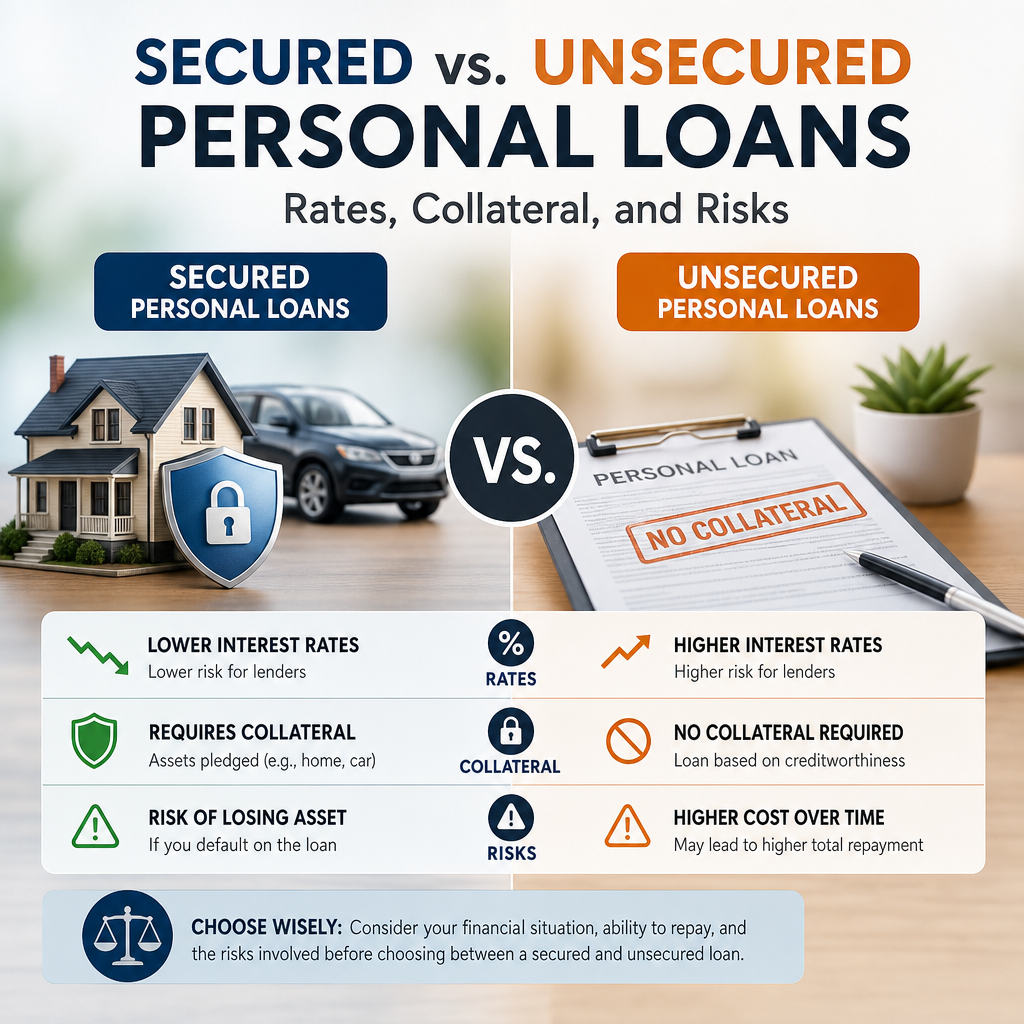
Secured vs. Unsecured Personal Loans: Rates, Collateral, and Risks
Wondering which loan type fits your needs? This guide breaks down secured vs unsecured personal loans, explaining how collateral, interest rates, and repayment risk can affect your borrowing options and your wallet.
By: Sarah Mitchell on July 28, 2026
When you compare secured vs. unsecured personal loans, the biggest differences usually come down to collateral, interest rates, approval standards, and risk. Both loan types can help you cover major expenses, consolidate debt, or finance a large purchase, but they work in very different ways. Choosing the right one depends on your financial situation, your credit profile, and how much risk you’re willing to take on.
Understanding how these loans function can help you avoid costly mistakes and borrow with confidence. Whether you need a loan for home improvements, medical bills, or debt consolidation, knowing the tradeoffs between secured and unsecured personal loans can save you money and protect your assets.
What Is a Personal Loan?
A personal loan is a fixed amount of money borrowed from a bank, credit union, or online lender and repaid in regular installments over a set term. Most personal loans come with a fixed interest rate, which means your monthly payment stays the same throughout the loan term.
People often use personal loans for:
Debt consolidation
Emergency expenses
Home repairs
Moving costs
Medical bills
Large one-time purchases
The main distinction between the two loan types is simple:
Secured personal loans require collateral.
Unsecured personal loans do not.
That single difference affects the loan’s approval process, rate, and risk level.
Secured vs. Unsecured Personal Loans: The Core Difference
The phrase secured vs. unsecured personal loans refers to whether the lender has something to claim if you fail to repay the loan.
Secured Personal Loans
A secured loan is backed by collateral, which is an asset you pledge to the lender. If you stop making payments, the lender may be able to take the collateral to recover losses.
Common forms of collateral include:
A savings account
A certificate of deposit (CD)
A vehicle
Other valuable assets, depending on the lender
Because collateral reduces the lender’s risk, secured loans often come with:
Lower interest rates
Higher borrowing limits
Easier approval for borrowers with thin or damaged credit
Unsecured Personal Loans
An unsecured loan does not require collateral. Instead, the lender evaluates your creditworthiness, income, debt-to-income ratio, and overall financial profile.
Since the lender has no asset to claim if you default, unsecured loans usually involve:
Higher interest rates
Stricter credit requirements
Faster application decisions
Less risk to your property
This is why many borrowers with strong credit prefer unsecured loans, while those with weaker credit may consider secured loans if they qualify.
How Collateral Changes the Borrowing Experience
Collateral is the most important factor in the secured vs. unsecured personal loans conversation because it directly affects both opportunity and risk.
Why Lenders Like Collateral
Collateral gives lenders more protection. If a borrower doesn’t repay, the lender has a path to recover some of the money. That added protection can make lenders more willing to offer:
Lower rates
Larger loan amounts
More flexible qualification terms
Why Borrowers Need to Be Careful
Using collateral means your asset is on the line. If you default, you could lose the savings account, car, or other asset tied to the loan.
That creates a major tradeoff:
You may get a better rate
But you also take on more personal risk
For example, a borrower who uses a vehicle as collateral might get a lower APR than with an unsecured loan. But if payments become unmanageable, the car could be repossessed.
Interest Rates: Why Secured Loans Often Cost Less
Interest rate is one of the biggest reasons people compare secured vs. unsecured personal loans.
Secured Loan Rates
Secured loans often have lower rates because the lender faces less risk. The collateral provides a safety net, which can make the loan cheaper over time.
Lower rates can mean:
Smaller monthly payments
Less total interest paid
A more affordable option for larger borrowing needs
Unsecured Loan Rates
Unsecured loans usually have higher rates because the lender relies mostly on your credit and income. If your credit score is excellent, you may still get a competitive rate. But if your credit is average or below average, the rate can be noticeably higher.
A higher rate can matter a lot over the life of the loan. Even a small rate difference can change the total amount you repay.
Example of Rate Impact
Imagine two borrowers each take out a $10,000 loan for three years:
Borrower A gets a secured loan at a lower rate
Borrower B gets an unsecured loan at a higher rate
Borrower B may pay significantly more in interest, even though the loan amount is the same. That’s why it’s important to compare the annual percentage rate, not just the monthly payment.
Approval Requirements and Credit Considerations
Lenders evaluate different factors depending on the loan type.
What Lenders Look for in Secured Loans
Because collateral lowers the lender’s risk, approval can be more forgiving. Still, lenders typically review:
Credit score
Income and employment history
Debt-to-income ratio
The value and type of collateral
Some secured loans are designed for borrowers who may not qualify for unsecured financing. For example, a savings-secured loan may help build or rebuild credit while allowing access to relatively low rates.
What Lenders Look for in Unsecured Loans
Unsecured loans depend more heavily on your financial profile. Lenders usually want to see:
Good or excellent credit
Stable income
Low existing debt
A history of on-time payments
Borrowers with strong credit often get the best unsecured loan offers. Those with weaker credit may still qualify, but they may face higher rates or lower loan amounts.
Risks of Secured Personal Loans
Secured loans can be useful, but the risk is real. If you borrow against an asset, you need to be confident you can make every payment on time.
Main Risks
Loss of collateral: If you default, the lender may take the pledged asset.
Greater financial strain: Missing payments can put savings or transportation at risk.
Overborrowing temptation: A larger loan amount can feel helpful, but it may also increase long-term debt.
When Secured Loans Make Sense
A secured loan may be worth considering if:
You want a lower interest rate
You have trouble qualifying for an unsecured loan
You have a clear repayment plan
You’re using low-risk collateral, such as a savings account
The key is to treat the loan seriously and avoid borrowing more than you can comfortably repay.
Risks of Unsecured Personal Loans
Unsecured loans don’t put property directly on the line, but they still carry meaningful risk.
Main Risks
Higher interest costs: You may pay more over time.
Stricter approval: Borrowers with weak credit may struggle to qualify.
Credit damage: Late payments and defaults can harm your credit score.
Collection activity: If you default, the lender may send the debt to collections or pursue legal action, depending on the loan terms and applicable law.
When Unsecured Loans Make Sense
An unsecured loan may be a better fit if:
You do not want to risk collateral
You have solid credit and steady income
You need funding quickly
You can qualify for a competitive rate
Many borrowers choose unsecured loans for peace of mind, even if the rate is slightly higher, because no asset is directly tied to the debt.
How to Compare Secured vs. Unsecured Personal Loans
If you’re deciding between the two, don’t focus only on the interest rate. Compare the entire loan picture.
1. Check the APR
The annual percentage rate includes the interest rate plus certain fees. It gives you a better sense of the true cost of borrowing.
2. Review the Loan Term
Longer terms usually mean lower monthly payments, but more interest over time.
3. Look at Fees
Ask about:
Origination fees
Late fees
Prepayment penalties
Returned payment fees
4. Consider the Collateral Risk
If you need to pledge a car, savings account, or other asset, ask yourself whether the loan is worth that risk.
5. Think About Your Budget
Choose a payment you can manage consistently. A loan that looks affordable today can become stressful if your income changes.
Practical Examples of Loan Choice
Example 1: Debt Consolidation With Good Credit
A borrower with strong credit and stable income wants to consolidate high-interest credit card balances. An unsecured personal loan may be ideal because it avoids collateral risk and could still offer a competitive rate.
Example 2: Credit Rebuilding With Savings Collateral
A borrower with limited credit history wants a small loan to cover home repairs. A secured loan backed by savings could provide better approval odds and a lower rate.
Example 3: Larger Expense With Asset Protection Concerns
A borrower needs money for an unexpected medical bill but does not want to risk a vehicle. In this case, an unsecured loan may be preferable, even if the rate is higher.
These examples show that the best choice depends on more than just cost. Risk tolerance matters too.
Tips for Borrowing Responsibly
No matter which loan type you choose, smart borrowing habits matter.
Borrow only what you need
Compare offers from multiple lenders
Read the fine print carefully
Make payments on time
Avoid using a loan to cover recurring budget problems without a plan
If you’re unsure, use a loan calculator to estimate total repayment before applying. That simple step can help you avoid taking on too much debt.
Frequently Asked Questions
1. What is the biggest difference between secured and unsecured personal loans?
The biggest difference is collateral. Secured personal loans require an asset to back the loan, while unsecured personal loans do not. That affects the lender’s risk, your approval odds, and often the interest rate.
2. Are secured personal loans always cheaper?
Not always, but they often are. Because the lender has collateral, secured loans usually come with lower rates. However, your exact rate depends on your credit, income, loan amount, term, and the lender’s terms.
3. Can I lose my car or savings with a secured personal loan?
Yes, if the loan is backed by your car or savings and you default, the lender may be able to take the collateral according to the loan agreement and applicable law. That is why it’s important to borrow carefully and make on-time payments.
4. Are unsecured personal loans harder to get?
They can be. Since there is no collateral, lenders often place more emphasis on credit score, income, and debt levels. Borrowers with strong credit usually have the best chance of qualifying for favorable unsecured loan terms.
5. Which is better for debt consolidation: secured or unsecured?
It depends on your situation. If you have good credit, an unsecured loan may offer a competitive rate without risking collateral. If your credit needs work, a secured loan may offer better approval odds and lower rates, but you’ll need to weigh the risk of losing the asset.
Choosing between secured vs. unsecured personal loans comes down to balancing cost, approval odds, and risk. Secured loans can be a smart option if you want lower rates or need easier approval, but they require collateral and put an asset at risk. Unsecured loans protect your property, yet they often cost more and may be harder to qualify for if your credit is less than ideal.
The best loan is not necessarily the one with the lowest monthly payment. It’s the one that fits your budget, supports your financial goals, and gives you a realistic path to repayment. Before you apply, compare APRs, review fees, read the loan terms carefully, and think honestly about what you can afford.
If you approach borrowing with a clear plan, either type of personal loan can be a useful financial tool. The key is choosing the structure that gives you the right mix of flexibility, affordability, and peace of mind.
Sarah Mitchell
Mary S, CFP®, is a Certified Financial Planner with over 12 years of experience in personal finance, retirement planning, and wealth management. She writes educational content that helps readers understand financial concepts and make informed decisions based on reliable information.