Railroad Retirement Benefits: Tier I, Tier II, and Spousal Payments
Railroad retirement benefits can look complicated at first, but the system becomes much clearer once you understand the three key pieces: Tier I, Tier II, and spousal payments. This guide breaks down each part in simple terms so railroad workers and families can better plan for retirement.
By: Emilly Adams on July 28, 2026
Railroad retirement benefits are a unique part of the U.S. retirement system. Unlike Social Security alone, railroad workers may qualify for benefits under the Railroad Retirement Act, which creates its own structure of payments. For many workers and families, the system can seem complicated at first because it includes two main benefit tiers, plus special rules for spouses and survivors.
If you or a family member worked in railroad employment, understanding how Tier I, Tier II, and spousal payments work can make retirement planning much clearer. This guide breaks down the basics, explains how each part functions, and shows how railroad retirement differs from regular Social Security.
What Is Railroad Retirement?
The railroad retirement system is a federal retirement program for eligible railroad workers and certain family members. It is administered by the Railroad Retirement Board (RRB), not the Social Security Administration.
The system exists because railroad employees historically had separate retirement coverage from the rest of the workforce. Today, railroad retirement benefits often resemble Social Security in some ways, but they also include additional benefits based on railroad service.
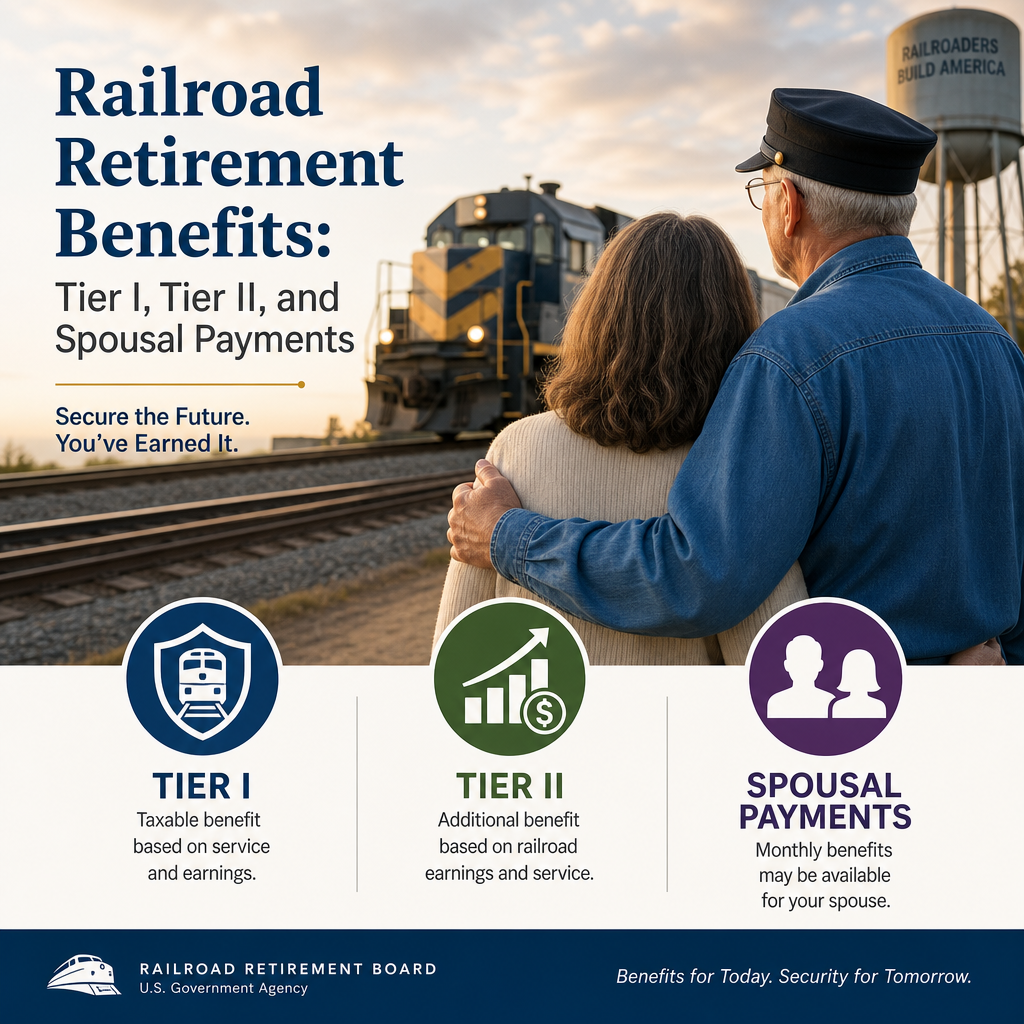
A key point is that railroad retirement benefits are generally divided into two tiers:
Tier I: Similar to Social Security
Tier II: Similar to a private pension or additional retirement benefit
In addition, some spouses, divorced spouses, and survivors may qualify for monthly payments based on the worker’s railroad record.
Tier I Benefits: The Social Security-Like Portion
Tier I benefits are the part of railroad retirement that most closely resembles Social Security. In many cases, the formula used to calculate Tier I is similar to the Social Security benefit formula, and eligibility is based on the worker’s earnings history and credits.
How Tier I Works
Tier I is designed to provide a base level of retirement income. It may be available to:
Railroad employees with qualifying service
Spouses of eligible railroad workers
Divorced spouses who meet certain conditions
Surviving spouses and other eligible survivors
Although Tier I is tied to Social Security principles, railroad employees generally do not receive Social Security retirement benefits separately for the same railroad service. Instead, their railroad earnings are covered under the railroad retirement system.
What Affects Tier I Amounts?
Several factors can influence Tier I payments:
The worker’s earnings record
Years of creditable railroad service
Age at retirement
Whether the beneficiary is eligible for reduced or unreduced benefits
Family benefit rules that may apply to spouses or survivors
In practice, Tier I often looks and feels like Social Security, but it is administered through the RRB and is calculated within the railroad retirement framework.
Example of Tier I in Action
Suppose a railroad employee has a long career in railroad service and retires at full retirement age. Their Tier I benefit may be similar to what they would have received from Social Security based on equivalent earnings. If they retire earlier, the Tier I portion may be reduced.
This makes Tier I the foundation of a railroad retirement package.
Tier II Benefits: The Railroad-Specific Pension-Like Portion
Tier II is what makes railroad retirement different from Social Security. This benefit acts more like an additional pension based on railroad service.
How Tier II Works
Tier II benefits are paid on top of Tier I and are based largely on the employee’s railroad earnings and years of service. The more qualifying railroad service a worker has, the more valuable the Tier II benefit may be.
Tier II is not the same as a 401(k) or private pension, but it serves a similar purpose: it provides extra retirement income beyond the base benefit.
Why Tier II Matters
Tier II is especially important because railroad employees often spend their careers in a specialized industry with distinct rules, work patterns, and retirement expectations. Tier II recognizes that service with an additional benefit.
The amount can depend on:
Average monthly compensation
Years of railroad service
Retirement age
Whether the worker qualifies for an unreduced benefit
Unlike Tier I, Tier II does not simply mirror Social Security. It is a separate railroad benefit with its own formula.
Example of Tier II in Action
Imagine a railroad employee with 30 years of service who retires after a long career. Their Tier I benefit may reflect a Social Security-style calculation, but their Tier II benefit adds extra monthly income because of their railroad service. That added payment can make a significant difference in total retirement income.
How Tier I and Tier II Work Together
For most railroad retirees, the monthly benefit is made up of both tiers. The two parts arrive together as a combined retirement package.
A simple way to think about it is:
Tier I = base retirement benefit, similar to Social Security
Tier II = additional railroad pension-like benefit
Together, they create a more complete income stream than Social Security alone.
Why This Structure Exists
The railroad system was designed to replace both Social Security-like coverage and part of a traditional pension system. Because of that, railroad retirement benefits can be more generous than standard Social Security benefits, especially for long-term workers with substantial railroad service.
Important Considerations
Some benefits may be reduced if the worker retires before full retirement age. In other cases, disability benefits or early retirement options may change how the tiers are paid. The exact outcome depends on the worker’s age, service history, and family circumstances.
Who Is Eligible for Railroad Retirement Benefits?
Eligibility depends on the type of benefit and the person’s railroad service history.
For Employees
A railroad employee generally needs sufficient creditable railroad service to qualify. In many cases, years of service, age, and employment history are key factors.
For Spouses
Spouses may qualify for benefits based on the railroad worker’s record if certain conditions are met. These payments can be particularly important for families relying on one partner’s career in the railroad industry.
For Divorced Spouses
A divorced spouse may be eligible if the marriage lasted long enough and other conditions are satisfied. These rules are similar in concept to Social Security divorced spouse benefits, but the railroad system has its own requirements.
For Survivors
If a railroad employee dies, eligible survivors may receive benefits. These can include a surviving spouse, divorced spouse, children, or other family members depending on the situation.
Spousal Payments: What They Are and How They Work
Spousal payments are monthly benefits paid to the spouse of an eligible railroad worker or retiree. These benefits are an important part of railroad retirement because they help support the household, not just the worker.
Types of Spousal Benefits
Depending on the circumstances, a spouse may receive:
A spouse annuity based on the worker’s record
A survivor annuity after the worker’s death
A divorced spouse annuity if the marriage met the eligibility rules
Eligibility Basics for Spouses
Spousal benefits usually depend on:
The worker’s railroad retirement eligibility
The spouse’s age
The length of the marriage
Whether the spouse is caring for a child
Whether the spouse is eligible under special survivor rules
In some cases, a spouse may begin receiving benefits at retirement age, while in others benefits can begin earlier if specific conditions are met.
Example of a Spousal Payment
Suppose a railroad retiree is receiving monthly Tier I and Tier II benefits. Their spouse may also qualify for a monthly spousal annuity. This helps ensure that retirement income supports both partners, especially if the spouse has limited personal earnings.
How Spousal Payments Differ from Employee Benefits
It is important to understand that spousal benefits are not the same as the employee’s own retirement annuity. The worker’s benefit is based on their railroad service and compensation, while the spouse’s benefit is based on relationship and eligibility rules.
Key Differences
Employee benefits are earned through railroad work
Spousal benefits are based on the worker’s record and the spouse’s eligibility
Survivor benefits may begin after the worker dies
Divorced spouse benefits have separate rules and proof requirements
In many families, the combination of worker and spousal benefits creates a more stable financial foundation in retirement.
Railroad Retirement vs. Social Security
Because Tier I resembles Social Security, many people assume railroad retirement and Social Security work the same way. They do not.
Major Differences
Here are some of the biggest differences:
Administration
Social Security is run by the SSA
Railroad retirement is run by the RRB
Benefit Structure
Social Security generally provides one retirement benefit
Railroad retirement provides Tier I and Tier II
Additional Family Benefits
Railroad retirement may include more specialized spouse and survivor rules
Pension-Like Portion
Tier II adds a second layer of retirement income for railroad workers
Can Someone Receive Both?
In some situations, people with railroad and non-railroad work history may be entitled to benefits under both systems. Coordination rules can apply, especially if someone has enough non-railroad employment to qualify for Social Security independently or if they receive certain dual benefits.
This is one reason the system can seem complicated. A person’s full retirement picture may involve both railroad and Social Security rules.
Early Retirement, Full Retirement Age, and Reductions
Like Social Security, railroad retirement benefits can be affected by the age at which payments begin.
Early Retirement
If a worker begins benefits before full retirement age, the monthly amount may be reduced. This can apply to Tier I and potentially other components, depending on eligibility.
Full Retirement Age
At full retirement age, benefits are typically payable without the same age-based reduction that applies to early retirement.
Delayed Retirement
In some cases, delaying retirement can increase the monthly benefit, though the rules may differ from Social Security and depend on the specific benefit type.
For spouses and survivors, age also matters. A spouse who claims early may receive a reduced amount, while later claiming may provide a higher monthly payment.
Survivors and Family Protection
Railroad retirement includes important survivor protections. If a railroad worker dies, family members may be able to receive monthly payments.
Common Survivor Benefits
Eligible survivors may include:
A surviving spouse
A divorced surviving spouse
Unmarried children in certain cases
Dependent parents in some situations
These benefits can help replace income after the loss of a worker and provide continued financial support.
Why Survivor Benefits Matter
For families depending on one railroad income, survivor annuities can be essential. They help reduce financial hardship and preserve stability during a difficult time.
Planning for Railroad Retirement Benefits
If you or your spouse worked in the railroad industry, good planning can help maximize benefits and reduce surprises.
Practical Steps
Review your railroad service record
Confirm your years of creditable service
Understand your estimated Tier I and Tier II amounts
Check spouse and survivor eligibility
Consider how retirement age affects monthly benefits
Keep records of marriage, divorce, and dependents
Questions to Ask
When planning, it helps to ask:
When will I be eligible for an unreduced benefit?
What will my spouse receive?
How do my railroad and non-railroad earnings affect my benefits?
Am I eligible for survivor protection?
Should I apply early or wait?
The answers can make a meaningful difference in long-term income.
Common Misunderstandings About Railroad Retirement
Because the system is specialized, a few myths are common.
“It’s Just Like Social Security”
Not exactly. Tier I is similar, but Tier II adds a separate railroad-specific benefit.
“Spouses Automatically Receive the Same Benefit”
Not true. Spouses may qualify for benefits, but the amount and timing depend on eligibility rules.
“Railroad Retirement Is the Same for Everyone”
Each case is different. Service history, age, marital status, and survivor rights all affect the final benefit.
“Only Current Employees Benefit”
Retirees, spouses, divorced spouses, and survivors may all have rights under the system.
Frequently Asked Questions
1. What is the difference between Tier I and Tier II railroad retirement benefits?
Tier I is generally calculated using railroad retirement and Social Security-covered earnings and is designed to resemble a Social Security benefit. Tier II is based on railroad service and compensation and functions more like a private pension.
2. Can a railroad worker receive both Railroad Retirement and Social Security?
A worker with sufficient railroad and nonrailroad employment may qualify under both systems. However, coordination and reduction rules may apply to the Tier I portion, while Tier II is generally based exclusively on railroad service and earnings.
3. Who may qualify for a railroad spouse annuity?
A current spouse may qualify based on age, marriage duration, the employee’s eligibility, and other applicable conditions. A spouse caring for the employee’s qualifying child may be eligible under different age requirements.
4. Can a divorced spouse receive railroad retirement benefits?
A divorced spouse may qualify if the marriage and age requirements are satisfied. Divorced spouse benefits are generally based on the Tier I component, and the applicant must provide proof of the marriage and final divorce.
5. How can a railroad employee or spouse apply for an annuity?
Applicants must file an application with the Railroad Retirement Board. An application may generally be filed up to three months before the desired beginning date, and supporting documents may be required for age, service, marriage, divorce, military service, or dependent relationships.
Railroad retirement benefits can be more complex than standard retirement programs, but the structure becomes easier to understand once you break it into parts. Tier I provides the Social Security-like foundation, Tier II adds a railroad-specific pension-style layer, and spousal payments help extend support to family members who qualify.
For railroad workers and their families, these benefits can play a major role in long-term financial security. Understanding how the pieces fit together makes it easier to plan for retirement, coordinate family benefits, and avoid costly surprises later on.
Emily A, holds a Master's degree in Public Administration (MPA) and has over 7 years of experience researching federal and state assistance programs. She writes educational content focused on government benefits, public policy, and community resources, using information from official agencies to help readers understand available programs and eligibility requirements.