HELOC Draw and Repayment Periods: How Home Equity Works
Understanding HELOC draw and repayment periods can help you borrow with confidence and avoid surprises later. In this guide, we’ll explain how each phase works, what your payments may look like, and how to plan your budget around them.
By: Sarah Mitchell on July 28, 2026
A HELOC draw and repayment periods structure can make home equity borrowing feel flexible and manageable—if you understand how it works before you borrow. A home equity line of credit, or HELOC, lets you tap the equity in your home as needed, then pay it back over time. Unlike a lump-sum loan, a HELOC works more like a revolving credit line, which means timing matters.
If you’re considering a HELOC for renovations, debt consolidation, tuition, or emergency expenses, it helps to know what happens during the draw period, what changes when repayment begins, and how those phases affect your monthly budget. This guide breaks down the basics in plain English so you can borrow with more confidence.
What Is a HELOC?
A HELOC, short for home equity line of credit, is a type of secured loan that uses your home as collateral. Lenders typically approve you for a credit limit based on your home’s value, your mortgage balance, your income, and your credit profile.
Instead of receiving all the money at once, you can borrow what you need, when you need it, up to your limit. That flexibility is one reason many homeowners choose a HELOC over a personal loan.
How a HELOC differs from a home equity loan
These two products are often confused, but they work differently:
HELOC: Revolving credit line with a draw period and repayment period
Home equity loan: Lump-sum loan with fixed repayment from the start
A HELOC may offer variable interest rates, while a home equity loan often has a fixed rate. The best choice depends on how you plan to use the funds and how much payment stability you want.
HELOC Draw and Repayment Periods: The Basics
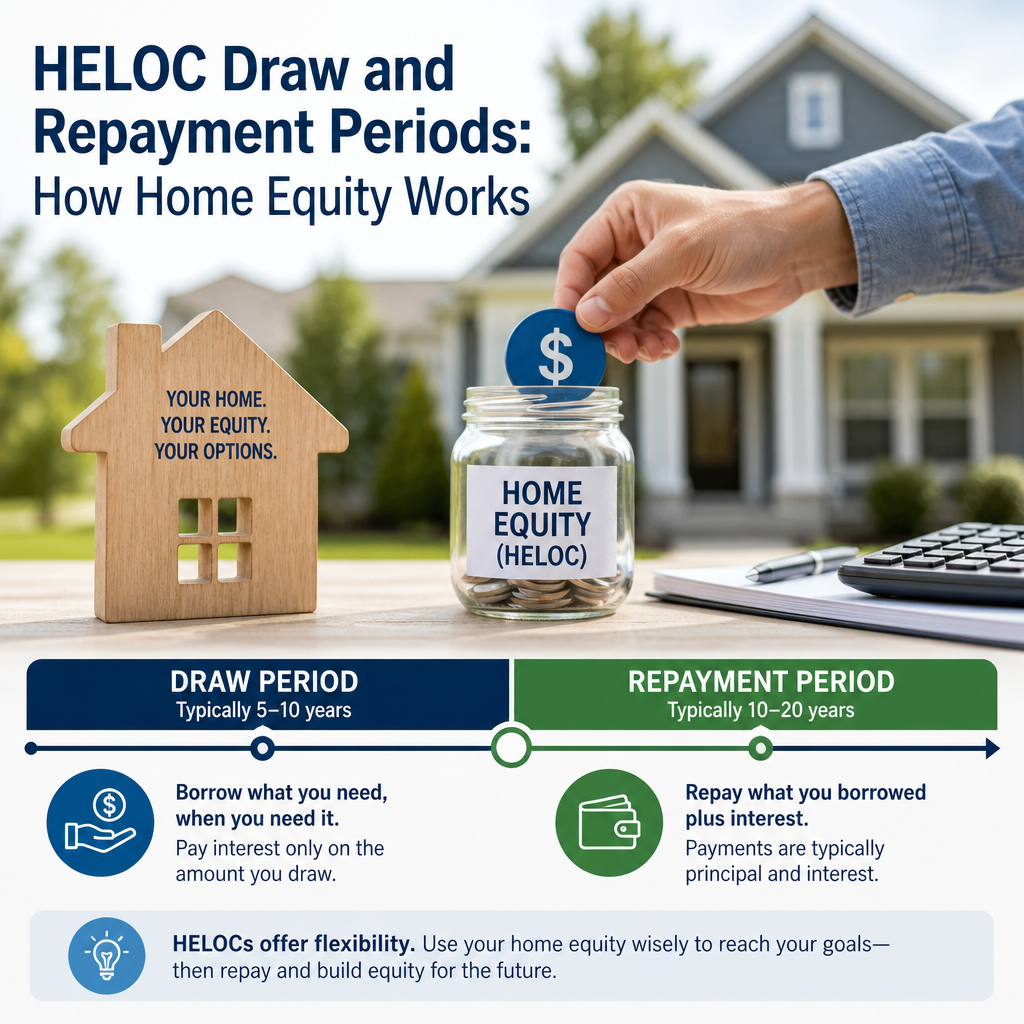
The most important thing to understand about HELOC draw and repayment periods is that the loan has two distinct phases.
1. Draw period
The draw period is the time when you can borrow from your available credit line. This period often lasts several years, though exact terms vary by lender.
During the draw period, you may be able to:
Take money out as needed
Make interest-only payments
Reborrow funds after paying them back, up to your credit limit
This is the phase that gives a HELOC its flexibility. If you’re funding a kitchen remodel in stages or covering uneven expenses, the draw period can be especially useful.
2. Repayment period
Once the draw period ends, the repayment period begins. At that point, you can no longer withdraw funds from the line of credit. Instead, you must pay back the outstanding balance, usually with principal and interest.
This is where many borrowers get surprised. Payments can increase significantly because you’re no longer making interest-only payments on the amount used. Now you’re repaying the borrowed balance itself.
How the Draw Period Works in Practice
During the draw period, your lender sets a credit limit and allows you to borrow against it. You do not need to use the full amount, and you can often borrow in multiple transactions.
Example of a HELOC draw period
Suppose you’re approved for a $60,000 HELOC. You borrow:
$15,000 for a bathroom remodel
$8,000 later for roof repairs
$5,000 for a tuition bill
At that point, you’ve used $28,000 and still have $32,000 available, assuming your lender allows continued borrowing up to the limit.
If your agreement allows interest-only payments during the draw period, your required monthly payment may be lower than with a traditional installment loan. But that does not mean the debt is disappearing—only that principal repayment may be delayed.
What can affect your draw period?
Lenders may impose rules such as:
Minimum withdrawal amounts
Limits on how often you can borrow
Annual or inactivity fees
Rate changes based on market conditions
It’s also common for HELOCs to have a variable interest rate tied to a benchmark rate plus a margin. That means your payment can change even before the repayment period begins.
What Happens During the Repayment Period?
When the draw period ends, the repayment period starts automatically according to your loan terms. At this point, the account works very differently.
Key changes in repayment
You can no longer borrow additional funds
Outstanding balances must be repaid
Monthly payments usually increase
Interest and principal are both included in the payment
This shift can be one of the biggest financial changes in a HELOC. If you borrowed near the end of the draw period, or if you made interest-only payments for years, the new monthly amount may feel much larger.
Why repayment can be a shock
Many borrowers focus on the initial flexibility and low early payments. But once the repayment phase begins, the balance must be fully amortized over the remaining term. That can mean a significant increase in monthly obligations.
For example:
During the draw period, you may pay only interest on what you borrowed
During repayment, you may owe principal plus interest on the remaining balance
That is why planning ahead is essential. A HELOC can be a smart tool, but only if you understand the payment reset that comes later.
Common HELOC Terms You Should Know
Before signing, review the loan agreement carefully. The following terms often appear in HELOC disclosures and can affect how the loan works.
Credit limit
Your maximum borrowing amount. This is not the amount you have to use; it’s the ceiling for the line.
Draw period length
The time window during which you can borrow funds.
Repayment period length
The time after the draw period when you must pay back the balance.
Variable interest rate
A rate that can go up or down based on the market. This is common in HELOCs.
Interest-only payment
A payment that covers interest but not principal. This may be available during the draw period.
Margin
The amount the lender adds to the index rate to determine your interest rate.
Understanding these terms can help you compare offers more accurately.
Pros and Cons of HELOC Draw and Repayment Periods
A HELOC can be useful, but the structure has both benefits and drawbacks.
Advantages
Flexibility: Borrow only what you need
Lower initial payments: Interest-only payments may ease cash flow
Reusability: You can often reborrow funds during the draw period
Good for staged expenses: Helpful for projects with changing costs
Potential downsides
Variable rates: Payments can rise if rates increase
Payment shock: Repayment phase may bring higher monthly bills
Collateral risk: Your home secures the debt
Temptation to overspend: Easy access to credit can lead to larger balances
A HELOC works best when you have a clear purpose and a realistic repayment plan.
Smart Ways to Use a HELOC
Because HELOCs are tied to your home, it makes sense to use them for expenses that have lasting value or a clear payoff.
Common use cases
Home improvements
Major repairs
Debt consolidation
Education expenses
Emergency cash reserves
A practical example
A homeowner might use a HELOC to replace an aging HVAC system and repair a leaking roof. These projects protect the home’s value and address urgent needs. In that case, the HELOC is being used for something tangible, not routine spending.
That doesn’t mean you should never use a HELOC for other goals. But if the expense won’t produce a lasting benefit, it’s worth asking whether the borrowing cost is justified.
How to Prepare for the Repayment Period
The smartest HELOC borrowers plan for repayment before the draw period ends. If you wait until the last minute, the higher monthly payment can be hard to absorb.
1. Check your loan timeline
Find out:
When the draw period ends
How long the repayment period lasts
Whether the rate is fixed or variable
Put the date on your calendar well in advance.
2. Estimate your future payment
Use your current balance, the remaining term, and the interest rate to estimate what repayment may look like. Even a rough estimate can help you avoid surprises.
3. Reduce the balance early
If possible, pay down more than the minimum during the draw period. Extra principal payments can make repayment much easier later.
4. Build a cushion
Create room in your budget before the repayment period starts. That may mean:
Cutting discretionary spending
Redirecting savings
Paying off other high-interest debt
Preparing for possible rate increases
5. Consider refinancing or restructuring
In some cases, homeowners refinance into a different product before repayment begins. Whether that makes sense depends on current rates, your credit, home value, and financial goals.
HELOC vs. Other Borrowing Options
Choosing a HELOC is not just about access to money. It’s about matching the borrowing method to your financial needs.
HELOC may be a better fit if:
You need funds in stages
You want access to a credit line over time
You can handle a variable rate
You have a repayment strategy
A home equity loan may be better if:
You want one fixed lump sum
You prefer predictable monthly payments
You don’t need ongoing access to funds
A personal loan may be better if:
You want unsecured borrowing
You have a smaller borrowing need
You prefer a fixed repayment schedule without using your home as collateral
Each option has trade-offs. The right choice depends on your budget, your risk tolerance, and how you plan to use the money.
Questions to Ask Before Opening a HELOC
Before you apply, make sure you understand the fine print. Ask the lender:
How long is the draw period?
How long is the repayment period?
Is the interest rate variable or fixed?
Are there annual fees, closing costs, or early closure fees?
Can I make principal payments during the draw period?
What happens if I can’t make the payment after the draw period ends?
Is there a limit on how much I can borrow at one time?
The more clarity you get upfront, the better prepared you’ll be later.
Frequently Asked Questions
What is the difference between a HELOC draw period and repayment period?
The draw period is when you can borrow money from the line of credit, while the repayment period is when you stop borrowing and start paying back the balance. During repayment, monthly payments usually increase because you’re paying both principal and interest.
Can I pay off a HELOC during the draw period?
Yes. You can usually make payments toward principal during the draw period, and in many cases you can reborrow the funds later if your account is still open and in good standing. Paying down the balance early can reduce interest costs and make repayment easier.
Do HELOC payments always stay the same?
No. Many HELOCs have variable interest rates, so your payment can change even during the draw period. When the repayment period starts, your payment often changes again because principal repayment is added.
What happens if I still owe money when the repayment period begins?
You will need to start repaying the remaining balance according to the terms of your agreement. Your lender will generally calculate a payment that amortizes the balance over the remaining term, which may be much higher than the interest-only amount you were paying before.
Is a HELOC a good idea for home renovations?
A HELOC can be a practical option for renovations, especially if the project will happen in stages or if the final cost is uncertain. It gives you flexible access to funds. Still, you should compare it with other financing options and make sure you can handle the repayment period later.
A HELOC can be a flexible and useful way to borrow against the equity in your home, but the structure matters just as much as the rate or credit limit. Understanding HELOC draw and repayment periods helps you avoid surprises, especially when the repayment phase begins and monthly payments can rise. The draw period offers convenience and access, while the repayment period brings the real test of affordability.
Before opening a HELOC, review the timeline, rate structure, fees, and payment terms closely. Think about how you’ll use the funds, how much debt you can comfortably carry, and how you’ll handle repayment later. If you plan ahead, make extra payments when possible, and choose the borrowing option that fits your needs, a HELOC can support your goals without putting unnecessary strain on your budget.
The key is to borrow intentionally, not casually. When you understand the full lifecycle of the account, you can use home equity more wisely and with far greater confidence.
Sarah Mitchell
Mary S, CFP®, is a Certified Financial Planner with over 12 years of experience in personal finance, retirement planning, and wealth management. She writes educational content that helps readers understand financial concepts and make informed decisions based on reliable information.