Federal Workers’ Compensation: How FECA Benefits Support Injured Employees
Federal workers compensation under FECA helps injured federal employees cover medical care, wage loss, and recovery-related costs after a work-related injury or illness. Knowing your benefits can make a stressful situation much easier to manage.
By: Emilly Adams on July 28, 2026
When a federal employee gets hurt on the job, the impact can reach far beyond the immediate injury. Medical bills can pile up, work hours may be lost, and recovery can take weeks, months, or even longer. For employees of the federal government, the primary safety net is the Federal Employees’ Compensation Act (FECA).
FECA provides workers’ compensation benefits to eligible federal workers who suffer work-related injuries or illnesses. It is designed to help injured employees recover without facing the full financial burden alone. Understanding how FECA works can make a major difference when an accident happens.
What Is FECA?
The Federal Employees’ Compensation Act is a federal law that provides compensation benefits to civilian employees of the United States government who are injured or become ill because of their work. It is administered by the Office of Workers’ Compensation Programs (OWCP) within the U.S. Department of Labor.
Unlike a private insurance policy, FECA is a statutory benefits program. That means eligible employees receive benefits based on the law, not on an employer’s discretion. The goal is to cover medical treatment, wage loss, and certain other costs related to a job-related injury or illness.
FECA applies to many federal workers, including employees in agencies such as:
The Department of Veterans Affairs
The Postal Service
The Department of Homeland Security
The Department of Defense
Other civilian federal agencies
It generally does not cover military personnel or most independent contractors.
Why FECA Matters for Injured Federal Employees
A workplace injury can affect every part of life. Even a relatively minor injury may require doctor visits, physical therapy, modified duties, or time away from work. More serious injuries can lead to extended recovery periods and permanent limitations.
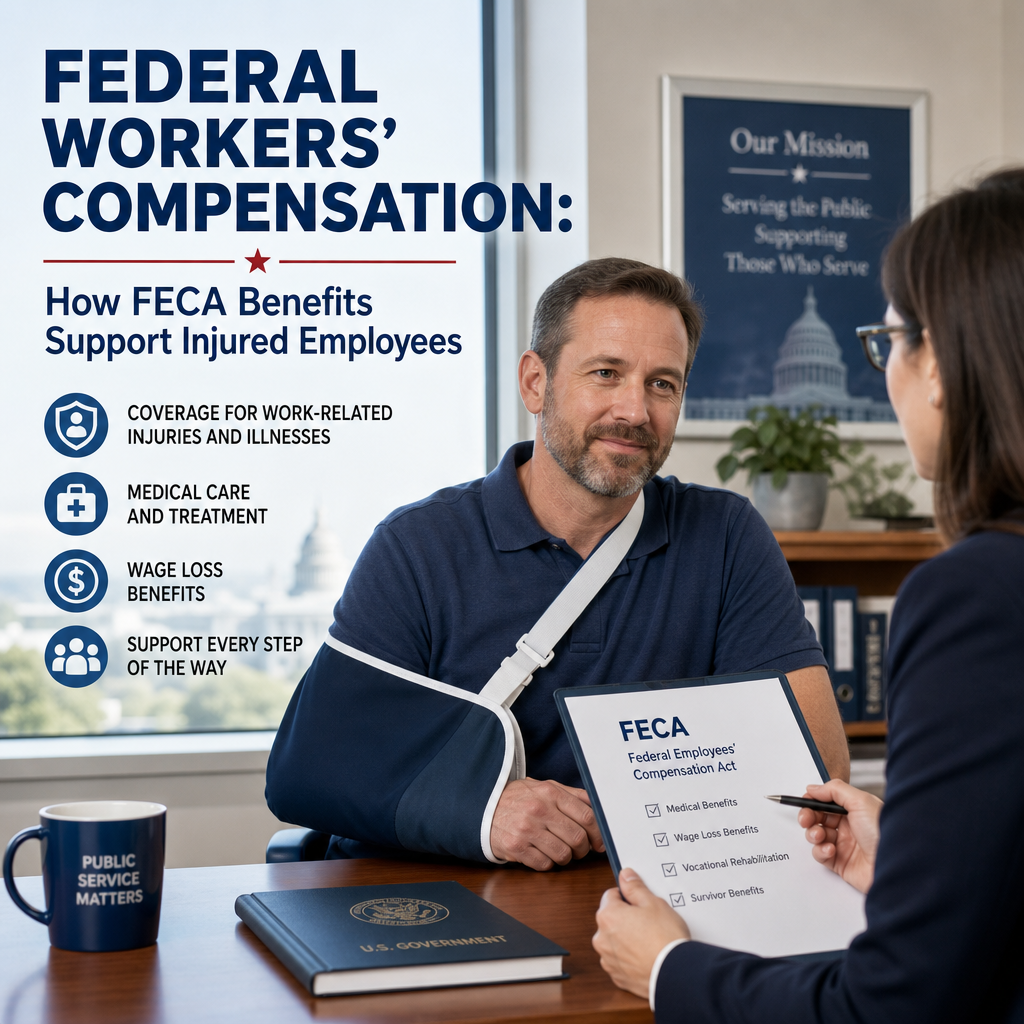
FECA matters because it provides a structured system for support. Instead of relying solely on personal savings, private health insurance, or leave balances, injured employees may receive benefits that help with:
Medical care
Partial wage replacement
Vocational rehabilitation
Compensation for permanent impairment in some cases
Survivor benefits for eligible dependents if a work injury results in death
This support helps workers focus on healing while protecting their financial stability.
Who Is Covered Under FECA?
FECA covers most federal civilian employees. Coverage is generally available when the injury or illness is linked to the employee’s job duties or work environment.
Examples of covered incidents may include:
A postal worker slipping on wet pavement while delivering mail
An office employee developing carpal tunnel syndrome from repetitive typing
A park ranger sustaining an injury during field duty
A maintenance worker getting hurt while repairing government property
An employee exposed to hazardous materials during work
To qualify, the injury or illness must typically arise in the performance of duty. This is an important standard under FECA. It means the condition must be connected to the employee’s federal work, not just something that happened at random.
Types of FECA Benefits
FECA offers several important benefits for injured federal employees. The exact benefits depend on the nature and severity of the injury.
1. Medical Benefits
One of the most important parts of FECA is coverage for medical treatment related to the work injury or illness. This can include:
Doctor visits
Hospital care
Surgery
Prescription medication
Physical therapy
Medical equipment and supplies
Diagnostic testing
Follow-up care
These benefits are intended to cover treatment necessary to cure, relieve, or reduce the effects of the accepted condition. In many cases, the employee can choose a treating physician, as long as the provider is authorized and the claim is properly managed.
2. Wage-Loss Compensation
If an injury prevents an employee from working, FECA may provide wage-loss benefits. These benefits help replace part of the income lost due to time away from work.
Wage-loss compensation is generally based on a percentage of the employee’s pay, not the full salary. The amount depends on factors such as family status and whether the employee is totally or partially disabled.
There are several forms of wage-loss benefits, including:
Total disability compensation when the employee cannot work at all
Partial disability compensation when the employee can work but earns less because of the injury
Schedule awards for permanent loss or impairment of specific body parts or functions
For many workers, wage-loss compensation is one of the most essential FECA benefits because it helps bridge the gap during recovery.
3. Schedule Awards
A schedule award may be available when a work-related injury causes permanent impairment to certain body parts or bodily functions. These awards apply to specific losses, such as:
Arms
Legs
Hands
Feet
Eyes
Hearing
The amount and duration of a schedule award depend on the severity of the impairment and the body part affected. Even if an employee returns to work, a permanent loss can still qualify for this type of compensation.
4. Vocational Rehabilitation
Sometimes an injured employee cannot return to the same job because of permanent limitations. FECA may provide vocational rehabilitation services to help the employee reenter the workforce.
This may include:
Job training
Resume assistance
Skills assessment
Counseling
Placement support
The purpose is to help the employee transition into suitable employment if the original position is no longer possible.
5. Death Benefits for Survivors
If a work-related injury or illness results in death, FECA can provide benefits to eligible survivors. These benefits may include:
Compensation for a surviving spouse
Benefits for dependent children
Funeral and burial expense reimbursement
These benefits are meant to ease the financial burden on families who lose a loved one because of a work-related incident.
How FECA Claims Work
The FECA claims process can seem complicated, but it follows a general path. Understanding the basics can make it easier to act quickly after an injury.
Step 1: Report the Injury
The first step is to notify the employer as soon as possible. Delaying a report can create problems later, especially if there is a question about whether the injury happened at work.
Employees should provide:
The date and time of the incident
A description of what happened
The body part or condition involved
Any witnesses to the event
Whether medical treatment was needed
Prompt reporting helps preserve evidence and supports the claim.
Step 2: Seek Medical Care
Employees should get medical treatment right away if needed. The doctor’s records can be critical in connecting the condition to the work incident.
Medical documentation should clearly describe:
The diagnosis
The cause of the injury or illness
Work limitations
Recommended treatment
Expected recovery time
Step 3: File the Appropriate Claim
The employee must usually submit the required FECA claim form to the agency. In many cases, this involves Form CA-1 for traumatic injuries or Form CA-2 for occupational diseases or illnesses.
The difference matters:
Traumatic injuries happen during a specific event or shift
Occupational diseases develop over time because of work exposure or duties
Filing the correct form is important for the claim to be processed properly.
Step 4: Agency Review and OWCP Decision
Once the claim is submitted, the employer and OWCP review the information. They may request additional medical evidence or witness statements before making a decision.
OWCP then decides whether the injury or illness is covered under FECA and what benefits apply.
Common Challenges in FECA Cases
Although FECA is designed to protect federal employees, claims are not always approved quickly or without dispute. Some common challenges include:
Lack of timely reporting
Incomplete medical records
Disagreement about whether the injury happened in the performance of duty
Questions about whether the condition is work-related
Delays in submitting forms or documentation
Disputes about disability status or return-to-work ability
For example, an employee who develops back pain may believe it is caused by repetitive lifting at work, but OWCP may require strong medical evidence showing the connection. Similarly, a stress-related claim may require detailed proof of work-related factors and medical diagnosis.
Because of these issues, documentation is often one of the most important parts of a successful claim.
Examples of How FECA Helps Injured Employees
Real-life situations can make FECA easier to understand. Here are a few examples.
Example 1: A Postal Carrier With a Knee Injury
A mail carrier slips on icy steps while delivering mail and injures a knee. The employee sees a doctor, misses several weeks of work, and later needs physical therapy.
Under FECA, the employee may receive:
Payment for approved medical care
Wage-loss compensation while unable to work
Additional benefits if the injury causes permanent impairment
Example 2: A Federal Office Worker With Repetitive Strain
An administrative assistant develops severe wrist pain after years of typing and data entry. A specialist diagnoses a repetitive strain condition linked to the employee’s duties.
Possible FECA benefits may include:
Treatment such as splints, therapy, or surgery
Compensation for time away from work
Vocational rehabilitation if permanent restrictions prevent a return to the same tasks
Example 3: A Field Inspector Exposed to Hazardous Materials
A federal inspector develops a respiratory condition after repeated exposure to toxic substances during field visits. After medical evaluation, the illness is linked to the employee’s work environment.
In this case, FECA may help with:
Medical testing and treatment
Wage replacement during recovery
Long-term disability benefits if the condition becomes permanent
These examples show how FECA can support workers in different types of roles and injury situations.
FECA vs. Other Benefits
Federal workers sometimes wonder how FECA interacts with other benefits such as sick leave, annual leave, or private disability insurance.
In general, FECA is separate from leave benefits. An injured employee may use leave initially, but once FECA benefits are approved, wage-loss compensation may replace the need to rely entirely on leave balances.
Some important points to remember:
FECA is for work-related injuries and illnesses
Sick leave and annual leave are general employment benefits
Private disability insurance may have different rules and requirements
FECA benefits are not based on fault
This means an employee usually does not need to prove negligence. The main issue is whether the injury or illness is connected to federal work.
Tips for Protecting a FECA Claim
Employees can strengthen their FECA claims by taking a few practical steps early on.
Keep Detailed Records
Save copies of:
Incident reports
Medical records
Work restrictions
Witness statements
Emails about the injury or modified duties
Follow Medical Advice
Follow the treatment plan and attend appointments. Gaps in treatment may raise questions about the severity of the condition.
Communicate Clearly
Be consistent when describing how the injury happened and what symptoms are present. Conflicting statements can make a claim harder to support.
Meet Deadlines
FECA has filing requirements and time limits. Missing deadlines can complicate or even jeopardize benefits.
Document Work Limitations
If a doctor recommends restrictions, make sure they are clearly documented. This helps support wage-loss or light-duty issues.
Frequently Asked Questions
1. What is the difference between a traumatic injury and an occupational disease under FECA?
A traumatic injury results from a specific incident or activity occurring during a single workday or shift and is generally reported using Form CA-1. An occupational disease develops from work conditions or exposures occurring over more than one workday and is generally reported using Form CA-2.
2. Which benefits may an injured federal employee receive?
Depending on the accepted condition and resulting limitations, FECA may provide medical treatment, continuation of pay, wage-loss compensation, schedule awards for permanent impairment, vocational rehabilitation, and survivor benefits following a work-related death.
3. Does FECA replace an employee’s entire salary during disability?
Not usually. FECA wage-loss compensation is generally paid at two-thirds of the employee’s pay rate or three-fourths when the employee has at least one qualifying dependent. Different rules may apply to continuation of pay and partial disability.
4. How does a federal employee file a FECA claim?
The employee should report the injury to the employing agency and use the Employees’ Compensation Operations and Management Portal when available. Supporting medical evidence should explain the diagnosis, employment factors, treatment, and connection between the condition and federal work.
5. What can an employee do if OWCP denies the claim?
The decision will explain the reason for denial and the available review rights. Depending on the situation, the employee may request reconsideration, an oral hearing, a review of the written record, or an appeal to the Employees’ Compensation Appeals Board within the applicable deadline.
Federal workers’ compensation through FECA plays a vital role in protecting injured federal employees. It helps cover medical care, replace lost wages, support workers with permanent impairments, and assist families after fatal workplace incidents. For federal employees facing an injury or occupational illness, FECA can be the difference between financial strain and a stable path to recovery.
Knowing how the system works, reporting injuries quickly, and keeping strong medical documentation can make the claims process smoother. For many federal workers, FECA is not just a benefit program—it is an essential source of support when the unexpected happens.
Emily A, holds a Master's degree in Public Administration (MPA) and has over 7 years of experience researching federal and state assistance programs. She writes educational content focused on government benefits, public policy, and community resources, using information from official agencies to help readers understand available programs and eligibility requirements.