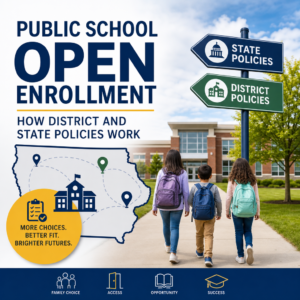
Public School Open Enrollment: How District and State Policies Work
Public school open enrollment can give families more choice in where their children go to school, but the rules depend on state and district policies. Understanding how these policies work can help parents find the right fit and avoid surprises during the application process.
By: Jennifer Collins on July 27, 2026
Public school open enrollment gives families more flexibility in choosing where their children attend school. Instead of being limited strictly to the school assigned by home address, students may be able to attend a different public school within the same district or even in another district, depending on state and local rules. For many families, open enrollment can mean access to a school with a stronger academic program, a better fit for a child’s learning style, or a more convenient location.
But open enrollment is not the same everywhere. Policies can vary widely by state, school district, and even by individual school. Understanding how these rules work can help parents make better decisions and avoid surprises during the application process.
What Is Public School Open Enrollment?
Open enrollment is a policy that allows students to attend a public school outside their assigned attendance zone. In traditional school assignment systems, a child attends the public school tied to their home address. Open enrollment creates more choice by letting families apply for a different school, subject to certain rules.
There are two common forms:
Intra-district open enrollment
This allows students to attend a school within the same school district but outside their neighborhood assignment.
Example: A student who lives in one part of a district may apply to a magnet program or a different elementary school elsewhere in the same district.
Inter-district open enrollment
This allows students to transfer to a school in a different school district.
Example: A family living near a district line may want to send their child to a neighboring district with a specialized program or shorter commute.
Open enrollment is often confused with school choice programs, charter schools, and private school options. While these can all offer alternatives, open enrollment specifically refers to access to another public school or district under state and local policy.
Why Families Consider Open Enrollment
Families pursue open enrollment for many reasons, including:
Academic programs such as advanced coursework, STEM, arts, or language immersion
School culture and environment that better fits a child’s personality or needs
Location and convenience, especially if a school is closer to a parent’s workplace or a childcare provider
Athletics, arts, or extracurricular opportunities
Safety or class size concerns
Special education or support services that may be a better match for the student
For some families, the assigned school works well. For others, open enrollment can be a practical way to find a better educational fit.
How State Policies Shape Open Enrollment
States set the legal framework for open enrollment. Some states make school choice relatively broad, while others limit transfers significantly. State policies can determine whether open enrollment is available at all, whether it is voluntary or mandatory for districts, and what rules districts must follow.
Key questions state policies answer
State law may address:
Whether districts must accept transfer students
Which students are eligible
Whether transfers are allowed within a district, between districts, or both
How applications are reviewed
Whether transportation is provided
Whether schools can limit enrollment based on capacity
Whether there are deadlines and renewal requirements
In some states, open enrollment is a statewide right with broad access. In others, districts may choose whether to participate. Some states even have separate rules for students transferring for special circumstances such as military moves, foster care, or family hardship.
Mandatory vs. voluntary participation
State policies often fall into one of two categories:
Mandatory participation: Districts are required to accept transfer applications unless they have a valid reason to deny them, such as lack of space.
Voluntary participation: Districts can choose whether to participate in open enrollment, and if they do, they may set their own limits and procedures.
A mandatory system generally gives families more options. A voluntary system may still offer opportunities, but access can be uneven depending on where a family lives.
Enrollment caps and priority rules
Even in states with open enrollment, a school may not have to accept every applicant. State law may permit districts to cap enrollment based on available seats, staffing, or program capacity. If more students apply than the school can take, the district may use a lottery or priority system.
Common priority factors include:
Siblings already attending the school
Children of district employees
Students living within the district boundaries
Students with specific program needs
Transfer history or previous attendance
These rules help districts manage space, but they can also make it harder for some students to get into popular schools.
How District Policies Work
Even when state law allows open enrollment, districts usually handle the day-to-day process. District policy determines the practical details families need to know.
Application windows
Most districts have specific application periods. These may occur:
In the fall for the following school year
In the winter or early spring
On a rolling basis if seats remain available
Missing a deadline can mean waiting another year, so families should check dates carefully. Some districts also require separate applications for elementary, middle, and high school transfer requests.
Required documents
Districts often ask for documents such as:
Proof of residency
Birth certificate or other proof of age
Immunization records
Report cards or transcripts
Attendance or discipline records
Special education records, if applicable
These documents help the district determine eligibility and placement.
Space availability
A school may deny a transfer request if it does not have room. Districts may consider:
Classroom capacity
Building size
Teacher availability
Program-specific limits
For example, a district might accept open enrollment students in general education but not in an already full dual-language program.
Academic and behavior expectations
Some districts review a student’s attendance, grades, or discipline record before approving a transfer. Others focus only on space and eligibility. Policies vary, but the goal is usually to ensure that transfer students can participate successfully in the school environment.
Renewal and staying enrolled
A student who is accepted through open enrollment may not always have automatic permission to stay forever. Some districts require annual renewal or reapplication. Others allow a student to continue as long as the family remains in good standing and the school still has capacity.
Families should understand whether a transfer is:
One-time approval
Approved through graduation
Reviewed annually
Conditioned on continued residency or behavior standards
Transportation: A Critical Piece of the Puzzle
Transportation is one of the biggest practical issues in open enrollment. Even if a transfer is approved, getting to school may be the family’s responsibility.
What districts usually provide
In many cases, districts provide transportation only for students attending their assigned neighborhood school. Transfer students may not receive bus service, or they may only be eligible if they live within a certain area.
Why transportation matters
A school may look ideal on paper but be difficult to attend if the commute is too long. Families should ask:
Is bus service available?
If not, how far is the drive?
What are morning drop-off and afternoon pickup options?
Does the family have a backup plan for transportation?
Example
A parent may choose a district two towns away because it offers a strong music program. But if the district does not provide transportation for transfer students, the family must decide whether the daily commute is realistic.
Open Enrollment and Special Programs
Some schools have specialized programs that draw applicants from beyond their normal attendance zones. These include:
Magnet schools
STEM academies
Language immersion programs
Arts-focused schools
Career and technical education programs
These schools may have separate application rules in addition to open enrollment policies. In some districts, admission is based on a lottery. In others, students must meet academic criteria, audition, or demonstrate interest in the program.
Example of a magnet school process
A district might allow open enrollment to a magnet middle school with a robotics focus. Families submit an application, and if the number of applicants exceeds the number of available seats, the district uses a lottery. Students who are accepted can then attend the school even if they do not live in that attendance zone.
How Open Enrollment Affects School Funding
School funding can be tied to student enrollment, which makes open enrollment important not only for families but also for districts. When a student transfers, the funding associated with that student may move with them, depending on state formula rules.
For receiving districts
A district that accepts more students may receive additional funding, which can support staffing and programs. However, too many transfer students can also strain classrooms and services if growth happens too quickly.
For sending districts
When students leave a district, it may lose funding. That can create pressure on local budgets, especially if many families transfer out at once.
This is one reason districts may set limits or carefully track transfer numbers. Open enrollment can expand choice, but it also affects how schools plan and allocate resources.
Rights, Restrictions, and Equity Concerns
Open enrollment can increase opportunity, but it may not work equally for every family. Access often depends on the quality of information, available transportation, application timing, and whether schools have capacity.
Potential benefits
More educational options
Better fit for student needs
Access to specialized programs
Competition that may encourage school improvement
Potential drawbacks
Unequal access for families without transportation
Confusing rules and deadlines
Limited seats in popular schools
Possible loss of neighborhood school connection
Challenges for students with special needs if services differ by site
Equity considerations
Families with more time, flexibility, and knowledge of the system may be better positioned to take advantage of open enrollment. That is why districts that want to make choice more equitable often provide clear guides, multilingual materials, and help lines for parents.
How to Evaluate an Open Enrollment Option
If a family is considering a transfer, it helps to look beyond test scores or school rankings. The best school is not always the one with the most public attention; it is the one that meets a child’s needs consistently.
Questions to ask
Does the school offer the program my child needs?
How far is it from home?
Is transportation provided?
Are there deadlines or annual renewal requirements?
What happens if the school becomes full?
How does the school support students with learning differences?
What are the class sizes and extracurricular options?
Can my child remain enrolled through the next grade levels?
A simple decision-making approach
Families can think about:
Academic fit — Will the school challenge and support my child appropriately?
Logistical fit — Can we manage transportation and schedule changes?
Social fit — Will my child feel comfortable and supported there?
Long-term fit — Can the student stay there for multiple years?
Example Scenarios
Scenario 1: Intra-district choice
A third grader attends an elementary school assigned by neighborhood, but the family applies to another school in the same district because it has a stronger reading intervention program. The district approves the transfer because space is available.
Scenario 2: Inter-district transfer
A high school student wants to join a neighboring district’s arts academy. The state allows inter-district open enrollment, but the receiving district only has a few seats. The student applies during the open enrollment window and is accepted through a lottery.
Scenario 3: Denial due to capacity
A middle school is popular because of its dual-language program. The district receives more applications than available seats and denies some transfers, even though the students meet all eligibility requirements.
These examples show how policy, space, and demand all affect outcomes.
Frequently Asked Questions
1. What is public school open enrollment?
Public school open enrollment allows a student to apply to a public school other than the one assigned according to the student’s home address. Availability and eligibility rules vary by state and school district.
2. What is the difference between intradistrict and interdistrict open enrollment?
Intradistrict enrollment allows students to transfer to another school within their current district. Interdistrict enrollment allows them to apply to a school located in a different public school district.
3. Is acceptance through open enrollment guaranteed?
No. Approval may depend on available classroom space, grade-level capacity, program requirements, application deadlines, enrollment priorities, and state or district policies.
4. Does the receiving school provide transportation?
Transportation policies vary. Some districts provide transportation, while others require families to arrange and pay for it. Parents should confirm transportation rules before accepting a placement.
5. Can students with disabilities participate in open enrollment?
Students with disabilities may participate when permitted by applicable state and district policies. Public schools must also comply with federal protections under IDEA and Section 504 and provide eligible students with appropriate educational services.
Public school open enrollment can be a valuable option for families seeking a better educational match, but it is shaped by a mix of state law and district rules. State policies determine the basic framework, while district policies set the real-world process for applications, admissions, transportation, and renewal.
For parents, the key is to understand the details early. Deadlines, capacity limits, and transportation rules can make a big difference. With the right information, open enrollment can open doors to more flexible and personalized public school choices.
Jennifer, M.Ed., holds a degree in Higher Education Administration, with
a focus on U.S. college financial aid, admissions policy, and student
support systems. She researches and writes about scholarships, federal
aid programs, and the college planning process to help students and
families make informed, well-supported decisions.