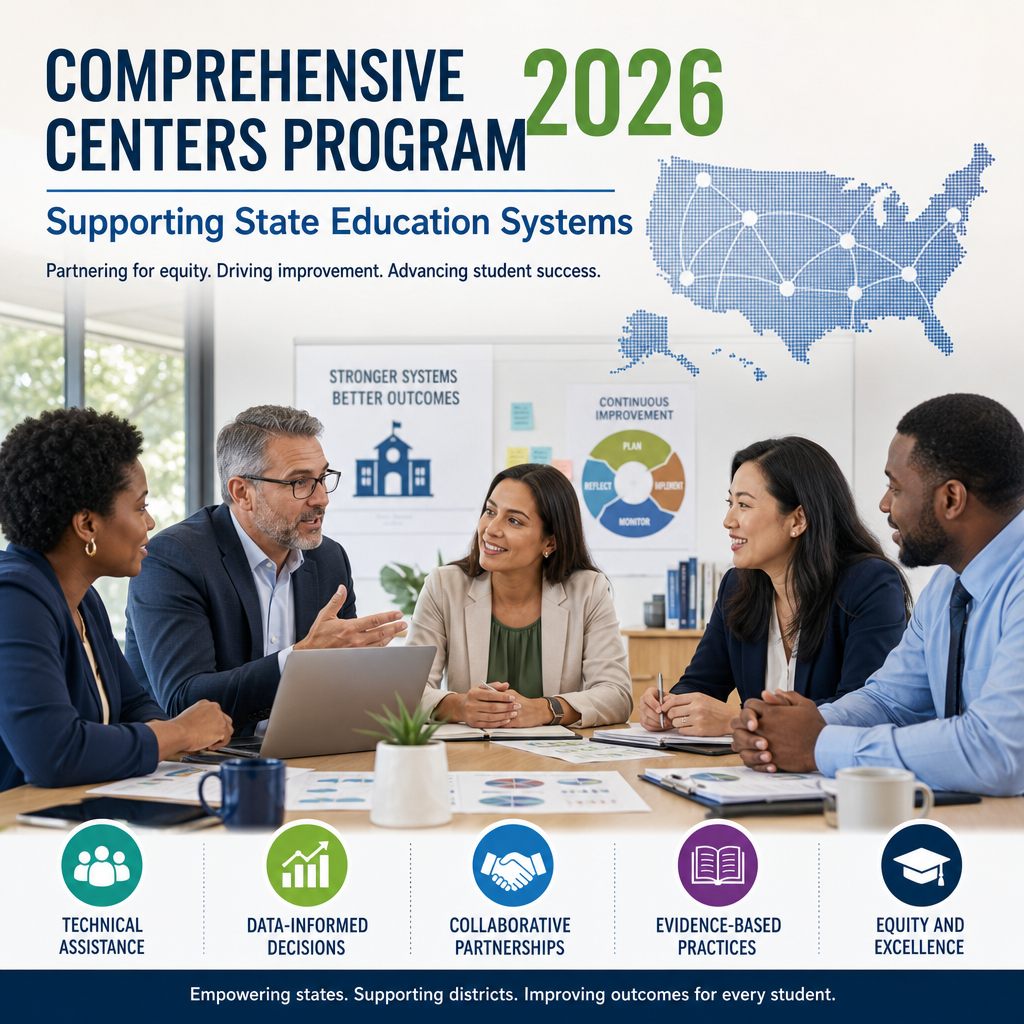
Comprehensive Centers Program 2026: Supporting State Education Systems
The Comprehensive Centers Program helps state education systems tackle today’s biggest challenges with practical, research-based support. In 2026, it serves as a trusted partner for states working to improve outcomes, strengthen capacity, and make lasting progress for students.
By: Jennifer Collins on July 27, 2026
State education systems face a growing list of responsibilities. They must improve academic outcomes, address chronic absenteeism, support multilingual learners, strengthen educator pipelines, and make smart use of limited resources. At the same time, many state education agencies are expected to respond quickly to policy changes, new data demands, and shifting community needs.
The Comprehensive Centers Program 2026 is designed to help meet those challenges. Built to support state education systems with technical assistance, research-based strategies, and sustained capacity building, the program plays an important role in helping states improve education for all students. Rather than offering one-time advice, the Comprehensive Centers work alongside state leaders to strengthen systems, solve problems, and build long-term improvements.
This article explores what the program is, how it supports state education systems, and why it matters in 2026 and beyond.
What Is the Comprehensive Centers Program?
The Comprehensive Centers Program is a federally supported technical assistance network that helps state education agencies and other education partners improve teaching, learning, and school systems. It provides expertise in areas such as:
Academic improvement
Leadership development
Data use and evaluation
Equity and access
School improvement
Student support services
Policy implementation
The program is structured to serve multiple states through regional and content-focused centers. These centers collaborate with state education leaders to identify priorities, analyze challenges, and implement strategies that are tailored to local needs.
In simple terms, the program acts as a partner for state education systems. It does not replace state leadership, but it strengthens the ability of states to lead effectively.
Why State Education Systems Need Support in 2026
The education landscape in 2026 is more complex than ever. States are dealing with a combination of long-standing issues and new pressures. These include pandemic recovery, declining attendance in some districts, staffing shortages, mental health concerns, and the need to improve outcomes for students who have historically been underserved.
State education agencies often must balance several realities at once:
Limited staff capacity
High public expectations
Complex accountability requirements
Diverse district and school needs
Rapid changes in technology and policy
Because of this, states need more than general guidance. They need targeted support that helps them build systems, not just fix isolated problems. The Comprehensive Centers Program addresses that need by focusing on capacity, implementation, and continuous improvement.
How the Comprehensive Centers Program Supports States
The biggest strength of the program is its focus on practical, sustained support. Instead of delivering generic training, the centers work with states to develop solutions that fit their goals and context.
1. Building State Capacity
A major goal of the program is to help state education agencies do their work more effectively. This means strengthening the systems, skills, and structures that allow states to support districts and schools over time.
For example, a center may help a state:
Improve its internal data systems
Create more efficient monitoring processes
Build leadership capacity among agency staff
Develop tools for school improvement support
This kind of support is especially valuable when a state is managing multiple initiatives and needs to coordinate efforts across departments.
2. Supporting Evidence-Based Decision-Making
State leaders are often asked to make important decisions quickly. The Comprehensive Centers Program helps states use evidence to guide those decisions. Centers may assist with:
Reviewing data trends
Identifying root causes of performance challenges
Selecting interventions backed by research
Evaluating whether strategies are working
For example, if a state wants to improve early literacy, a center might help analyze reading data, compare intervention models, and determine which strategies are most likely to succeed in local districts.
3. Assisting with Implementation
Even strong policies can fail if implementation is weak. The program recognizes that good ideas need strong execution. Centers help states move from planning to action by supporting:
Rollout timelines
Stakeholder communication
Professional learning
Progress monitoring
Adjustment of strategies based on feedback
This implementation support is critical because many state initiatives involve multiple layers of responsibility. Without a clear plan, even well-designed reforms can stall.
4. Promoting Equity and Access
One of the most important functions of the Comprehensive Centers Program is helping states identify and close equity gaps. States often want to improve outcomes for specific student groups, including:
Students with disabilities
Multilingual learners
Students experiencing poverty
Students in rural communities
Students of color
Students in foster care or experiencing homelessness
Centers can help states examine where inequities exist and design policies that promote fair access to opportunity. This may include supporting equitable funding models, improving educator preparation, or helping states ensure that interventions reach the students who need them most.
5. Strengthening School Improvement Efforts
Many states continue to support schools identified for comprehensive or targeted improvement. The Comprehensive Centers Program helps state leaders develop strategies that are specific, measurable, and realistic.
This can include:
Analyzing school performance data
Identifying priority needs
Supporting turnaround planning
Building district capacity to support schools
Monitoring progress over time
A state struggling with persistent low performance in a subset of schools may use center support to create a more focused and effective improvement system.
Examples of Support in Action
To understand how the program works, it helps to look at practical examples. While every state’s needs are different, the following scenarios show how centers may contribute.
Example 1: Improving Chronic Absenteeism
A state sees that student attendance rates have dropped in several regions. The Comprehensive Center helps the state examine attendance patterns by grade level, geographic area, and student group. Together, they identify possible causes such as transportation barriers, disconnected school climates, and family communication gaps.
The center then helps the state develop a response plan that includes:
Clear attendance data dashboards
Guidance for districts on family outreach
Strategies for re-engaging students
Training for school leaders on attendance supports
Instead of reacting to the problem in a fragmented way, the state builds a more coordinated system.
Example 2: Supporting Multilingual Learners
Another state wants to improve services for multilingual learners but finds that districts use inconsistent identification and support practices. A center helps the state review current policies and create clearer guidance for districts.
The support may include:
Reviewing intake and placement procedures
Developing professional learning for teachers
Creating monitoring tools for language development
Sharing examples of successful instructional models
As a result, the state gains more consistency and better outcomes across districts.
Example 3: Expanding Teacher Recruitment and Retention
In response to teacher shortages, a state asks for help improving recruitment and retention. A center works with state leaders to analyze where shortages are most severe and which factors contribute to turnover.
Together, they examine:
Compensation issues
Preparation pathways
Mentoring programs
Working conditions
Geographic staffing challenges
The center helps the state prioritize actions and align efforts across higher education, district partners, and workforce agencies.
The Role of Collaboration
The Comprehensive Centers Program is effective because it is collaborative. Centers do not impose solutions from the outside. Instead, they work with state education agencies to build trust, identify needs, and co-develop strategies.
This collaborative model matters because state systems are complex. A policy that works in one state may not work in another without adjustment. Centers understand that context matters. They listen first, then provide support based on the state’s goals, data, and constraints.
Collaboration also helps build ownership. When state leaders help shape a solution, they are more likely to use it, refine it, and sustain it after the center’s direct involvement ends.
Key Areas of Focus in 2026
While the program addresses a wide range of needs, several priority areas are likely to remain especially important in 2026.
Academic Recovery and Growth
Many states continue to focus on helping students recover from learning disruptions and accelerate academic growth. Centers can support states in identifying evidence-based strategies for literacy, mathematics, and attendance-related learning loss.
Educator Workforce Stability
Teacher and principal shortages remain a major concern. Centers may help states think through certification pathways, mentoring structures, and retention incentives to strengthen the educator pipeline.
Early Childhood and Early Literacy
Early learning remains a powerful lever for long-term success. The program can support states in improving kindergarten readiness, early literacy systems, and cross-agency coordination.
Data Systems and Continuous Improvement
As states collect more data, they need better systems for interpretation and action. Centers help agencies use data not just for reporting, but for decision-making and improvement planning.
Student Well-Being and Whole Child Supports
Academic success depends on more than test scores. States are increasingly focused on mental health, belonging, safety, and student engagement. Centers may support the integration of academic and nonacademic supports into broader state strategies.
How State Leaders Can Use the Program Effectively
To get the most from the Comprehensive Centers Program, state leaders should treat it as a strategic partnership. A few best practices can make the support more effective.
Be Clear About the Problem
States benefit most when they define the issue clearly. Instead of asking for broad help, it is useful to frame a specific challenge, such as improving literacy outcomes in high-need districts or strengthening compliance monitoring for special education services.
Use Data to Guide the Work
Centers are strongest when they can work from solid evidence. States should bring relevant data, including performance trends, survey results, and implementation findings.
Build Internal Ownership
The goal is not to depend forever on outside support. State agencies should involve internal teams early so that knowledge and skills remain after the center’s direct assistance ends.
Align Multiple Initiatives
Many states have several ongoing reforms at once. A center can help align these efforts so that staff time, funding, and communication are used efficiently.
Focus on Sustainability
States should ask how a new strategy will continue after the initial rollout. That may mean updating policy, building staff roles, or creating tools that can be maintained over time.
Why the Program Matters for Long-Term Improvement
The real value of the Comprehensive Centers Program is that it helps states build stronger systems. Education improvement is rarely achieved through isolated efforts. It depends on coordinated leadership, clear strategy, and the ability to adapt over time.
By helping states strengthen theirinternal capacity, the program supports improvements that can last beyond a single initiative or funding cycle. That is especially important in 2026, when states are expected to do more with fewer resources and respond to increasingly complex needs.
The program also reflects a practical truth: state education agencies do not have to solve every challenge alone. With the right support, they can improve their systems, support districts more effectively, and create better outcomes for students.
Frequently Asked Questions
1. What is the Comprehensive Centers Program?
The Comprehensive Centers Program is a federally funded network that provides capacity-building and technical assistance to state, regional, and local educational agencies and schools. Its purpose is to improve educational opportunities, instructional quality, and student outcomes.
2. What types of Comprehensive Centers operate within the program?
The network includes a National Comprehensive Center, Regional Comprehensive Centers, and specialized Content Centers. The 2026 competition also includes a National Center for Improving Literacy for Students with Disabilities.
3. What services do the centers provide?
Centers may help education agencies analyze data, select evidence-based practices, implement policies, improve school-support systems, develop leadership capacity, strengthen educator workforces, and evaluate whether improvement strategies are producing the intended results.
4. Can families or individual students receive financial assistance from the program?
No. The program does not provide scholarships or direct financial benefits to families and students. Its grants support organizations that deliver technical assistance and capacity-building services to education agencies and schools.
5. What is the status of the program in 2026?
The U.S. Department of Education announced a new Comprehensive Centers grant competition in May 2026. The fiscal year 2026 appropriation is $48.5 million, while the final number and amounts of new awards remain subject to the competition and selection process.
The Comprehensive Centers Program 2026 remains an important resource for state education systems facing urgent and ongoing challenges. Through technical assistance, collaboration, and evidence-based support, the program helps states strengthen capacity, improve implementation, and advance equity.
In a time when education systems must be both responsive and resilient, this kind of partnership matters. By supporting state leaders with the tools and expertise they need, the Comprehensive Centers Program helps build the foundation for lasting improvement across schools, districts, and communities.
Jennifer, M.Ed., holds a degree in Higher Education Administration, with
a focus on U.S. college financial aid, admissions policy, and student
support systems. She researches and writes about scholarships, federal
aid programs, and the college planning process to help students and
families make informed, well-supported decisions.