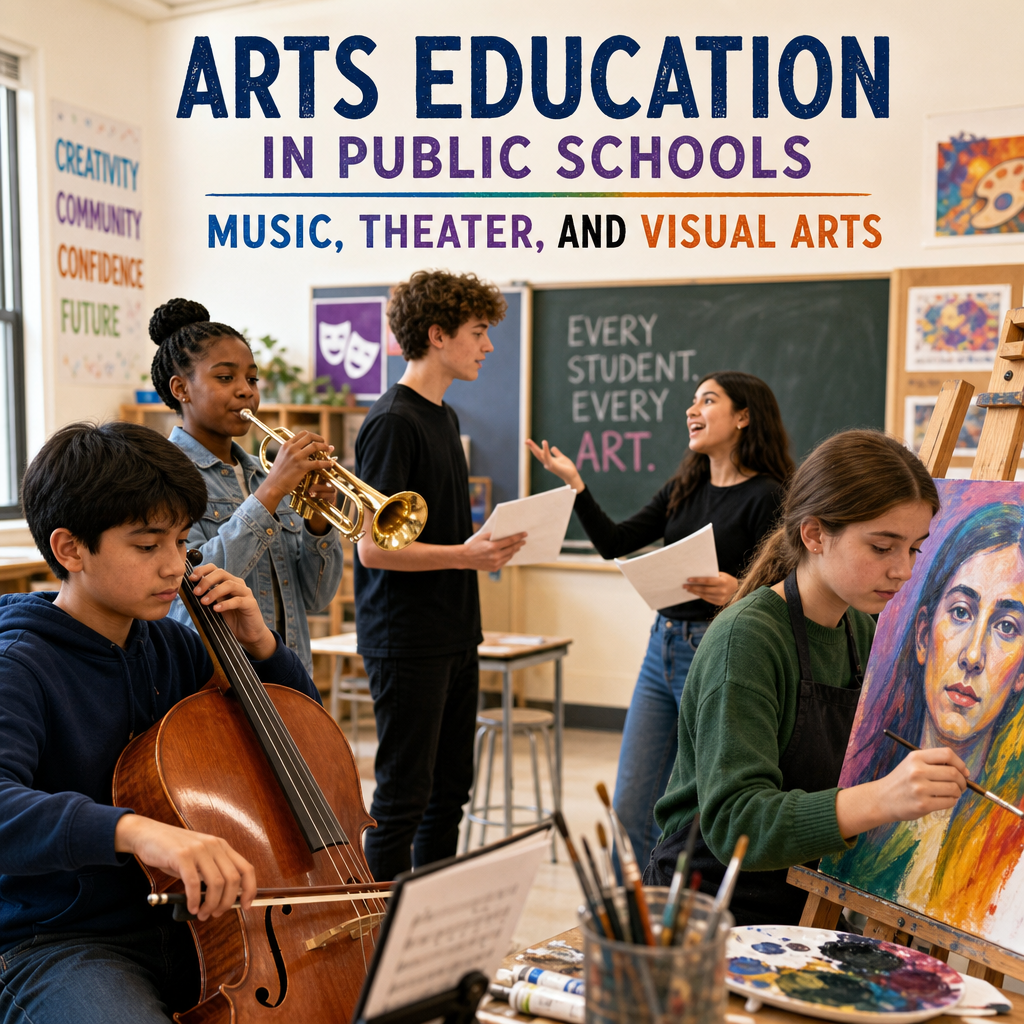
Arts Education in Public Schools: Music, Theater, and Visual Arts
Arts education in public schools gives students more than creative outlets—it builds confidence, teamwork, and problem-solving skills that support learning across every subject. From music and theater to visual arts, these programs help students stay engaged, express themselves, and thrive in school.
By: Jennifer Collins on July 27, 2026
Arts education has long been part of the public school experience, yet in many districts it is treated as optional rather than essential. When budgets tighten, music rooms lose teachers, theater programs are cut back, and visual arts classes are reduced to a few elective periods. But arts education is not a luxury. It is a core part of a well-rounded education that supports creativity, academic growth, social development, and student engagement.
Public schools that invest in music, theater, and visual arts programs give students more than a chance to paint, sing, or perform. They offer tools for communication, problem-solving, collaboration, and self-expression. These benefits extend far beyond the stage, studio, or classroom. They shape how students learn and how they see themselves.
Why Arts Education Matters
Arts education helps students develop skills that support success across subjects. A student who learns to read music or perform in a play is also practicing discipline, memory, attention, and teamwork. A child who draws, sculpts, or creates mixed-media projects is learning to observe carefully, make choices, and express ideas visually.
Research and classroom experience both show that the arts can improve school engagement. Students who feel connected to school are more likely to attend regularly, participate actively, and persist through challenges. For many children, the arts provide a place where they can excel even if traditional academic subjects are difficult.
Arts programs also make schools more inclusive. Not every student thrives in the same environment, and the arts open different pathways to learning. A quiet student may find confidence through acting. A student who struggles in math may shine in ceramics or choir. These experiences can help students discover talents and interests that might otherwise go unnoticed.
Music Programs: Building Discipline and Expression
Music education is one of the most common arts offerings in public schools, and it can take many forms. Some schools have general music classes in the elementary grades, while others offer band, choir, orchestra, jazz ensembles, and music technology in middle and high school.
What Students Learn Through Music
Music instruction teaches more than songs and scales. Students learn:
Rhythm and timing, which support mathematical thinking and pattern recognition
Listening skills, which improve attention and communication
Memory and concentration, especially through memorization and practice
Collaboration, when performing in ensembles
Perseverance, as mastering an instrument takes time and effort
For example, a student in band must listen to other musicians, follow a conductor, and stay in sync with the group. This is a practical lesson in cooperation and responsibility. A choir student learns breath control, vocal technique, and how individual effort contributes to a collective performance.
Music Beyond Performance
Music education also includes composition, songwriting, and digital music production. These modern approaches can engage students who are interested in technology and media. A student might use software to create beats, record vocals, or experiment with electronic sound design. This expands music education beyond traditional performance and helps connect it to careers in audio engineering, film scoring, and production.
Music programs often create memorable school experiences as well. Concerts, recitals, marching band events, and district festivals give students goals to work toward and families a chance to celebrate their progress. These public performances can build confidence and school pride.
Theater Programs: Confidence Through Collaboration
Theater education gives students a chance to step into different roles while learning how stories are built and communicated. It includes acting, improvisation, stagecraft, directing, costume design, lighting, and set construction. In many schools, theater becomes a highly collaborative program that combines artistic expression with practical problem-solving.
The Value of Theater in School
Theater helps students develop a range of important skills:
Public speaking and voice projection
Empathy, by exploring different characters and perspectives
Teamwork, since productions require coordination across many roles
Adaptability, especially during live performances
Creative thinking, when interpreting scripts or solving staging challenges
A student who performs in a school play learns how to remember lines, work with a cast, and respond to unexpected moments on stage. A student helping build scenery learns to measure, design, and manage materials. These activities promote responsibility and a sense of ownership.
Theater as a Space for Personal Growth
Theater can be especially valuable for students who are shy or anxious. In a supportive environment, they may gain confidence by rehearsing with peers and gradually taking on larger roles. Even students who do not act can participate behind the scenes, which makes theater more accessible to a wide range of learners.
Theater programs also encourage literacy. Students read scripts, analyze dialogue, and explore themes, character motivations, and historical context. A middle school class studying A Raisin in the Sun or The Wizard of Oz through performance may engage with the material in a deeper way than they would through reading alone.
In addition, school theater often builds strong community connections. A spring musical or fall drama can bring together students, teachers, parents, and local audiences. These events highlight student talent and remind communities of the importance of the arts in education.
Visual Arts Programs: Creativity, Observation, and Design
Visual arts classes include drawing, painting, printmaking, sculpture, photography, ceramics, and digital art. These programs give students the chance to create, interpret, and communicate through images and objects. They also help students develop visual literacy, a skill that matters in a world full of media, design, and digital communication.
What Students Gain From Visual Arts
Visual arts instruction supports growth in several areas:
Observation skills, by teaching students to notice detail
Fine motor skills, through drawing, cutting, painting, and sculpting
Problem-solving, when deciding how to represent an idea or technique
Patience and focus, especially on longer projects
Self-expression, through original creative work
For example, a student making a self-portrait must think about proportion, color, shading, and personality. A ceramics student learns how materials behave and how to revise after mistakes. A digital art student may use design software to create posters, animations, or illustrations that combine creativity with technology.
Visual Arts and Academic Learning
Visual arts can also reinforce learning in other subjects. A history class might use sketching to study artifacts or architecture. A science class might include scientific illustration or diagram design. Students can create visual timelines, maps, and infographics that demonstrate understanding in creative ways.
Art projects also teach revision. Students rarely complete an artwork perfectly on the first try. They learn to sketch, test ideas, receive feedback, and improve. This mirrors the learning process in academic subjects and helps build resilience.
The Wider Benefits of Arts Education
Although music, theater, and visual arts each have unique strengths, they share several broader benefits that support school success.
Academic Engagement
Students who participate in the arts often show greater motivation and stronger school attachment. Arts classes can act as an anchor for students who may otherwise feel disconnected from school. When a student has a reason to stay after class for rehearsal or finish an artwork for display, they are more likely to remain involved in the school community.
Social and Emotional Development
Arts programs help students express emotions, manage stress, and work through challenges. The process of creating something meaningful can be deeply satisfying, especially for children and teens facing pressure or uncertainty. Group activities like ensembles and productions also provide safe spaces to practice communication and trust.
Equity and Access
Public schools play a critical role in ensuring that arts education is available to all students, not just those whose families can afford private lessons or outside programs. In many communities, school-based arts instruction is the only opportunity students have to learn an instrument, perform on stage, or study visual design. When schools provide these opportunities, they help reduce inequities in access to enrichment.
Common Challenges Facing Arts Programs
Despite their value, arts programs often face real obstacles in public schools.
Budget Constraints
One of the biggest challenges is funding. Districts under financial pressure may prioritize tested subjects and reduce arts staffing or materials. This can lead to fewer class offerings, larger groups, or outdated instruments and supplies.
Limited Scheduling
Schools often struggle to fit arts classes into crowded schedules. Students may be forced to choose between arts and other electives, or only certain grade levels may have access. In some schools, the arts are available only as extracurricular activities rather than part of the regular curriculum.
Unequal Access
Arts access is not equal across all schools. A district may have a strong band program in one school and no theater or visual arts teacher in another. Students in rural or low-income communities are especially likely to face gaps in opportunity.
Perception of the Arts as Nonessential
Another challenge is cultural. Some people still view arts education as “extra” rather than foundational. This perception can weaken support for staffing, facilities, and scheduling. In reality, the arts contribute directly to student development and school climate.
Ways Schools Can Strengthen Arts Education
There are practical steps public schools can take to protect and expand arts opportunities.
Integrate the Arts Into the School Day
Arts should be part of the regular instructional schedule, not just an after-school option. This ensures that all students, including those with transportation or family constraints, can participate.
Support Qualified Teachers
Effective arts instruction depends on skilled educators. Schools should prioritize hiring and retaining music, theater, and visual arts teachers who can build strong programs and adapt to student needs.
Expand Cross-Disciplinary Projects
Schools can connect the arts to other subjects through interdisciplinary projects. For instance:
A science class could create exhibit posters about ecosystems
A social studies class could stage historical scenes
A math class could explore symmetry and design in visual art
A language arts class could write and perform original scenes
These connections help students see the relevance of the arts across the curriculum.
Encourage Public Showcases
Concerts, exhibitions, and performances give students meaningful goals and help build support for arts programs. When families and community members see the results of student work, they are more likely to value and advocate for the arts.
Offer Diverse Art Forms
Not every student connects with the same artistic medium. Schools should provide a range of options, including traditional and contemporary forms. Digital photography, film, animation, and music technology can attract students who might not join a choir or drawing class.
A Stronger School Experience for Every Student
Arts education in public schools is about much more than artistic talent. It supports learning, confidence, collaboration, and creativity. Music teaches discipline and listening. Theater builds empathy and communication. Visual arts strengthen observation and expression. Together, these programs help students grow in ways that standard academics alone cannot achieve.
When schools invest in the arts, they create richer, more inclusive learning environments. Students gain opportunities to discover their strengths, connect with others, and share their ideas with the world. A strong public education should prepare children not only to test well, but to think creatively, work with others, and contribute meaningfully to their communities. The arts make that possible.
Frequently Asked Questions
1. What subjects are included in public school arts education?
Arts education may include music, theater, dance, visual arts, media arts, photography, digital design, filmmaking, and other creative disciplines. Available subjects depend on the school’s staffing, curriculum, facilities, and funding.
2. Is arts education considered part of a well-rounded education?
Yes. The federal Elementary and Secondary Education Act, as amended by the Every Student Succeeds Act, includes music and the arts among the subjects that can contribute to a well-rounded education.
3. Are public schools required to offer arts classes?
Requirements vary by state and school district. Some states include arts instruction or credits in their academic standards and graduation requirements, while individual schools determine the specific courses and programs available.
4. How can arts education support students?
Arts programs can help students practice creativity, communication, observation, collaboration, discipline, and self-expression. Participation may also strengthen student engagement and provide additional ways to connect with the school community.
5. How can families find available arts programs?
Families can review the school’s course catalog, contact teachers or administrators, attend curriculum events, and ask about electives, ensembles, performances, exhibitions, after-school programs, and partnerships with community arts organizations.
Arts education is an important part of a well-rounded public school experience. Music, theater, and visual arts give students meaningful opportunities to develop creativity, communication, discipline, confidence, and collaboration while discovering talents that may not emerge in traditional academic classes.
When schools provide qualified teachers, diverse course options, adequate resources, and equitable access, arts programs can strengthen student engagement and create a more inclusive school community. Protecting these opportunities ensures that every student—not only those who can afford private instruction—has the chance to create, perform, express ideas, and develop skills that can support future education, employment, and personal growth.
Jennifer, M.Ed., holds a degree in Higher Education Administration, with
a focus on U.S. college financial aid, admissions policy, and student
support systems. She researches and writes about scholarships, federal
aid programs, and the college planning process to help students and
families make informed, well-supported decisions.