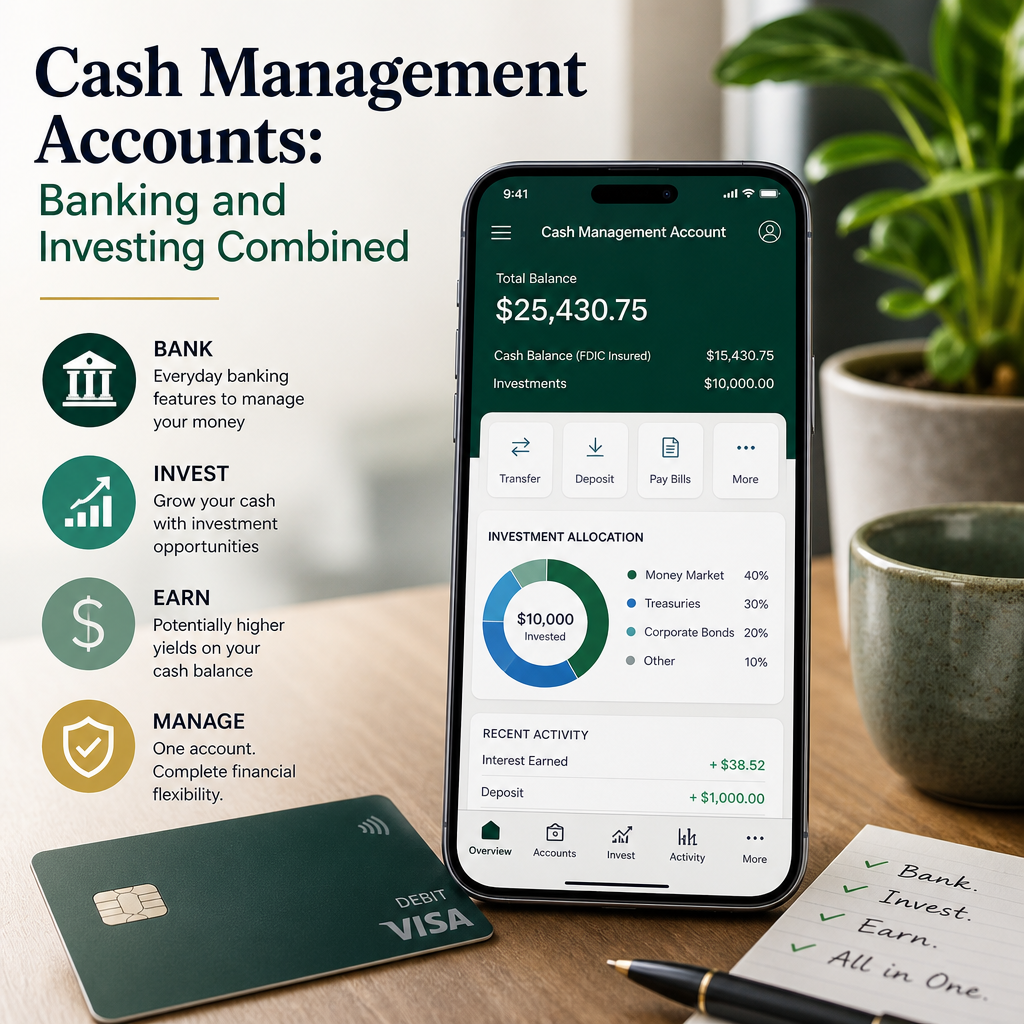
Cash Management Accounts: Banking and Investing Combined
A cash management account brings banking and investing together in one place, giving you tools like direct deposit, bill pay, and debit card access while helping your idle cash work harder. For people who want simplicity without giving up flexibility, it can be a smart way to manage everyday money.
By: Sarah Mitchell on July 28, 2026
Cash management accounts are becoming a popular option for people who want the convenience of banking and the flexibility of investing in one place. If you’ve ever wished your checking account could earn more interest, give you easy bill-pay tools, and still let you move money smoothly into investments, a cash management account may fit the way you handle money.
These accounts are designed to simplify everyday finances. Instead of keeping separate accounts at a bank, brokerage, and savings institution, many people use a cash management account to centralize their money flow. That can make it easier to track spending, automate transfers, and keep unused cash working more efficiently.
At the same time, a cash management account is not identical to a traditional checking account or a high-yield savings account. It blends features from both banking and investing, but the exact details depend on the provider. Understanding how these accounts work can help you decide whether they belong in your financial toolkit.
What Is a Cash Management Account?
A cash management account is a financial account offered by a brokerage or fintech firm that combines features commonly associated with checking, savings, and investing accounts. In many cases, the account holds uninvested cash, lets you pay bills, withdraw money, receive direct deposits, and may sweep funds into partner banks or money market funds.
The key idea is convenience. Instead of using separate institutions for basic cash handling and investing, you can often manage both from a single dashboard.
Common features of a cash management account
While features vary by provider, many cash management accounts include:
Direct deposit
Debit card access
Bill payment tools
ATM withdrawals
Mobile check deposit
Online transfers
FDIC insurance through partner banks in some cases
Interest or yield on idle cash
Access to linked investing accounts
Some accounts look and function very much like checking accounts, while others feel closer to a brokerage cash balance with added spending tools.
How Cash Management Accounts Work
A cash management account usually holds your money in a way that keeps it accessible while potentially earning a return. Depending on the provider, your cash may sit in a sweep program, a bank deposit account, or a money market fund. That structure determines how your money is protected, how quickly you can access it, and whether it earns interest.
Here’s a simple example:
You deposit your paycheck into the cash management account.
The provider places your funds in a partner bank account or cash sweep program.
You use the account to pay bills, send money, or withdraw cash.
Any extra cash may earn interest or be available for investment into stocks, ETFs, or mutual funds through the same platform.
This setup can be especially useful for people who want their cash ready for short-term needs without leaving large balances idle in a low-interest checking account.
Banking-like functions
A cash management account often includes many of the everyday tools people expect from a bank account:
Debit card purchases
Online bill pay
Peer-to-peer transfers
Automatic deposits and withdrawals
ATM access
Direct deposit for paychecks or government benefits
For many users, these features make the account a practical replacement for checking.
Investing-related functions
The investing side usually appears in one of two ways:
Uninvested cash earns interest or is swept into an interest-bearing vehicle.
Money can be transferred easily into investment accounts to buy securities.
Some providers also offer built-in investing tools. That means you can move from “cash I plan to use soon” to “cash I want to invest for the long term” without switching platforms.
Cash Management Account vs. Checking Account
A checking account is typically designed for day-to-day spending. A cash management account can do many of the same things, but it may offer a few extra benefits.
Similarities
Both may include:
Debit cards
Bill pay
Direct deposit
ATM access
Electronic transfers
Differences
A cash management account may offer:
Higher interest on idle cash
Integration with investment accounts
A broader financial dashboard
Fewer traditional branch services
Different deposit insurance arrangements, depending on the provider
A checking account from a bank may still be the better choice if you want:
Local branch access
Cash deposits at a branch or ATM network
A long-established banking relationship
Traditional loan products bundled with the same institution
In other words, a checking account is mainly built for transactions, while a cash management account tries to combine transactions with cash optimization.
Cash Management Account vs. Savings Account
A savings account is usually meant for money you don’t plan to spend immediately. It’s often used for emergency funds, vacations, or other goals where safety matters more than easy spending access.
A cash management account can overlap with savings, but it often offers more liquidity. That means you can access your funds more easily than you might in a standard savings account.
When a cash management account may be better
It may work well if you want:
Easy access to cash
A higher return than a standard checking account
One platform for banking and investing
Automatic transfers into investments
When a savings account may be better
A savings account may be a better fit if you want:
A separate bucket for emergency savings
A simple, familiar banking product
Less temptation to spend cash you want to keep untouched
A place to store money with a traditional bank
Many people use both: a savings account for true reserves and a cash management account for money they want available but productive.
Cash Management Account vs. Brokerage Account
A brokerage account is primarily designed for investing. You can hold cash there, but the main purpose is to buy and sell securities.
A cash management account is different because it focuses on handling cash first, with investing features as an added benefit.
Brokerage account strengths
Wide investment choices
Long-term portfolio building
Potentially robust trading tools
Taxable investing flexibility
Cash management account strengths
Everyday cash access
Bill pay and debit features
Easier movement between cash and investments
Better fit for short-term holdings
If your goal is active investing, a brokerage account is still the core tool. If you want cash that behaves more like a modern financial hub, a cash management account may be more convenient.
Benefits of Cash Management Accounts
A cash management account can be useful for people who want simplicity without sacrificing flexibility.
1. Consolidation
You can often manage spending, saving, and investing in one place. That reduces the need to log in to multiple institutions and can make money management easier to follow.
2. Better use of idle cash
Instead of letting extra money sit in a low-interest account, a cash management account may help that cash earn more. Even modest yield can be better than leaving funds inactive.
3. Easy money movement
If the account is tied to a brokerage platform, moving cash into investments is usually quick and simple. That makes it easier to put surplus money to work.
4. Digital convenience
Many cash management accounts are built for app-first users. Features like mobile check deposit, instant transfers, and card controls can be especially appealing if you prefer to manage money from your phone.
5. Potentially lower fees
Some providers offer cash management accounts with no monthly maintenance fees or low minimum balance requirements. That can make them attractive to people trying to keep banking costs down.
Limitations and Risks to Consider
Cash management accounts are useful, but they are not perfect for everyone. Before opening one, it helps to understand the trade-offs.
Deposit protection may differ
Insurance depends on how the provider structures the account. Funds may be protected through partner banks, sweep programs, or other arrangements. Make sure you understand whether your cash is covered by FDIC insurance, SIPC protection, or something else.
Access to cash deposits may be limited
Some accounts make it easy to receive direct deposits and electronic transfers but do not support cash deposits as smoothly as a branch-based bank. If you regularly handle cash, that matters.
Interest rates can change
If your account earns interest or yield, the rate may fluctuate over time. A competitive rate today does not guarantee the same return later.
Not all accounts are equally robust
Some cash management accounts offer excellent tools; others are more limited. Always compare:
Fees
ATM access
Insurance structure
Transfer speed
Card features
Customer service quality
Tax considerations still apply
Interest earned in a cash management account is generally taxable, just like interest from many savings or checking accounts. If funds are invested, capital gains and dividends may also create tax consequences.
How to Decide If a Cash Management Account Is Right for You
The best account depends on how you use money in daily life. A cash management account is often a good fit for people who want a streamlined digital setup and who keep a moderate amount of cash available between spending and investing.
Ask yourself these questions:
Do I want my cash to earn more than a typical checking account?
Do I want one app for spending and investing?
Do I use direct deposit and debit cards regularly?
Do I keep an emergency fund separate from day-to-day cash?
Do I need frequent cash deposits or branch service?
If you answered yes to convenience, digital access, and integrated investing, a cash management account could be a strong choice. If you answered yes to cash deposits, branch banking, or complex lending needs, a traditional bank may still play an important role.
Practical Ways People Use Cash Management Accounts
Here are a few common real-world uses:
For everyday spending
Some people use a cash management account as their main transaction account. They set up direct deposit, pay bills automatically, and use the debit card for routine purchases.
For short-term savings
Others keep money in the account for near-term goals, such as:
A home repair fund
Travel expenses
Upcoming tuition payments
Irregular bills
As a hub before investing
A common strategy is to keep excess cash in the account temporarily and transfer it into investments when ready. This creates a useful middle ground between spending money and long-term investing.
For young professionals and digital-first users
People who want fewer accounts and more mobile control often like the simplicity. If you already manage most of your life through an app, a cash management account may feel natural.
Tips for Choosing the Right Cash Management Account
Before opening an account, compare the details carefully.
Look at the insurance structure
Find out where your money is held and what protections apply.
Review fees
Check for:
Monthly fees
ATM fees
Overdraft fees
Transfer fees
Out-of-network ATM charges
Compare yield and liquidity
A higher yield is helpful, but only if your cash remains easy to access when you need it.
Test the user experience
A polished app, responsive support, and clear account controls can make a big difference in day-to-day use.
Check integration with investing
If you plan to invest through the same platform, make sure the transfer process is fast and intuitive.
Frequently Asked Questions
1. Are cash management accounts safe?
Cash management accounts can be safe, but the level of protection depends on how the provider structures the account. Some funds may be FDIC-insured through partner banks, while others may have different protections. Read the account agreement carefully so you understand coverage, limits, and how your money is held.
2. Can I use a cash management account like a checking account?
Yes, many cash management accounts offer checking-like features such as debit cards, bill pay, direct deposit, and ATM withdrawals. However, not every provider supports cash deposits or branch services. If you rely on those features, compare the account’s banking tools before switching.
3. Do cash management accounts earn interest?
Many do, but the rate and structure vary by provider. Some pay interest on cash balances, while others sweep funds into bank deposit programs or money market vehicles. The yield can change over time, so it’s smart to review current terms before opening an account.
4. How are cash management accounts different from brokerage accounts?
A brokerage account is mainly for investing, while a cash management account is designed for holding and using cash with added banking features. Some platforms connect the two, making it easy to move money between spending and investing. Still, the main purpose of each account is different.
5. Who should consider a cash management account?
Cash management accounts are often a good fit for people who want simple, digital money management and easy movement between cash and investments. They can work well for busy professionals, new investors, and anyone who wants to earn more on idle cash without giving up access to everyday payment tools.
Cash management accounts offer a practical middle ground between traditional banking and investing. For many people, they provide the day-to-day access of a checking account, the cash efficiency of a savings tool, and the convenience of a brokerage platform all in one place. That combination can make it easier to manage bills, move money, and keep idle cash from sitting untouched.
Still, the best account depends on your priorities. If you value branch access, cash deposits, or a classic banking setup, a traditional bank account may still be important. If you want a cleaner digital experience, stronger integration with investing, and a streamlined way to handle money, a cash management account can be a smart option.
The most important step is to compare the account’s insurance structure, fees, yield, and features before you commit. With the right setup, you can build a more efficient financial system that supports both your short-term needs and long-term goals.
Sarah Mitchell
Mary S, CFP®, is a Certified Financial Planner with over 12 years of experience in personal finance, retirement planning, and wealth management. She writes educational content that helps readers understand financial concepts and make informed decisions based on reliable information.